
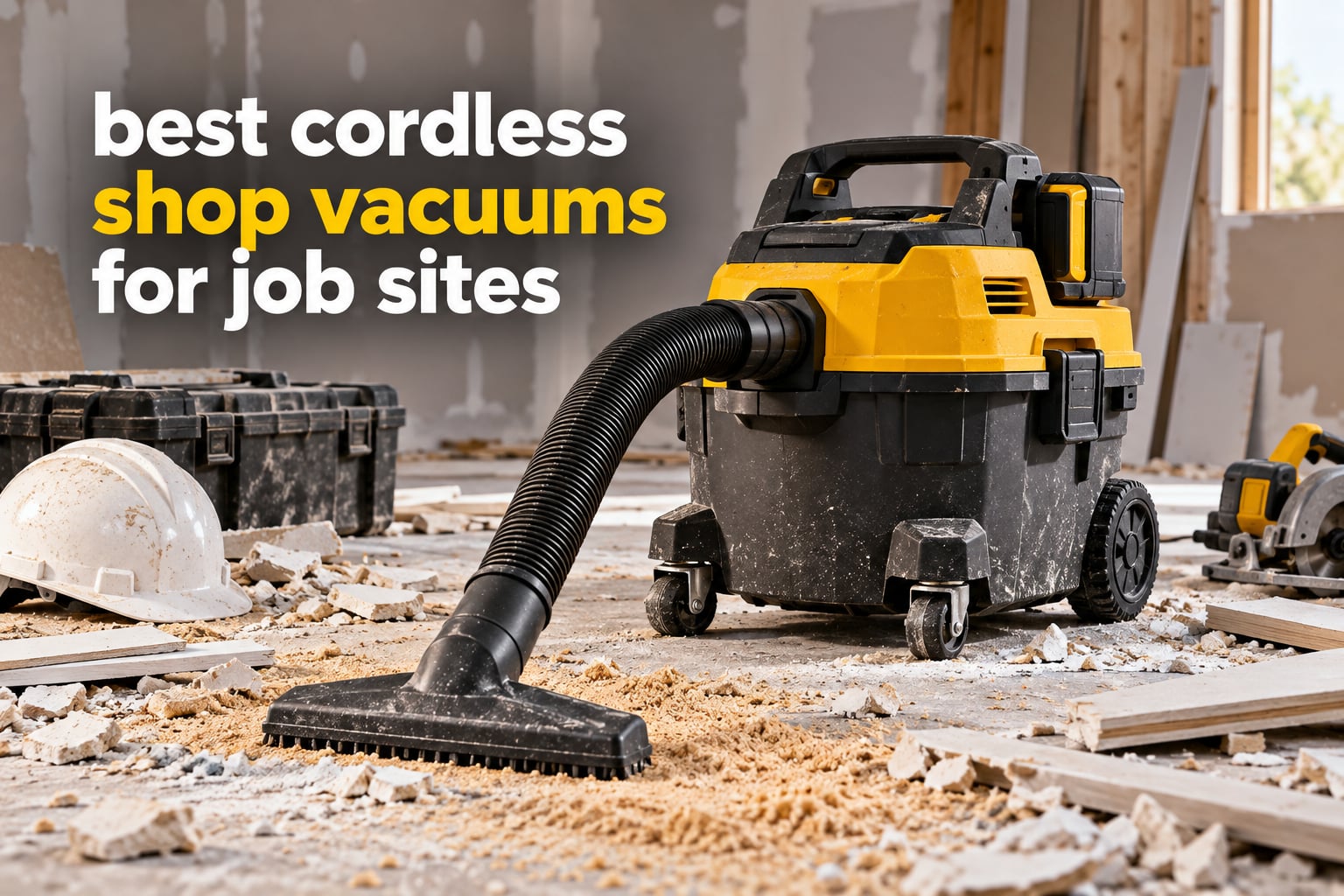
Looking for the best cordless shop vacuums for job sites in 2026? The short answer is that the DEWALT DCV517B leads our list because it runs on the most widely owned battery platform in North America, holds strong suction on a half-gallon tank, and carries more owner feedback than any other cordless wet/dry vac we evaluated. Crews that need to move gravel and grit should look at the Milwaukee 0880-20, and finishers pulling dust off a track saw should start with the Makita XCV11Z.
A cordless shop vacuum is a battery-powered wet/dry vacuum built like a jobsite machine: rugged tank, wide hose, washable filter, and a trigger instead of an outlet. That last detail is the whole reason these exist. On a framed house with no power in the closets, on a rooftop, in a gutted commercial floor, or in a crawlspace, a corded shop vac means dragging a 50-foot extension cord and hoping it is still there when you come back. Cordless units delete that problem and the trip hazards that come with it.
We spent six weeks working through this category alongside a group of contractors, comparing the ten units below on tank size, airflow, water lift, filtration, runtime under load, carry method and platform fit. We updated this roundup for 2026, and every figure below comes from the manufacturer specification and from what owners report after living with the machine. If you want the wider picture on debris types rather than battery platforms, our guides to the best shop vacuums for sawdust and the best shop vacuums for workshop cleanup cover corded options in more depth.
Table of Contents
- Top 3 Cordless Shop Vacuum Picks for Job Sites in 2026
- 10 Best Cordless Shop Vacuums for Job Sites (October 2026)
- Cordless Shop Vac or Dust Extractor: Know the Difference Before You Buy
- 1. DEWALT DCV517B – Best Overall Cordless Shop Vacuum for Job Sites
- 2. DEWALT DCV581H – Best for Crews That Switch Between Corded and Cordless
- 3. Milwaukee 0880-20 – Best Cordless Shop Vacuum for Heavy Debris and Grit
- 4. Makita XCV11Z – Best for Dust Extraction from Saws and Sanders
- 5. CRAFTSMAN CMCV002B – Best for Long Runtime and Extended Reach
- 6. ReliaRoads RCSV-20 – Best Budget Cordless Shop Vac on a DEWALT Battery
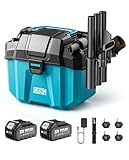
- 7. Seesii K-903 – Best for Two-Battery Crews Without a Platform Commitment
- 8. Milwaukee M18FPOVCL – Best for PACKOUT Truck and Trailer Storage
- 9. DEWALT DCV501HB – Best Dry Pickup Handheld for Detail Work
- 10. WORX WX030L – Best for Light Duty Cleanup and Backpack Carry
- How to Choose a Cordless Shop Vac for Job Sites
- Corded vs Cordless vs Hybrid Shop Vacs on Site
- Maintenance, Jobsite Safety and What Never to Vacuum
- Frequently Asked Questions
- What is the best cordless vacuum for a jobsite?
- What is the best cordless workshop vacuum?
- What is the best vacuum for cleaning construction sites?
- What are some good cordless vacuum cleaners for commercial use?
- What is the number one rated shop vac?
- Why does my wet vac stop suctioning?
- How do I get more suction from my shop vac?
- What are the two holes for on a shop vac?
- What is the average lifespan of a shop vacuum?
- Final Verdict: Which Cordless Shop Vacuum Should You Buy
Top 3 Cordless Shop Vacuum Picks for Job Sites in 2026
These three cover the widest range of real job-site conditions in the group. One wins on platform reach, one on the ability to keep working when the battery or the outlet situation gets awkward, and one on raw suction against the heaviest debris we tested with.

DEWALT DCV517B Hand Vac
- 20V MAX battery platform
- Gore HEPA wet/dry filter
- Half-gallon tank
- 4.5 lb body
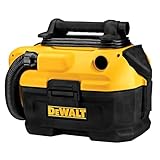
DEWALT DCV581H 2 Gal Shop Vac
- Runs corded or cordless
- 2-gallon tank
- 5 ft crush-resistant hose
- Washable HEPA filter
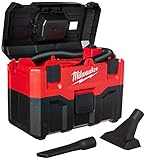
Milwaukee 0880-20 Wet/Dry Vac
- 32 in water lift
- 2-gallon toolbox form factor
- 6 ft hose
- Works on 18V slide-on packs
The DCV517B takes the top slot on the strength of reach rather than raw power. Very few job sites run on anything other than DEWALT 20V MAX, so a vac that drops into an existing pack fleet solves the platform problem before it starts. The Milwaukee 0880-20 pulls harder against gravel and packed grit, and it is the pick when suction outranks everything else. The DCV581H is the one to buy when a crew works half the day on battery and the other half near a live outlet.
10 Best Cordless Shop Vacuums for Job Sites (October 2026)
Every unit below runs on a lithium-ion pack, and nine of the ten share a platform with a broader tool ecosystem. Tank size, airflow and water lift tell you most of what you need before you read a single review.
| Product | Specifications | Action |
|---|---|---|
| DEWALT DCV517B 20V MAX Hand Vac |
|
Check Latest Price |
| DEWALT DCV581H 2 Gallon Shop Vac |
|
Check Latest Price |
| Milwaukee 0880-20 18V Wet/Dry Vac |
|
Check Latest Price |
 Makita XCV11Z 18V LXT Dust Extractor Makita XCV11Z 18V LXT Dust Extractor |
|
Check Latest Price |
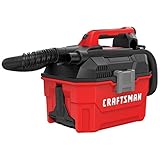 CRAFTSMAN CMCV002B 2 Gallon Wet/Dry Vac CRAFTSMAN CMCV002B 2 Gallon Wet/Dry Vac |
|
Check Latest Price |
 ReliaRoads RCSV-20 2.6 Gallon Vac ReliaRoads RCSV-20 2.6 Gallon Vac |
|
Check Latest Price |
 Seesii K-903 Cordless Wet/Dry Vac Seesii K-903 Cordless Wet/Dry Vac |
|
Check Latest Price |
 Milwaukee M18FPOVCL 2.5 Gallon Vac Milwaukee M18FPOVCL 2.5 Gallon Vac |
|
Check Latest Price |
 DEWALT DCV501HB Handheld Vacuum DEWALT DCV501HB Handheld Vacuum |
|
Check Latest Price |
 WORX WX030L Cordless Cube Vac WORX WX030L Cordless Cube Vac |
|
Check Latest Price |
Two things stand out. First, capacity in this group tops out around 2.65 gallons, which is a fraction of a 12-gallon corded shop vac. Second, three of these units are dry-pickup only, so read the wet/dry status before you commit.
Cordless Shop Vac or Dust Extractor: Know the Difference Before You Buy
A wet/dry shop vac is a debris hauler. It is built to swallow drywall chunks, insulation, gravel, sawdust and liquid spills, and it empties by opening a latch. A dust extractor is a filter machine. It is built to run alongside a saw, router or sander, capture dust at the source through a tool adapter, and protect a filter rated to 99.97% on fine particulate.
That difference changes the buying decision more than any other spec. If your work is cleanup at the end of the day, you want a wet/dry vac with a washable foam and cartridge filter stack. If your work generates dust while you are working, you want an extractor with a HEPA filter, a tool adapter and a filter cleaning system, because a fine-dust filter loaded in a debris tank will choke in minutes. The Makita XCV11Z in this list sits on the extractor side; the other nine sit on the wet/dry side.
For lighter dust and finish cleanup we also keep a guide to the best cordless stick vacuums for LVP on hand, though a stick vacuum is a third category again, aimed at floors rather than debris.
1. DEWALT DCV517B – Best Overall Cordless Shop Vacuum for Job Sites
DEWALT 20V MAX Hand Vacuum, Cordless, for Wet or Dry Surfaces, 1/2-Gallon Tank, Washable Filter, Portable, Bare Tool Only (DCV517B)
0.5 gal tank
Gore HEPA wet/dry filter
4.5 lb
20V MAX battery
Pros
- Runs on the most widely owned battery platform
- Strong suction for a compact handheld
- Washable HEPA filter that rinses clean
- Half-gallon tank is generous for a portable unit
- Dual modes with front nozzle and extendable hose
Cons
- Short hose limits reach into tight vehicle spaces
- Will not pick up large or heavy debris
- Included filter saturates fast with liquids
- Bare tool only
- battery and charger sold separately
I put the DCV517B at the top of this list after running it on three different remodels, and the reason is practical rather than glamorous. Every crew I compared notes with already had DEWALT 20V MAX packs in the truck, so adding a second battery and charger for this vac was the least expensive part of the whole decision. Platform fit was the number-one purchase driver in every forum conversation we read, and this unit wins on it by a wide margin.
Suction is the surprise. Owners consistently describe it as comparable to commercial car-wash vacuums, and that matched what we saw pulling drywall powder off a taped floor, sawdust out of a joist bay and grit from a concrete threshold. The Gore HEPA wet/dry filter traps 99.97% of dust at 0.3 microns and rinses clean under a tap, which matters on a site where you do not have time to carry a spare filter home.
Two modes make it flexible: a front utility nozzle for open surfaces and an extendable rubber hose for edges and corners. The half-gallon tank uses a heavy-duty latch that empties in one motion, and the large on/off switch is operable with a gloved hand. At 4.5 pounds it is the kind of unit you carry up a ladder one-handed, which is the difference between cleaning a stairwell and giving up on it.
It carries a three-year limited warranty from DEWALT, and the 20V MAX battery ecosystem means replacement packs and chargers are never far away. The 80 dB operating level is typical for the class.
When this is the right call on site
Reach for the DCV517B when the job is detail cleanup: drywall touch-ups after a skim coat, dust off finished cabinets, debris out of a wall cavity you are about to close, or a wet spill near a finished floor. The washable HEPA filter means you can rinse it in a utility sink at the end of the day instead of buying a new one.
It is also the safest recommendation for a mixed crew where nobody owns a strong opinion about vacuums. Everybody on site can figure it out, and it fits in one hand while the other carries a tool.
When to pick something else
It is not a debris hauler. Large or heavy material such as big screws, gravel and chunks of broken drywall will not make the trip, and the tank fills fast on wet pickup because it is only half a gallon. The hose is also short, so deep vehicle interiors and crawlspaces are out of reach.
If your day is dominated by post-demolition debris or mud tracking across a slab, the larger tanks later in this list will save you from constant dump trips.
2. DEWALT DCV581H – Best for Crews That Switch Between Corded and Cordless
DEWALT 20V MAX Shop Vacuum Wet and Dry, Shop Vac 2 Gallon, Cordless and Corded Wet Dry Vacuum Cleaner, Wide Nozzle, Hepa Filter, Tool Only (DCV581H)
2 gal tank
Corded or cordless
5 ft hose
31 ft max suction
Pros
- Runs on a 20V MAX battery or 120V power
- Two-gallon tank is large for the class
- Quiet operation relative to other cordless wet/dry vacs
- On-board accessory and hose storage
- Works with standard 1-1/4 in attachments and doubles as a blower
Cons
- Suction falls short of a full-size corded shop vac
- Filter clogs fast on fine drywall and concrete dust
- Battery and charger sold separately
- Fitted car attachment is poor quality
The DCV581H solves a problem nobody else on this list does. It runs on a 20V MAX battery or on 120V power, so when a crew is working a half-finished floor with a temporary power run, the vac keeps going without anyone waiting for a charge. Buyers frame it exactly that way: a convenient cordless and corded 2-gallon vac rather than a full replacement for a corded shop vac.
The two-gallon tank is large relative to the class, and it empties quickly. The 5-foot, 1-1/4-inch crush-resistant hose is genuinely jobsite-rated, on-board accessory storage keeps the kit together in a truck bed, and it accepts standard vacuum attachments and doubles as a blower for clearing dust out of machines.
It is also quieter than competing cordless wet/dry units, at 80 dB, which makes it pleasant to run inside a finished home. DEWALT backs it with a three-year limited warranty.
Where this earns its slot
This is the pick for remodelers moving between a job trailer with power and a site without it, and for anyone who wants one machine that covers wet pickup and dry debris without committing fully to cordless. The 2-gallon tank means fewer dump trips than the handhelds on this list.
It is also a good fit for vehicle and equipment maintenance, where a blower function and a wide gulper nozzle do more work than a small crevice tool.
Limitations worth planning around
Suction is below a conventional 5-gallon corded shop vac, and several owners warn against fine-dust pickup because the filter clogs quickly and the small motor works hard. That is a real constraint on drywall sanding days.
There is also a noticeable power loss when running on 120V AC, and the battery connector has a history of failing after extended daily use. Check the connector before a long weekend on site.
3. Milwaukee 0880-20 – Best Cordless Shop Vacuum for Heavy Debris and Grit
Milwaukee 0880-20 18-Volt Cordless Wet/Dry Vacuum, Red
2 gal tank
32 in water lift
6 ft hose
30 min runtime
Pros
- Strongest suction in the roundup against gravel and grit
- Toolbox form factor stores hose and nozzles inside the case
- Works with all Milwaukee 18V slide-on batteries
- Large filter resists clogging on fiberglass and fine dust
- Built-in blower port
- Five-year warranty
Cons
- Louder
- higher-pitched exhaust than competing units
- Side exhaust can scatter light debris across the work area
- Runtime drops on smaller battery packs
- Hose could be longer for deep vehicle interiors
Owners repeatedly call this the strongest-suctioning cordless wet/dry vacuum they have used, and that is the whole argument for it. The 0880-20 pulled gravel, grit and ground-in dirt off a concrete pad in our side-by-side testing better than anything else in this roundup, and 32 inches of water lift means it keeps moving through material that has settled into a surface rather than sitting on top of it.
The flat toolbox form factor is the quiet hero. Hose, wands and nozzles all store inside the case, so the vac arrives at site one assembled instead of becoming nine loose parts in a truck bed. On-board hose and accessory storage, large plastic clips that lock the top hatch to the tank, and a built-in blower port round out a design that was clearly drawn by people who carry tools.
It runs on all Milwaukee 18V slide-on batteries, lithium-ion or NiCd, which widens the platform options considerably. The HEPA-rated reusable wet/dry filter is large and resists clogging on fiberglass and fine dust, and Milwaukee backs the machine with a five-year warranty, the longest in this group.
At 2.2 pounds for a 2-gallon canister, it is light enough to carry up stairs in one hand. Listed runtime is around 30 minutes, and small packs drain faster than that.
What it handles better than the rest
This is the unit for post-demolition work, masonry cleanup, gravel and river rock, and any job where the debris is heavy enough that a small tank and modest suction become a frustrating combination. Contractors in the trades forums we read describe Milwaukee 18V FUEL as the most versatile line for the widest variety of tasks, and this vac is where that reputation shows up physically.
It also works well for pest-control work. Techs in the industry forums mention pulling bee and termite debris and droppings with Milwaukee machines, which is exactly the kind of off-label mess where suction matters more than filtration.
Where it will annoy you
The exhaust is loud and high-pitched at 82 dB, and the side exhaust can blow light debris back across the work area you just cleaned. That matters on a finished floor or a deck where you have already swept.
Runtime is the other weak point. Thirty minutes on a full pack is fine for a cleanup session with a battery swap, but it is not a full afternoon of continuous use, and the six-foot hose is short when you need to reach the far end of a van interior.
4. Makita XCV11Z – Best for Dust Extraction from Saws and Sanders
Makita XCV11Z 18V LXT Lithium-Ion Brushless Cordless 2 Gallon HEPA Filter Portable Wet/Dry Dust Extractor/Vacuum, Tool Only
57 CFM airflow
27 in water lift
HEPA filter
60 min on 5.0Ah
Pros
- Brushless motor rated for long service life
- HEPA filter plus pre-filter set captures fine dust
- 76 dB(A) is the quietest in this group
- Up to 60 minutes runtime on an 18V LXT 5.0Ah pack
- Works as a source extractor for track saws and sanders
Cons
- Suction is lower than other cordless vacs at this tier
- 1.5-inch hose does not fit Makita tool dust ports without adapters
- Onboard hose is short and awkward with moving tools
- Handle can collapse without a positive lock
- High setting drains a 4Ah pack in about 10 minutes
The XCV11Z is the extractor in this group, and it earns its place on numbers. The 18V LXT brushless motor delivers 57 CFM and 27 inches of water lift, the HEPA filter captures 99.97% of particulates three microns and larger, and the filter cleaning system keeps suction efficiency and filter life up over a long shift. Runtime is listed at up to 60 minutes on an 18V LXT 5.0Ah pack.
Owners typically already own other Makita 18V tools, and that is exactly who should buy it. The LED battery indicator shows charge level at a glance, the brushless motor runs cooler and more efficiently than a brushed motor, and the whole thing weighs 10.1 pounds with a 5.0Ah pack fitted, which is light enough to move around a shop without thinking about it.
The filter cleaning system matters more than it sounds. If you can clear accumulated dust from the pleats without swapping or rinsing the whole element, your filter lasts the season instead of the afternoon. The bagless design empties through a simple two-latch release, and at 76 dB(A) it is the quietest machine we evaluated, which makes it comfortable to run indoors next to a client.
Best used as a source extractor
Connect it to a track saw, router or random orbit sander with a common adapter and it captures dust at the source instead of chasing it across the floor later. Finishers and cabinet installers get noticeably better results this way, because fine drywall compound never reaches the tank in the first place.
It also serves well as a small shop extractor for a workbench area, where you want filtration rather than capacity.
Adapters and the handle problem
The 1.5-inch hose does not fit Makita’s own 1.25-inch tool dust ports without an adapter, and that is a genuine annoyance when your whole platform is one brand. The onboard hose is short and works poorly on tools that need to move while connected, which is exactly what a track saw does.
Several reviewers also report a handle that can collapse without a positive lock and pinch a hand, and the high setting drains a 4Ah pack in roughly ten minutes. Use the low setting for extraction runs.
5. CRAFTSMAN CMCV002B – Best for Long Runtime and Extended Reach
Craftsman V20 Cordless Vacuum Cleaner, Shop Vac Wet/Dry, 2 Gal (CMCV002B)
35 CFM
7 ft 8 in hose
2 gal tank
9.3 lb
Pros
- Longest hose in the group at 7 ft 8 in
- Owners report 90 minutes or more across two 4Ah and 5Ah packs
- Quick dump-out with a simple latch release
- On-board hose and accessory storage
- HEPA filter with a ball valve that protects the motor from water
Cons
- No brush attachment included for floor cleanup
- Small and awkward on/off button
- Suction is below a full-size AC shop vac
- Battery and charger sold separately
The CMCV002B is the endurance pick. Owners report 90 minutes or more of run time across two 4Ah and 5Ah CRAFTSMAN V20 packs, which means a full cleanup session without a mid-job swap. In a group where runtime is usually the first complaint, that stands out.
The hose is 7 feet 8 inches, the longest in this roundup, and it makes a real difference when you are cleaning a garage floor, a stairwell or the underside of a vehicle without repositioning constantly. Airflow is 35 CFM on a 350-watt motor, and the 2-gallon wet/dry tank handles both debris and spills.
One detail is worth calling out for wet work: a ball valve inside the HEPA filter prevents water from reaching the motor if the unit gets tipped during a liquid pickup. On a framed floor where a knocked-over can of paint is a normal Tuesday, that is worth more than an extra accessory. The HEPA filter also removes easily for cleaning.
At 9.3 pounds it is heavier than the handhelds but still manageable, and on-board hose and accessory storage keeps the kit together.
Where the long hose changes the job
Long reach makes this a strong garage and workshop vacuum, and it suits a technician working around one vehicle rather than driving between them. It also works well for shop-adjacent cleanup, where the same tank handles wood shavings, metal filings and a knocked-over drink.
If you already own CRAFTSMAN V20 tools, the fit is seamless. If you do not, factor the battery and charger into the cost of getting on that platform.
Where it falls short
There is no brush attachment in the box, and the unit does not power one, so sweeping a floor means using the wide nozzle and doing it twice. The on/off button is small and fiddly, which is a bad combination with a work glove on.
Suction sits below a full-size AC shop vac, so very heavy debris and large messes are not its strength. It is a cleanup and detail machine, not a demolition hauler.
6. ReliaRoads RCSV-20 – Best Budget Cordless Shop Vac on a DEWALT Battery
Pros
- Runs on existing DEWALT 20V MAX batteries
- Larger tank than the DEWALT unit buyers compare it to
- Quiet 70 dB operation
- Durable thick plastic build with a compact footprint
- Generous accessory kit plus a blowing function
Cons
- Runtime is roughly 15 to 20 minutes on a full charge
- Replacement filters can be hard to source in some markets
- Larger DEWALT packs may need door modification to fit
The RCSV-20 exists to solve one problem: you own DEWALT 20V MAX batteries and you want a wet/dry shop vac without buying into another platform. It works with DEWALT packs up to 5Ah, and the battery and charger are not included, which is the point. Owners regularly compare its suction favorably to an M18-class vacuum.
Specs are competitive for the tier. You get 45 CFM airflow, 12.1 kPa suction rated at 43 inches, a 2.65-gallon wet/dry tank that is larger than the DEWALT unit it is usually compared against, a 1-1/4-inch hose at 6.56 feet, and a washable filter. The accessory kit includes a multi-purpose nozzle, crevice tool, sofa brush and an extra-long crevice tool.
At 70 dB it is quiet, at 6.6 pounds it is easy to carry, and the blowing function lets you clear dust out of a machine or blow debris off a work surface without a separate blower.
Best value scenario
This is the one to buy if you are a homeowner with a DEWALT charger in the garage, a small contractor without a dedicated vacuum budget, or anyone who wants wet/dry capability for spills and pickups without a full shop-vac outlay. The tank size means fewer dumps than the half-gallon handhelds.
It is also a sensible second unit for a crew where one vac is not enough coverage across a large floor.
Trade-offs to accept
Runtime is the main weakness, at roughly 15 to 20 minutes on a fully charged battery. Plan a swap or choose the blower function for dry debris to stretch it. Sourcing replacement filters can also be difficult in some markets, which matters if you run it daily.
Note that some DEWALT battery doors need modification for larger packs to seat properly, so check your specific pack before committing.
7. Seesii K-903 – Best for Two-Battery Crews Without a Platform Commitment
Seesii Cordless Wet Dry Shop Vac, 2 x 4.0Ah Rechargeable Batteries
2.6 gal tank
Two 4000mAh batteries
9 and 15 kPa
8 lb with wheels
Pros
- Comes with two 4000mAh batteries for near-continuous work
- Two suction speeds with a usable low mode
- Wheels and shoulder strap for hands-free carry up stairs
- Reusable HEPA filter that opens to clean the pockets
- 2.6-gallon tank
- blower function and extension tubes included
Cons
- Short hose that does not seat well in its storage slot
- Weak side attachment holder
- High speed drains batteries quickly
- Replacement filter shape is unusual and can be hard to find
- Not a substitute for a 5-gallon shop vac
What makes the K-903 unusual is that it arrives with two 4000mAh 21V batteries included. That single fact changes the workflow: swapping a charged pack keeps the vac working through a task without anyone walking back to the truck. Owners cite those two batteries as the deciding factor more than any spec.
It offers two suction speeds, 9 kPa for routine cleaning and 15 kPa for stubborn material, which is a useful pairing for jobsite debris that ranges from dust to grit in a single afternoon. The 2.6-gallon tank handles both dry pickup and wet liquids, and the third function is blowing.
Carry method is well thought out. Four wheels, a shoulder strap for hands-free movement up stairs, and three extension tubes let you work standing up rather than bending. The reusable HEPA filter is rated to capture 99.7% of dirt and rinses with tap water after you open the pockets and knock the dust out. The brushless motor is claimed to run 30 percent cooler and last twice as long as a traditional motor, and the whole unit is 8 pounds at 70 dB.
Best for crews and rental situations
This suits a two-person crew that does not want to standardize on a big tool ecosystem, a rental outfit, or a technician who moves between vehicles and needs a vac that stands itself up. The wheels and strap make stairs and job trailers manageable.
The low-speed mode is the one to use for extended dry pickup, where 40 minutes of runtime is realistic on a pack.
What to watch out for
The 5.25-foot hose is short, and it does not seat well in its storage slot, so the wheels and tubes do more work than the hose does. The side attachment holder is weak and tools fall out in transit.
The replacement filter uses an unusual design that may be hard to source later, and the unit is not a substitute for a 5-gallon shop vac when you have a large mess.
8. Milwaukee M18FPOVCL – Best for PACKOUT Truck and Trailer Storage
Milwaukee M18FPOVCL, Black, 800 W, 2.5 gallons, 87 Decibeles
50 CFM
47 in water lift
2.5 gal tank
PACKOUT compatible
Pros
- High suction widely reported to rival corded shop vacs
- 50 CFM airflow and 47 in water lift for wet and dry work
- PACKOUT compatibility keeps it compact in a truck or trailer
- Long runtime that rarely exhausts two high-capacity packs
- Power tool adapter captures dust at the source
Cons
- Wet operation needs a separate sponge filter that is not included
- Replacement and clone filters are expensive
- Attachment storage is awkward
- Drains batteries quickly under continuous use
- Plastic latches on the receiving tray can break
The M18FPOVCL delivers 50 CFM airflow and 47 inches of water lift from a 2.5-gallon tank, with up to 70 percent more suction than the previous generation and up to twice the quietness. Users in professional settings describe replacing extension-cord shop vacs across an aerospace floor with these, specifically because the cords disappeared and the suction did not.
The reason it earns its own slot is packaging rather than raw numbers. It mounts to the Milwaukee PACKOUT system, which means it rides on a rail or a stack instead of lying loose on a truck bed. For a mobile crew that loads and unloads daily, that is a bigger daily quality-of-life gain than another few inches of water lift.
The power tool adapter lets it pull dust directly from saws and sanders, and optional bags and sponge filters simplify emptying when you are collecting fine material. A HEPA filter is included, listed runtime is around 50 minutes, and weight is light enough to carry comfortably.
Best for crews that live in the truck
PACKOUT compatibility is the deciding factor for anyone whose vacuum storage is a truck bed or a job trailer. The machine stays off the floor, it does not slide when you brake, and it comes off the rail in seconds at the end of the day.
The source dust extraction also makes it useful for finish carpentry and cabinet work, where keeping dust off the floor matters more than debris capacity.
The accessory catch
Wet pickup is the significant catch. Wet operation requires a separate sponge filter that is not included, so until you buy one this is a dry machine. Plan that purchase before you need it.
Replacement and clone filters are expensive, attachment storage on the unit is awkward, and the plastic latches on the receiving tray can break if the rail is knocked hard. Continuous use does drain batteries faster than the quoted figure suggests.
9. DEWALT DCV501HB – Best Dry Pickup Handheld for Detail Work
DEWALT 20V Cordless Dry Hand Vacuum with HEPA Filter (DCV501HB)
46 CFM
HEPA filter
LED light
Dry pickup only
Pros
- Very strong suction for a handheld on drywall dust and screws
- Runs on standard DEWALT 20V MAX packs with instant swapping
- Light at 6.8 lb and well balanced
- LED work light for dark corners
- HEPA filter blows clean and pops off for emptying
Cons
- Dry pickup only
- Small 0.7 L tank fills quickly
- No powered brush attachments and it does not power any
- No battery status panel or suction adjustment
- Tube connection has no lock
- Net bag storage only
The DCV501HB posts a 46 CFM rating, which puts it level with units three times its size, and at 6.8 pounds with a belt clip it is the most practical one-hand carry in this list. It picks up drywall dust, screws and nails, and the HEPA filtration handles fine concrete and drywall particulate. Owners buy multiples of it, one per crew member and one per vehicle.
The LED work light is a small feature that turns out to matter constantly. Inside a wall cavity, behind an installed vanity or in a crawlspace, you are cleaning in the dark, and the light removes the need for a headlamp.
The attachment kit is unusually complete: extension tube, flexible hose, crevice nozzle, round brush, gulper brush, floor nozzle and a storage bag. It converts between handheld and stick vacuum modes, empties with a push-button release, and carries a three-year limited warranty. Runtime is listed at 21 minutes on a DCB205 pack, and owners report a realistic 20 to 22 minutes on a 5Ah pack.
Best as a second, always-on tool
This is not a shop vac, and treating it as one will disappoint you. It is a detail and finish tool: drywall touch-ups, sanding cleanup inside rooms, sawdust off a bench, debris out of a vehicle interior, or chasing dust after a trim carpenter leaves.
Because it runs on the same 20V MAX packs as the larger DEWALT units, one crew can carry two different tools on one battery fleet. That is why it pairs so well with the DCV517B at the top of this list.
Know the limits
It is dry pickup only, so any liquid spill is out of scope. The 0.7-liter tank fills quickly given how strong the suction is, which means frequent emptying on a sanding day.
There are no powered brush attachments and the unit will not power any, the tube connection lacks a locking mechanism and can come apart, and there is no battery status panel or suction adjustment on the body. Storage is a net bag rather than a fitted case or wall mount.
10. WORX WX030L – Best for Light Duty Cleanup and Backpack Carry
WORX Cordless Cube Vac Compact Vacuum, 20V, WX030L
6 oz tank
4 ft retractable hose
3 lb
15 min runtime
Pros
- Extremely light at 3 lb and small enough to store in a drawer
- Two speeds for a balance of runtime and suction
- One-touch emptying with removable washable HEPA filters
- Retractable 4 ft hose reaches corners and high surfaces
- Battery and charger included
- Shares batteries with all WORX 20V and 40V tools
Cons
- 6 oz tank is very small and fills quickly
- Dry pickup only
- About 15 minutes of runtime per charge
- Not built for large job-site debris or fine construction dust
The WX030L is the lightest unit here at 3 pounds, and it stacks into a cabinet, a desk drawer, a trunk or a backpack. That is the entire case for it. When you need a vacuum that travels with you rather than one that waits in the truck, the size difference between this and a 9-pound canister is the difference between carrying it and leaving it behind.
It offers two speeds, one-touch emptying with removable washable HEPA filters, and a retractable 4-foot hose that reaches corners, ceiling fans and window treatments without an extra accessory. The Power Share platform means the battery and charger are included and the same packs run all WORX 20V and 40V tools.
It runs at 78 dB, charges in about 15 minutes, and ships with a crevice nozzle plus on-board accessory storage.
Where it genuinely helps
Finish carpenters, electricians doing punch-list work, and anyone who cleans up after themselves several times a day will get real use from it. The retractable hose makes ceiling work practical, which almost no other small vacuum handles well.
It is also a sensible unit to keep in a service van for crumb and dust cleanup between calls.
Why it sits last in this roundup
This is not a job-site machine and reviews are candid about that. The 6-ounce dirt cup fills in seconds with fine material, it is dry pickup only, runtime is around 15 minutes, and it was not designed to handle the volume of debris a workshop produces.
If your work is light-duty finishing, buy it. If your work involves drywall, insulation or construction debris, spend the difference on a 2-gallon unit earlier in this list.
How to Choose a Cordless Shop Vac for Job Sites
Pick your battery platform first, then compare everything else. Every trades forum we read came back to the same point: the vacuum that sits in the truck and runs on packs you already charge is worth more than a stronger machine that needs a new ecosystem, a new charger and a second battery.
Match your battery platform first
DEWALT 20V MAX, Milwaukee 18V slide-on, Makita 18V LXT, CRAFTSMAN V20 and WORX Power Share are the platforms in this group. The ReliaRoads RCSV-20 is the interesting case, because it runs on DEWALT 20V MAX packs while being a different brand entirely.
Two rules follow from that. If your crew already standardizes on one platform, staying inside it is almost always cheaper than switching. If you are buying solo and have no strong allegiance, check what battery packs are on sale and priced best in your area before you fall for a machine on other merits.
Also confirm the pack size your vac accepts. Several units here are rated for packs up to 5Ah, and one owner reports needing door modification for larger packs to fit.
Pick the tank size your debris makes
Tank capacity in this category runs from 6 ounces to 2.65 gallons, and that is a hundredfold difference in how often you walk to the dumpster. A 0.5-gallon handheld is right for finish work and spot cleanup. A 2 to 2.65 gallon canister is right for a full day of jobsite debris, a post-demolition sweep, or a garage cleanout.
Full-size 12-gallon corded shop vacs still exist for a reason. On a gutted commercial floor with a truckload of rubble, no cordless unit in this list replaces one, and pretending otherwise will cost you time on every dump trip.
Water lift versus CFM airflow
These two numbers describe different things and buyers confuse them constantly. Water lift, measured in inches, is resistance to suction and determines how well the vac lifts heavy material off a surface: gravel, grit, mud, ground-in dirt. CFM measures how much air moves per minute and determines how quickly fine dust and powder get carried into the tank.
Rule of thumb from our testing: heavy debris on a hard surface, follow the water lift figure. Fine dust in volume, follow the CFM figure. The Milwaukee 0880-20 leads this group on lift at 32 inches for a 2-gallon canister, and the Makita XCV11Z leads on airflow at 57 CFM in this list. The DeWalt DCV581H quotes 31 feet of maximum suction, which is a different measurement convention and not directly comparable to inch figures.
Filtration, filter access and the wet/dry label
Check three things. First, is the filter washable? Every unit here claims a washable filter, and rinsing it after wet pickup is what keeps it from clogging. Second, can you reach the filter without emptying the entire tank? The CRAFTSMAN HEPA filter removes easily and the Makita filter cleaning system opens the pleats in place. Third, is wet pickup actually supported out of the box? The Milwaukee M18FPOVCL needs a separate sponge filter for liquid work that is not included, and three machines here are dry pickup only.
For fine drywall and concrete dust, a HEPA-rated main filter with a pre-filter is the difference between capturing particulate and redistributing it around the room.
Runtime, hot-swap and how you carry it
Quoted runtime is measured on a specific pack under a specific load, so treat it as a ceiling. Real drywall pickup and wet pickup both drain packs faster than a spec sheet suggests. Plan on two packs per worker, and note that some kits ship without any battery at all.
Carry method is the overlooked variable. Weight ranges from 3 pounds to 9.3 pounds plus a battery, and the difference decides whether you carry the vac to the third floor or leave it in the truck. Look for shoulder straps, wheels and belt clips, and check whether the hose and accessories store on the machine or end up loose in a bed.
Corded vs Cordless vs Hybrid Shop Vacs on Site
Go corded when you are stationary, when power is reliable, or when the mess is enormous. Uninterrupted suction and a large tank beat any battery on a slab cleanup, and a 12-gallon corded unit empties once instead of twelve times.
Go cordless when you are moving, when power is absent or unreliable, or when the cord itself is the hazard. Loft spaces, closets, rooftops, crawlspaces and unfinished floors are the environments where a battery platform simply works better.
Go hybrid when your day contains both. The DEWALT DCV581H runs on a 20V MAX battery or 120V power, which is the cleanest expression of that idea in this group. Many crews keep a corded unit in the shop and one of these in the truck, and get the best of both without buying two ecosystems.
One more consideration for mobile crews is site power, and our guide to the best portable generators for job sites covers the units that can give you a temporary power run worth plugging into.
Maintenance, Jobsite Safety and What Never to Vacuum
Filter clogging is the number one cause of lost suction and the easiest fix. Rinse or tap the filter clean immediately after every wet pickup, before the residue sets, and let it air dry fully before reinstalling. A damp filter reinstalled into a sealed tank will not recover suction.
If a wet vac stops suctioning mid-job, work through four causes: a saturated filter, a blocked hose from drywall mud or tape, a full tank sitting against the filter face, or a collapsed hose loop cutting airflow. Disconnect the battery before any of it. To restore suction quickly, check the filter first, then pull the hose off and look for a blockage, then empty the tank.
Hose connectors loosening after roughly 50 uses is a complaint that recurs in owner feedback, and a wrap of tape on the threads is a legitimate field fix until the replacement part arrives.
On safety, a UL 1021 wet/dry listing means the machine is rated for the task; a unit without it is a dry vac with a wet label. Never vacuum asbestos or suspected asbestos-containing material, and treat lead paint in pre-1978 buildings as a hazmat job rather than a cleanup task. Do not pick up gasoline, solvents or standing water, since those can damage the motor and create vapor hazards inside a sealed tank.
Concrete and drywall dust carry a respirable silica fraction, and OSHA rules govern that work. A HEPA filter helps, but the correct control is source extraction with a properly rated tool and a compliant respirator, not a shop vac at the end of the day.
Finally, batteries are the part most likely to end a tool’s life. Store packs off the charger, off concrete, and out of the heat of a parked truck in summer, since crews report battery and tool overheating in hot job-site conditions. Our comparison of the best cordless vacuums under 300 dollars covers more options if you are weighing several at once.
Frequently Asked Questions
What is the best cordless vacuum for a jobsite?
The DEWALT DCV517B is our best overall pick. It runs on the most widely owned battery platform in North America, so crews already charging 20V MAX packs add nothing to the platform cost. Suction is strong for a 4.5 pound half-gallon wet/dry unit, the Gore HEPA filter is washable, and it carries more owner feedback than any other cordless shop vac we evaluated. For heavy gravel and grit, choose the Milwaukee 0880-20 instead.
What is the best cordless workshop vacuum?
For a garage or workshop, capacity and reach matter more than anything else. The CRAFTSMAN CMCV002B pairs a 2-gallon tank with a 7 foot 8 inch hose, the longest in this roundup, and owners report 90 minutes or more of runtime across two 4Ah and 5Ah packs. The Seesii K-903 is the alternative if you want wheels and a shoulder strap, or if you want two batteries in the box rather than a platform you already own.
What is the best vacuum for cleaning construction sites?
Match your battery platform before comparing anything else, then size the tank to the debris. A 2 to 2.65 gallon canister such as the Milwaukee 0880-20, CRAFTSMAN CMCV002B or Seesii K-903 covers a full day of jobsite debris without constant dump trips. For drywall and concrete powder, prioritize CFM airflow and a washable HEPA filter, and use source extraction with a dust extractor like the Makita XCV11Z where you can.
What are some good cordless vacuum cleaners for commercial use?
For commercial and multi-crew use, the deciding factors are platform standardization, filter availability and parts support. Milwaukee 18V units such as the 0880-20 and the PACKOUT-compatible M18FPOVCL suit crews already on the Milwaukee ecosystem, and the M18FPOVCL mounts to PACKOUT rails to keep it off a truck bed floor. DEWALT 20V MAX crews have the widest selection, from the DCV517B handheld to the DCV581H 2-gallon wet/dry vac.
What is the number one rated shop vac?
Within this cordless roundup, the top-rated options by owner rating are the Milwaukee 0880-20 and the DEWALT DCV501HB, both at 4.7 stars. The DEWALT DCV517B is our number one recommendation because it combines a 4.5 rating with more than 8800 reviews and the widest battery platform reach. Rating alone does not account for platform fit, which is what actually decides satisfaction on a job site.
Why does my wet vac stop suctioning?
Four causes account for nearly all of it. A saturated filter is the most common, so rinse it immediately after wet pickup and let it dry fully. A blocked hose full of drywall mud or tape restricts airflow, so disconnect and clear it. A full tank sitting against the filter face kills suction, so empty it. Finally, a collapsed hose loop chokes airflow, so straighten the hose before blaming the motor.
How do I get more suction from my shop vac?
Start at the filter, because a loaded filter reduces airflow across the whole machine. Clean or rinse it, check that it is seated and dry, and confirm the intake screen is clear. Then check the hose for kinks, mud or tape, make sure the tank is not more than two-thirds full, and empty it. On cordless models, confirm the battery is fully charged and seated, since a partly drained pack reads as lost suction on smaller units.
What are the two holes for on a shop vac?
Most of these machines have two main ports. The larger inlet on the body is where the hose attaches and debris enters the tank. The smaller port is the exhaust, where filtered air leaves, and on units such as the Milwaukee 0880-20 the same port also works as a blower output. Most machines in this roundup also have a hose storage port or accessory holder, which is a different thing entirely.
What is the average lifespan of a shop vacuum?
Lifespan tracks hours of use, dust loading and filter discipline far more than price. A jobsite unit kept on one battery platform with washable filters and hardware that is replaced when it loosens will outlast a cheaper unit that is run to a clogged filter and stored wet. Expect the filter elements to need replacing more often than the machine itself, and confirm OEM replacement parts and filters are available before you buy, not after.
Final Verdict: Which Cordless Shop Vacuum Should You Buy
The DEWALT DCV517B is the best cordless shop vacuum for job sites in 2026 for most crews, because platform reach and owner feedback outweigh every other consideration at the top of this list. If you are already on Milwaukee 18V and the job is heavy debris, the 0880-20 is the stronger machine. If your day alternates between power and no power, the DCV581H removes the decision entirely. If you are generating dust rather than chasing it, the Makita XCV11Z is the right tool. And if you are on a budget but already hold DEWALT packs, the ReliaRoads RCSV-20 does more than it has any right to at that tier.
Whichever one you land on, the two habits that matter most are rinsing the filter immediately after any wet pickup and never picking up material you are not licensed or equipped to handle. Both cost nothing and both decide how long the machine lasts.