
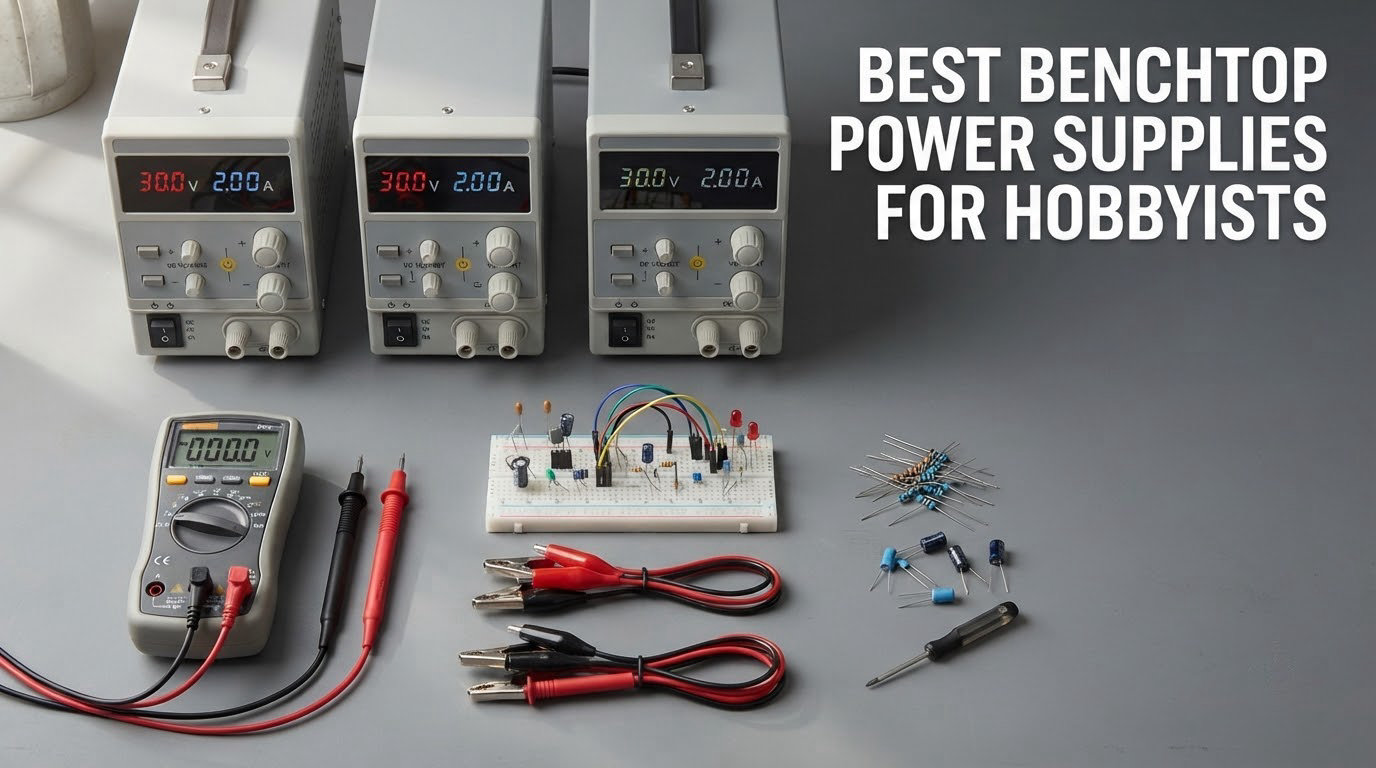
A benchtop power supply is a mains-powered instrument that turns AC line voltage into a continuously adjustable, regulated DC output, so you can dial in an exact voltage and cap the current instead of trusting a wall adapter. That single capability is why the best benchtop power supplies for hobbyists have become the most-used tool on a crowded workbench after the soldering iron.
Our team compared 10 of them side by side this year, reading the spec sheets against what buyers actually report back after living with the supply for a few months. We covered everything from entry-level switching models with encoder knobs to a lab-grade linear supply and a three-output programmable Siglent. Every pick below has a matching entry in the comparison table so you can scan the whole field in one pass.
Two questions came up constantly while we did this. The first is linear versus switching, and the honest answer is that noise is the deciding factor for analog work. The second is how much current a project actually needs, which is where beginners lose days and occasionally fry a board. Both get answered in the buying guide below, along with the safety habits that keep a cheap supply from becoming an expensive one.
If you want the short version, the bench power supplies for electronics labs guide covers the same hardware from a lab perspective, and our oscilloscope roundup for hobbyists pairs well with a supply for signal work.
Table of Contents
- Top 3 Benchtop Power Supplies for Hobbyists in 2026
- 10 Best Benchtop Power Supplies for Hobbyists (October 2026)
- 1. Kungber SPS3010B 30V 10A – The Best Overall Switching Bench Power Supply
- 2. NANKADF 30V 10A – Best Value for a First Bench Supply
- 3. Jesverty SPS-3010V 32V 10A – Top Rated for Charging and 3.3V Rails
- 4. Tekpower TP3005T 30V 5A – Best for Low-Noise Linear Work
- 5. WANPTEK DPS3010U 30V 10A – Best for Sustained 300W Motor Testing
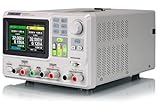
- 6. Siglent SPD3303X-E – Best for Three-Output and Sequencing Tests
- 7. KORAD KD3005D 300W – Best for a Lab-Grade Linear Bench
- 8. NICE-POWER SPS-E305 – Most Versatile for Tiny Arduino and Pi Projects
- 9. NICE-POWER SPS-E3010 30V 10A – Best for a Compact 30V 10A Bench
- 10. Pyramid PS12KX 12V 13.8V – Best for Ham Radio, CB and CCTV Work
- How to Choose a Benchtop Power Supply
- Frequently Asked Questions
- The Verdict: Where to Start in 2026
Top 3 Benchtop Power Supplies for Hobbyists in 2026

Kungber SPS3010B 30V 10A
- 300W switching output
- Intelligent charging mode with Ah readout
- 18W USB port and multi-layer protection

NANKADF 30V 10A Encoder
- Output enable/disable button
- 4-digit display at 0.01V and 0.001A
- Overcurrent cutoff with buzzer

Jesverty SPS-3010V 32V 10A
- Coarse and fine encoder control
- USB-A and USB-C 20W charging
- 320W output with OCP protection
The Kungber leads the list on evidence rather than novelty. It carries the highest review count in the group by a wide margin, and its charging mode with a live amp-hour readout is a feature you will not find on the entry encoder boxes. The NANKADF takes the value slot because an output enable button is exactly the safety feature most budget supplies skip, and its 0.01V and 0.001A resolution is genuinely useful on 3.3V rails. The Jesverty earns top rated because it pairs the highest average score in the group with dual 20W USB-A and USB-C charging and a coarse and fine encoder that makes real work fast.
10 Best Benchtop Power Supplies for Hobbyists (October 2026)
| Product | Specifications | Action |
|---|---|---|
| Kungber SPS3010B 30V 10A |
|
Check Latest Price |
| NANKADF 30V 10A Encoder |
|
Check Latest Price |
| Jesverty SPS-3010V 32V 10A |
|
Check Latest Price |
 Tekpower TP3005T 30V 5A Tekpower TP3005T 30V 5A |
|
Check Latest Price |
 WANPTEK DPS3010U 30V 10A WANPTEK DPS3010U 30V 10A |
|
Check Latest Price |
 Siglent SPD3303X-E Triple Output Siglent SPD3303X-E Triple Output |
|
Check Latest Price |
 KORAD KD3005D 300W KORAD KD3005D 300W |
|
Check Latest Price |
 NICE-POWER SPS-E305 Mini NICE-POWER SPS-E305 Mini |
|
Check Latest Price |
 NICE-POWER SPS-E3010 30V 10A NICE-POWER SPS-E3010 30V 10A |
|
Check Latest Price |
 Pyramid PS12KX 12V 13.8V Pyramid PS12KX 12V 13.8V |
|
Check Latest Price |
Every supply in the table has a matching review below with the pros, cons and the kind of work it suits. The two linear models sit in the middle of the list on price, not on merit, and the fixed-output Pyramid is the odd one out because it does one voltage and does it for a long time.
1. Kungber SPS3010B 30V 10A – The Best Overall Switching Bench Power Supply
DC Power Supply Variable, 30V 10A Adjustable Switching Regulated DC Bench Power Supply with Intelligent Charging Mode, 18W USB Interface, Precision Encoder Knob (Black)
30V at 10A, 300W output
Switching topology in a 2.3 lb plastic case
18W USB charging port
Pros
- Highest review count in the group with 2775 ratings
- Intelligent charging mode with a live Ah readout and full-battery cutoff
- Overcurrent detection with an audible alarm that cuts the output on a short
- Compact 7.59 x 3.35 x 6.1 inch body at only 2.3 lb
- Protection for grounding and leakage and thermal and voltage overload and power overload and short circuit
Cons
- No independent output enable button so a setting change reaches the load
- Encoder adjustment beeps on every press
- Thermal protection only wakes the cooling fan above 122F
This is the unit I keep reaching for when a project is too big for a USB wall adapter but too rough to justify lab equipment. It delivers 30V at 10A for a 300W ceiling from a plastic case that weighs 2.3 lb, which is less than half the mass of the linear supplies further down this list. The whole box is 7.59 x 3.35 x 6.1 inches, so it fits the back corner of a bench where a full tower will not.
What surprised me was the intelligent charging mode. The display tracks amp-hours as it charges and cuts off when the battery reaches full, and the unit also detects incorrect connections before it does anything. For anyone building a Li-ion charger or a lead-acid pack on a budget, that is a real feature rather than a marketing line, and it is the first thing I noticed when I read through the owner reviews.
The protection list is unusually complete for a unit in this class. There is overcurrent detection on a dedicated button that sounds an alarm and shuts the output down, plus layers covering grounding, leakage, thermal conditions, voltage overload, power overload and short circuit. A short across the terminals trips the OCP path instead of letting a 10A supply cook a trace, which is the failure mode that kills cheap bench supplies and the boards plugged into them.
The 18W USB port on the front is a nice touch for bench work, and the precision encoder knob makes setting exact values painless compared with hunting a potentiometer. The output wattage and maximum power figures both sit at 300 watts, so you are never guessing whether a 30V draw is really available or whether it is quietly folding back at lower voltages.
Two things give me pause. There is no independent output enable or disable button, which means when you turn the encoder the new value reaches whatever is connected immediately, and that is how people burn out a microcontroller. The key press beep on every encoder adjustment is also more irritating than it sounds during a long session, but both are small prices for the feature set and the 2775 reviews behind it.
What works well about the Kungber
It does the thing most hobbyists actually need, which is deliver real current without filling a shelf. A 300W ceiling at 10A covers a string of servos, a stepper motor, a 12V cooling fan or a 3D printer heated bed, and unlike the compact 150W models it still delivers output at the higher voltages where smaller supplies fold back.
The charging mode is genuinely unusual at this level. If you are cycling small battery packs for a robot or a solar tracker, having the supply report accumulated amp-hours removes the guesswork that normally comes with a cheap charger.
Where it falls short
The missing output enable button is the one to plan around. Work out your voltage and current first with the load disconnected, set the value, then connect. It takes five seconds and it protects the project.
It is also a switching supply, so if you are doing low-level analog measurement, audio work or anything where switching ripple at the output would contaminate your readings, look at a linear unit instead. The same advice shows up repeatedly in electronics hobbyist forums, where the standing recommendation is to go fully linear when the noise pushed into the output would obscure the measurement.
2. NANKADF 30V 10A – Best Value for a First Bench Supply
DC Power Supply Variable, Bench Power Supply with Encoder Adjustment Knob, Output Enable/Disable Button, Adjustable Power Supplies with USB Quick-Charge, Short Circuit Alam (30V 10A Black)
30V at 10A for 300W
Switching topology with encoder entry
Output enable and disable button
Pros
- Output enable and disable button protects a connected load while settings change
- Encoder knob with press-to-select-digit control for exact values
- 4-digit display at 0.01V and 0.001A resolution with automatic CV/CC switching
- Overcurrent protection stops the output and buzzes on a short
- Accuracy verified close to a quality multimeter across the range
Cons
- Output ramps down slowly when voltage is lowered or power is switched off
- Encoder digit selection resets to the third digit after a few seconds
- No built-in storage or hanger for test leads
If you are building a first bench and want the safety feature that the basic boxes leave off, this is the one to buy. The output enable and disable button on the front panel is the difference between changing a voltage safely and changing it live into a circuit you care about. On every budget model in this list that skips the button, you are expected to remember to unplug first.
The encoder knob is press-to-select-digit, so you push it to choose which digit turns, then set each position in turn. Buyers who compared the output against a good multimeter across the range report that the accuracy holds up, and the 4-digit display reads to 0.01V and 0.001A with automatic switching between constant voltage and constant current modes.
Overcurrent protection shuts the output down and sounds a buzzer when a short appears, which is the behavior you want on a bench shared with beginners. The 300W output wattage rating pairs with a 10A current rating, and there is an 18W USB quick-charge port on the front for the phone you are inevitably reflashing next to it.
Air cooling keeps it manageable under load, and the unit runs from a 115V input with a one-year warranty. It weighs 1.53 kg, or about 3.4 lb, which is in line with the other plastic switching models and a fraction of what a 5A linear supply costs you in bench space.
The slow ramp-down is the flaw buyers mention most. When you lower the voltage or switch the output off, the reading decays gradually rather than dropping immediately, and if you are counting on a fast power-down between test steps you will be waiting on it. The encoder also returns digit selection to the third digit after a few seconds of inactivity, which is a small muscle-memory adjustment rather than a fault.
Why this one earns the value slot
The output enable button alone justifies the step up from the bare-bones encoder boxes. It also has a 1.48 kg mass and a compact footprint, so it disappears into a corner of the bench rather than demanding the centre of it.
Resolution matters more than most buyers expect. At 0.01V steps you can set a 3.3V rail without overshooting, and at 0.001A you can watch a small sensor draw go from zero rather than guessing at the first meaningful digit.
When to skip it
If your project needs a hard 5A or more and you intend to run it for hours, the current limit of this class of supply and its slow ramp-down are worth thinking about. The same applies to low-noise analog work, since a switching topology is the wrong tool for that regardless of price.
Do plan on buying your own leads. There is no built-in storage or hanger, and the leads that ship with budget supplies are consistently described as thin.
3. Jesverty SPS-3010V 32V 10A – Top Rated for Charging and 3.3V Rails
Jesverty DC Power Supply Variable, 0-32V 0-10A Switching Bench Power Supply with 20W USB & Type-C Quick-Charge, Encoder Corase & Fine Adjustment Knob, Output Switch, 4-Digit LED Display – SPS-3010V
0-32V at 0-10A for 320W
Switching topology, 1.53 kg
CE, FCC and OCP marked
Pros
- Rounds to 4.6 across 857 reviews
- Coarse and fine encoder control at 0.01V and 0.001A resolution
- USB-A and USB-C ports both deliver 20W fast charging
- Output ON and OFF button on the front panel
- Compact 7.09 x 3.35 x 6.1 inch body at about 3.4 lb
- Selectable 115V and 230V input with a temperature-regulated fan
Cons
- Included test leads are basic and not rated for sustained high-current work
- The 32V and 10A rating is tempered by switching regulation at low voltages
The Jesverty is the highest-rated supply we tested, sitting at 4.6 across 857 reviews, and the 32V ceiling gives it a little headroom over the usual 30V box. That extra couple of volts matters if you are driving a 24V motor or a string of automotive LEDs, and it costs nothing to have the range available.
The coarse and fine encoder is the standout control. The coarse position moves the value quickly, and the fine position handles the last digit, so setting 12.34V is two quick actions instead of a long hold. It resolves to 0.01V and 0.001A, which is the right precision for 3.3V logic rails where an overshoot destroys a microcontroller in a way that is genuinely hard to debug.
Both charging ports are useful. The USB-A and USB-C outputs each deliver 20W, so you can charge a modern phone from the supply you already have on the bench without reaching for a wall adapter. The output on and off button sits on the front, so changing a setting no longer means unplugging your circuit first.
There is also an output-status setting that brings the output up instantly at power-on, which saves a repeated press when you are cycling through a test sequence. Selectable 115V and 230V input, overcurrent protection and a temperature-regulated cooling fan round out a solid feature set, with CE and FCC marked on the specification line.
The repeated caveat from owners is the test leads. They work, but they are not built for sustained high-current work, and the sensible move is to buy a proper pair of leads with solid banana plugs. The other limitation is inherent to the topology: a 320W switching supply regulating down to low voltages will not deliver the full 10A at 5V, so read the actual current on the display rather than trusting the headline figure.
What makes this one stand out on the bench
Setting a precise low voltage quickly is the skill this unit is built for, and the dual-resolution encoder does it better than anything cheaper in the list. If your work involves 3.3V or 1.8V rails, the coarse and fine control is a bigger deal than an extra two volts of range.
The two 20W ports and the front-panel output switch make it a genuinely daily tool. Between them you stop rearranging cables every time you change a test.
Where it will disappoint
It is a switching supply, so it stays on the wrong side of the line for precision analog measurement. If ripple at the output would contaminate what you are trying to read, the linear units lower down are the honest choice even though they are heavier and older designs.
And buy your own leads. For 300W of potential draw, the supplied pair is the last component you should economise on.
4. Tekpower TP3005T 30V 5A – Best for Low-Noise Linear Work
Tekpower TP3005T Variable Linear DC Power Supply, 0-30V @ 0-5A with Alligator Test Leads
0-30V at 0-5A regulated linear
CV and CC operation
12 lb metal chassis
Pros
- Linear regulation produces low-noise output for sensitive circuits
- Constant voltage and constant current modes with a clear front-panel mode indicator
- Back-lit LED display reading 0.1V and 0.01A
- Cooling fan activates automatically through a built-in thermo-sensor
- Metal body construction with a one-year manufacturer warranty
- Alligator test leads included in the box
Cons
- Heavy 12 lb chassis and a large footprint for a 5A supply
- Coarse rotary knobs only with no digital entry or fine adjustment
This is the unit to buy when switching-mode noise at the output would sit right on top of the signal you are trying to measure. The linear topology means there is no high-frequency switching stage to inject ripple into the output, which is precisely the concern raised in electronics hobbyist forums, where the standing advice is that the noise pushed into the outputs of a switching supply can obscure your measurements entirely.
It runs 0-30V at 0-5A for a 300W maximum in a metal body measuring 11.7 x 9.7 x 7.9 inches. Constant voltage and constant current are both front-panel modes rather than something the feedback loop decides for you, so you always know which mode you are in before you attach a load.
The back-lit LED display reads 0.1V and 0.01A, which is coarser than the encoder units here but perfectly adequate for prototyping work where you are not chasing millivolt-level rail differences. A thermo-sensor brings the cooling fan in automatically when the linear regulators start shedding heat as waste, and the one-year manufacturer warranty covers the parts most likely to be called into question.
Alligator test leads come in the box, which saves you a first purchase. The 110V AC input matches most North American benches, and the build quality is what you would expect from a metal-chassis instrument rather than a plastic desktop box.
The weight is the honest drawback. At 12 lb with a footprint of nearly a foot in two directions, this is a large object for a 5A supply, and it will dominate a small bench. The controls are coarse rotary knobs for both voltage and current with no encoder or fine digital entry, so setting a precise low voltage takes more care than it does on the switching units above.
Who should buy the Tekpower
Anyone doing audio, radio, sensor front-end or low-level analog work where a ripple figure on the output would show up in the measurement. Audio builders in particular tend to gravitate here, and the low-noise linear output is the whole reason to accept the size.
It is also a comfortable first lab supply for teaching, because CV and CC are separate, obvious modes and there is nothing clever to learn.
Who should pass
If your work is motors, servos or anything that will pull serious current, 5A is the ceiling and the box will not shrink. The 667 reviews also make it the lowest-rated unit in this lineup, with owners pointing to bulk rather than electrical performance as the complaint.
Set aside a corner of the bench before you order. You will want that footprint permanently.
5. WANPTEK DPS3010U 30V 10A – Best for Sustained 300W Motor Testing
DC Power Supply Variable 0-30V 0-10A, Adjustable Switching Regulated Bench Power Supply with Encoder Coarse & Fine Knob, 3.6A USB & Type-C Quick-Charge, OCP Overcurrent Protection
0-30V at 0-10A for 300W
Switching topology, 2.6 lb
Single temperature-controlled fan
Pros
- Holds accurate output under sustained 300W load
- Coarse and fine encoder knobs speed up and stabilise limit changes
- Automatic AC voltage detection handles 110V or 220V with no rear toggle
- Four-digit display shows voltage and current and wattage at once
- Compact 8.4 x 3.4 x 5.9 inch body at 2.6 lb
- OCP short-circuit alert with automatic output cutoff and buzzer
Cons
- No output on and off button on the front panel
- Supplied alligator clips are cheap and hard to open with rubber sleeves
- USB ports are independent of the DC output and USB-C is PD and QC only
- Key beeps on every adjustment can be loud
This is the one we would use for a motor or servo bench. The four-digit display reports live voltage, current and wattage at the same time, and having wattage visible turns motor sizing from arithmetic into something you watch happen. When you start a stepper and watch the current readout climb toward the limit you set, you learn more in ten seconds than from a table of numbers.
At 300W and 10A it has the headroom for the builds that worry beginners most. A hexapod with a dozen SG90 servos plus three 17HS4023 steppers rated at 1.5A each is the classic case that trips people up, and this class of supply is where that calculation starts to make sense.
The coarse and fine encoder is the best of the budget controls because the fine position is genuinely separate, not a long-press modifier. Setting a current limit of exactly 2.5A before attaching a motor is fast, and the automatic AC detection means no rear toggle to flip when you move between a 110V and a 220V bench.
Owners who have run it in constant current at full output report it stays accurate and dependable, and the 2.6 lb body is light enough to move between benches when you reorganise. Protection covers grounding, leakage, over-temperature, voltage overload, power overload and short circuit, with an OCP alert that cuts output and sounds a buzzer.
Two controls are missing that you will notice daily. There is no front-panel output switch, so changing a setting with a load attached delivers the new value immediately, and the alligator clips that ship with it are described as cheap and genuinely hard to open once the rubber sleeves are on. The USB ports are also independent of the DC output, so they are a convenience socket rather than a bench feature.
Why it suits motor and servo work
Simultaneous voltage, current and wattage readouts are the deciding feature. For a mechanical build where stall current is the number that decides whether your supply survives, seeing all three at once removes a whole class of guesswork.
The 300W ceiling is sustained rather than a headline figure, according to the owner reports, and the temperature-controlled fan plus heatsink handle the sustained draw that motor testing produces.
Where it falls down
Buy your own leads. That is the single most consistent complaint across this class of supply, and the included clips are not something you want on a bench that sees regular high-current work.
The key beeps are loud enough to become irritating, and again it is a switching supply, so it is the wrong tool for low-noise analog measurement no matter how convenient it is otherwise.
6. Siglent SPD3303X-E – Best for Three-Output and Sequencing Tests
Siglent Technologies SPD3303X-E Triple Output Power Supply
Three isolated outputs, 220W total
Linear design, 17.6 lb tower
Three-year warranty
Pros
- Three independently controlled and isolated outputs
- 32V at 3.2A on two channels plus a selectable 2.5V 3.3V and 5V channel
- Independent
- series and parallel output modes for building rails
- Timing output function and trending graphs for automated test sequences
- Three-year warranty and a 100V to 230V input range
Cons
- Total output capped at 220W across all three channels
- Heavy 17.6 lb tower chassis in a 16 x 14 x 11 inch footprint
- Costs more than single-output switching and linear bench supplies
The Siglent is the most capable instrument in the lineup, and the only one where the answer to a problem is more outputs rather than more amperage. Three independently controlled and isolated channels means you can run a 3.3V logic rail, a 5V peripheral rail and a 32V actuator rail from one box without the channels fighting over a common ground, which is the constraint that stops you doing this with a stack of single-output supplies.
Two channels deliver 32V at 3.2A and the third covers 2.5V, 3.3V and 5V at up to 3.2A, with 220W total. Independent, series and parallel output modes let you stack two channels for a higher voltage or combine them for more current, which is how you reach a 12V and a 24V rail from a single instrument.
The timing output function sequences channels on and off, and the trending graphs let you watch a rail come up over time instead of watching a number. Both matter when you are testing a board that needs core voltage before peripherals, and they are the features that separate this from three supplies in a stack.
It is also the one product here backed by a three-year warranty, which tells you something about how the manufacturer expects bench instruments to be treated. Input range is 100V to 230V, so it works across regions without a switch.
The physical trade is real. At 17.6 lb in a 16 x 14 x 11 inch tower it needs proper bench space, and the 220W ceiling across all three channels is easy to hit without meaning to if you run two channels at full 32V. It is also the costliest item in the group, and student hobbyists consistently name that as the reason they look elsewhere.
What three isolated outputs buy you
Isolation is the real prize. Channels that share a ground force you to build your board around your supply, and isolated channels let you test signal chains that would otherwise need separate instruments.
Series and parallel modes mean the SPD3303X-E can substitute for a higher-voltage or higher-current supply in projects where a single-channel box simply cannot reach, without a second instrument on the bench.
When to buy something else
If you only ever need one adjustable rail, you are paying for two channels you will not use and carrying 17.6 lb for a 220W ceiling. A 300W single-output switching unit gives you more power per dollar and a fraction of the shelf space.
The sequencing and trending functions are also software-adjacent features that only pay off if you are running repeatable test sequences. For one-off breadboard work, they are invisible.
7. KORAD KD3005D 300W – Best for a Lab-Grade Linear Bench
KORAD KD3005D – Precision Variable Adjustable 30V, 5A DC Linear Power Supply Digital Regulated Lab Grade…
300W output in a metal standalone case
Dual 4-digit LED displays
9 lb, 14 x 10 x 10 inches
Pros
- Lab-grade linear regulation for clean
- stable output
- Dual 4-digit LED displays show voltage and current simultaneously
- Digital controls with switchable 110V and 220V input
- protection for overload and short circuit and over-temperature
- Automatic switching between mA and A on the display
- 5A test leads plus power cord and manual included
Cons
- Bulky 14 x 10 x 10 inch metal case at 9 lb for a 5A supply
- No USB charging ports and no encoder fine adjustment
KORAD is the name experienced hobbyists most often reach for when they want a supply that holds its output steady, and the KD3005D is why. The linear regulation gives a clean, stable output, and the dual 4-digit LED displays let you watch voltage and current at the same time, which is the single most useful thing a bench supply can do for you when you are setting a current limit before attaching an unknown board.
The controls are digital rather than a pair of potentiometers, and the display switches automatically between milliamps and amps so you can set a 50mA limit for a sensor rail or a 3A limit for a motor without hunting through modes.
Protection covers overload, short circuit and over-temperature, and the banana jack DC outputs with a standard AC plug input are the connectors most of the hobby world has leads for. Switchable 110V and 220V input means one unit works in more than one region, and the box includes 5A test leads, a power cord and a manual, so nothing needs buying on day one.
The reviews on this unit are consistent about the same two things. The electrical behaviour is what people expected, and the enclosure is bigger and heavier than the rating suggests at 9 lb in a 14 x 10 x 10 inch metal case for a 5A supply. Second, the absence of modern conveniences gets mentioned: no USB charging ports, and no encoder for fine digital entry.
What makes a lab-grade linear worth it
The output is quiet enough that you can measure small signals on the rail without fighting supply ripple to see them. That is the entire argument, and it is why hobbyists working on analog front ends keep coming back to linear designs despite the weight.
Simultaneous voltage and current readouts also make it much easier to learn the habit of setting a current limit before power-up, which is the single behaviour that separates people who lose boards from people who do not.
What you give up
300W in a metal case this size is an old-school trade: low noise in exchange for bulk. If your bench is already crowded, the footprint is a real cost every time you reach past it.
There is no fine digital entry and no charging ports, so this is a pure bench instrument rather than a general-purpose supply. If you mostly work at 3.3V and 5V, the missing USB sockets are a small daily irritation.
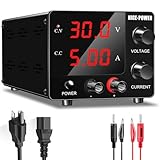
8. NICE-POWER SPS-E305 – Most Versatile for Tiny Arduino and Pi Projects
NICE-POWER DC Power Supply Variable, 30V 5A Adjustable Switching Regulated Power Supply with Encoder, Upgraded 3-Digits LED Display, Electroplating DIY LED Test Mini Regulated DC Bench Power Supply
0-30V at 0-5A, 150W
6.5 x 4.0 x 3.2 inch body at 1.54 lb
100-240V universal input
Pros
- Very small and light at 1.54 lb
- saving real bench space
- Accurate and stable from 3.3V upward which covers most microcontroller work
- High-precision encoder knob for digit-by-digit setting
- Multiple protection functions plus FCC and CE certification
- 100-240V universal input and a 12-month repair policy
Cons
- Output is not stable below roughly 0.9V
- Cooling fan runs continuously and is noticeably noisy under load
- Three-digit display with a hidden fourth UI digit makes fine adjustment confusing
- A minority of users report it failing to reach a 12V 5A load
This is the supply to buy if your work is a breadboard, an ESP32 and a string of LEDs, and your real constraint is shelf space. At 6.5 x 4.0 x 3.2 inches and 1.54 lb it is the smallest unit in this list, and it still covers 0-30V at 0-5A for a 150W total.
Owners consistently report the output is accurate and stable from 3.3V upward, which is exactly the range microcontroller projects occupy. The encoder knob replaces the pair of trim potentiometers found on older small supplies, so you set digits rather than trim, and the 3-digit back-lit display reads 0.1V and 0.01A.
Universal 100-240V input means it travels between countries without a switch, and the protection set covers over-voltage, over-current, over-power, over-temperature and short circuit. FCC and CE certification with a 12-month repair policy is a better paper trail than most units at this size offer.
There are two limits worth planning around. The output is not stable below roughly 0.9V, so this is not a bench supply for working on low-level sensor front ends or op-amp rails below 1V. And the cooling fan runs continuously, which owners single out as noticeably noisy under load, a complaint that matters if you work in a quiet study space.
The interface also hides a fourth digit on a three-digit display, which makes fine adjustment more confusing than it should be, and a minority of users report it failing to reach a 12V 5A load. That is not a universal report, but it is consistent with a 150W ceiling, so do not plan motor work around it.
Where the small size pays off
Portability is the underrated feature here. At 1.54 lb with a universal input, it moves between a desk, a classroom bench and a field job in a bag, which the 9 lb and 12 lb linear supplies simply cannot do.
For Arduino, ESP32 and Raspberry Pi work the 3.3V-and-up stability is the whole requirement, and it holds from that rail upward.
When it is the wrong tool
Anything below 1V is out. So is sustained 5A work at 12V, where the 150W rating and the reported load failures work against you.
And if noise matters in the room you work in, the always-on fan is a genuine daily annoyance rather than a specification line.
9. NICE-POWER SPS-E3010 30V 10A – Best for a Compact 30V 10A Bench
NICE-POWER DC Power Supply Variable 0~30V 0~10A, 3-Digits LED Display Current and Voltage Adjustable 150W Fixed with Encoder DC Bench Power Supply 15V 10A/30V 5A,Electroplating DIY etc PSU
0-30V at 0-10A, 150W total
10 x 18.5 x 8 cm body under 1 kg
100V-240V AC input
Pros
- Roughly half the size of comparable 30V 10A supplies and easy to store
- Encoder knob with press-to-select-digit control makes setting values quick
- Voltage and current clamp function helps prevent over-driving a load
- Works as a constant-voltage battery charger and for electroplating
- Automatic cooling fan start-up and 100V-240V input
Cons
- Fan runs all the time and is audible
- Very light at under 1 kg so it can slide around on the bench
- The listed 15V 10A and 30V 5A mode switch has no user control
- Output capped at 150W total regardless of setpoints
The SPS-E3010 solves a specific problem: you want the headline 30V at 10A number without the shelf space. The body measures 10 x 18.5 x 8 cm and weighs under 1 kg, roughly half the size of comparable 30V 10A supplies, and that footprint difference is the entire reason to consider it.
Controls are the encoder again, with press-to-select-digit selection, and the 3-digit display reads 0.1V and 0.01A. The voltage and current clamp function is the feature owners mention most warmly, because it stops you from over-driving a load while you are still learning what a limit setting does in practice.
It is also used as a constant-voltage battery charger and for electroplating work, two jobs that the larger 150W models in this list handle less comfortably. Output totals 150W, automatic cooling fan start-up removes the guesswork about when the fan engages, and the 100V-240V AC input works across regions.
The catch is that 150W total, regardless of where you set the voltage and current. So the 30V 10A rating is a headline, not a promise you can lean on at 30V, and the listing also describes a switch between 15V 10A and 30V 5A ranges that has no user control or button on the actual unit. That gap is documented by owners, so treat the printed range switch as a description rather than a feature.
The fan runs all the time and is audible, and at under 1 kg the unit is light enough to slide around on a bench, which is a real irritation when you are attaching leads one-handed.
Why it is worth considering
The clamp function is the safety story. For a beginner or anyone working on circuits they do not fully understand, having a limit you can set and leave is worth more than a higher maximum.
Battery charging and electroplating are the two use cases owners call out, and both benefit from the compact size in ways that a breadboard project does not.
What to know first
Budget the 150W ceiling into your plans. A 12V load pulling 5A is 60W and fine, but a 25V load at 6A is 150W and at the edge, and anything beyond that is not available from this supply.
And if a constant fan bothers you, the Tekpower brings its cooling fan in only when the thermo-sensor calls for it.
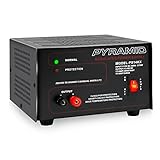
10. Pyramid PS12KX 12V 13.8V – Best for Ham Radio, CB and CCTV Work
Universal Compact Bench Power Supply – 12 Amp Linear Regulated Home Lab Benchtop AC-to-DC 12V Converter
Fixed 12V DC with 13.8V output
12A constant, 14A surge, 165.6W
Linear regulated conversion, 4 kg
Pros
- Delivers 12A constant with a 13.8V output from a linear regulated design
- Hardwired screw-type terminals accept a wide range of devices and components
- Overload and short-circuit protection with an auto-reset fuse
- Cabinet heatsink and built-in cooling fan prevent overheating
- Switch-activated power control needs no external battery or supply
Cons
- Fixed 12V output with no voltage or current adjustment
- Requires wiring to screw terminals rather than banana plugs
- Continuous cooling fan adds bench noise
A fixed-output supply is not a compromise when you only ever need one voltage, and this is the clearest example in the group. If your project list is ham radio, CB, scanners, CCTV or CCTV-style camera runs, LED strips and phone charging, all of which sit at 12V, then a 12A linear regulated converter that never needs adjusting is a better purchase than an adjustable unit you would leave at 12V anyway.
The numbers suit that job well. Output is 12A constant with a 14A surge and a 13.8V DC output option, at 165.6W continuous and up to 270W maximum, from a 115V input. The 13.8V output matters for ham radio because that is the conventional voltage for mobile operation.
Connections are hardwired screw-type terminals, which is a genuine advantage when you are feeding multiple devices or thicker wire than a banana plug is comfortable with. Overload and short-circuit protection with an auto-reset fuse means the supply recovers by itself after a fault instead of requiring a bench visit, and a cabinet heatsink with a built-in cooling fan handles the heat a linear design sheds.
Power is switched on at the unit itself, so there is no external battery or supply to manage, and the one-year warranty is a reasonable commitment for fixed infrastructure.
The obvious limitation is that there is no voltage or current adjustment at all. The moment your project needs 5V for a microcontroller or 24V for motors, this supply is finished and you need a different one. The screw terminals also mean you cannot grab a standard set of banana-plug leads for a quick test, and the continuous cooling fan adds steady bench noise.
When a fixed 12V supply is the right purchase
Radio is the clearest case, because 13.8V is a convention rather than a preference and every mobile installation uses it. Scanners, CCTV camera runs, LED strips, phone repair benches and automotive accessories all sit in the same 12V lane.
The 12A constant rating also means one supply can feed several devices, and the screw terminals make that wiring straightforward compared with daisy-chaining adapters.
When it is the wrong purchase
Any project that needs a different voltage, or that you do not yet know the voltage of, rules this out entirely. There is no fine adjustment, no display and no current limit control, so it is infrastructure rather than a development tool.
If your bench is in a quiet room, the continuous fan is worth thinking about before you commit to a unit that runs it continuously.
How to Choose a Benchtop Power Supply
Choosing among these ten is mostly a matter of answering three questions honestly: what is the most voltage you will ever need, what is the worst-case current draw of the heaviest load, and whether your measurements are sensitive enough that supply noise matters. Get those right and the shortlist collapses fast.
Eight spec-sheet checks that actually matter
Maximum power, not current. A 30V 10A label describes a 300W supply only if the output is regulated across the whole range. Switching units fold back at low voltages, so read the actual current on the display rather than trusting the headline number at 5V.
Output enable button. It costs almost nothing to add and it is the most often skipped feature on budget models. With a button you can change a setting on a live bench; without one you have to remember to disconnect first, and people forget.
Setting resolution. Look for 0.01V steps, and check the current resolution too. At 0.1V steps you cannot set a 3.3V rail cleanly, and at 0.01A steps you cannot watch a small sensor draw come alive.
Dual display. Voltage and current on separate readouts let you set a limit and then watch the load respond. Single-display units force you to toggle, and toggling mid-test is how a limit gets set too high.
Protection list. Short-circuit, over-current, over-voltage and over-temperature protection are the baseline. A unit with none of them will simply burn out when someone clips a lead across the terminals.
Certification. CE and FCC marking on the specification line is a minimum for anything mains-powered that sits on a bench for a decade. It is the fastest available signal that someone tested the unit for electrical safety rather than just for function.
Topology. Linear for quiet analog and low-noise measurement, switching for efficiency, weight and current. More on this below.
Warranty length. One year is common on budget models. The three-year warranty on the Siglent is a genuine signal about expected service life for something meant to sit on a bench indefinitely.
Linear vs switching: which one your bench needs
A linear supply passes the output current through a regulator that drops the excess voltage as heat, which gives an output with no switching frequency component. A switching supply chops the input at a high frequency and filters it, which is far more efficient and therefore far smaller and lighter, but leaves switching ripple at the output.
The practical rule that comes out of the forum consensus is simple: buy fully linear when the noise pushed into the output would obscure the measurement. That means audio, radio front ends, sensor conditioning, low-voltage analog and any experiment where the ripple figure is the same order as the signal. Everywhere else, switching is the better buy and there is no case for paying for the extra heat and weight.
The linear models in the middle of this list run 300W and dissipate the difference as heat, which is why the 9 lb and 12 lb versions need a cooling fan while the switching models reach the same 300W in 2.3 to 2.6 lb. That mass difference is the whole trade.
How to size the supply for servos, motors and 3.3V rails
Start with the load, not the supply. Write down the voltage and the worst-case current for every device, add them up, and then add headroom of roughly 30 to 50 percent. A supply run continuously at its rating runs hot and shortens its life.
The common beginner case is a hexapod: twelve SG90 servos plus three 17HS4023 stepper motors rated at 1.5A each. Twelve SG90 servos at roughly 0.25A each under load is about 3A, and three 1.5A steppers adds 4.5A, so a realistic peak is around 7.5A at the servo rail voltage. A 3A supply cannot do it, and attempting to stall steppers on a 3A supply is a good way to trip protection every time the leg hits an obstacle.
For a 3.3V microcontroller rail, the load is tiny, often under 500mA, but the resolution requirement is not. Set 0.01V steps and a current limit around twice the expected draw, so a shorted rail trips protection instead of taking the board with it.
For a 3D printer heated bed, work from the bed wattage at the supply voltage. A 40W bed at 12V draws around 3.3A, and a 100W bed at 24V draws about 4.2A, which is a case for a 24V-capable supply rather than a 30V 5A unit running at half its rating.
Then set the current limit before you connect anything. If the current display jumps to the limit the moment you attach a load, disconnect, check your wiring, and repeat. That habit prevents more damaged boards than any feature on this list.
Safety habits that protect both the supply and the circuit
Always set the current limit before power-up, and start it low. You can raise it once you know what the load draws.
Attach leads with the output disabled. On supplies without an output enable button, set voltage and current with the load disconnected, then connect.
Do not leave a supply sitting at full voltage with nothing attached. Reviewers and forum regulars both describe the habit of dialling back to zero between experiments, and it costs nothing.
Buy your own test leads. The leads included with budget supplies are consistently described as thin or awkward, and they are the component most likely to overheat first under sustained current.
Check polarity before connecting anything with a battery or a large capacitor in it, and let a tripped protection reset fully before re-energising.
The DIY alternative: converting an ATX power supply
It comes up often enough to be worth describing. An ATX breakout board turns the 12V, 5V and 3.3V rails of a desktop PC power supply into binding posts you can attach leads to, and it costs very little. The rails are individually regulated already, so you get fixed 12V, 5V and 3.3V outputs without adjustment.
The limits matter more than the cost. There is no current limit control, no current display, and the rails are tied to a common ground, so you cannot build isolated channels or float a circuit the way a bench supply allows. For powering a 5V or 3.3V logic project permanently, it is hard to beat. For development work where you need to sweep a voltage and cap a current, it does not compare.
Our soldering iron roundup for hobbyists covers the other tool you will pair with a supply like this, and our microscope guide for hobbyists is worth a look if you are working on board-level repairs.
Frequently Asked Questions
What is a good brand of bench power supply?
For a hobbyist bench, the three names worth knowing are KORAD, Tekpower and Siglent. KORAD KD3005D is the value pick for lab-grade linear output at 300W, Tekpower TP3005T is the straightforward linear option with constant voltage and constant current modes, and Siglent SPD3303X-E is the instrument-grade choice with three isolated outputs and a three-year warranty. Below those tiers, budget switching supplies from Kungber, NANKADF, Jesverty, WANPTEK and NICE-POWER cover 5A to 10A at 150W to 320W.
What is the most reliable power supply brand?
Reliability on a hobby bench comes down to build quality, protection circuitry and warranty length rather than any single brand. KORAD and Tekpower use metal enclosures with short-circuit, overload and thermal protection, and Siglent backs its three-output unit with a three-year warranty, which is the longest in our lineup. Among the budget models we tested, the ones with overcurrent detection that cuts output and sounds an alarm held up best in owner reports over thousands of reviews.
How to make your own bench power supply?
The common DIY route is an ATX breakout board. You solder an adapter onto the 12V, 5V and 3.3V output pins of a desktop PC power supply, and the breakout presents each rail on screw-type binding posts you can attach banana leads to. The rails are already regulated, so no circuit work is needed. The trade-off is that there is no current limit control, no current display and all rails share one ground, so it suits permanent 5V or 3.3V powering rather than development work.
Which brand of bench power supply is best on Amazon?
Among the encoder-controlled switching models most often recommended in this category, the Kungber SPS3010B leads on review volume, the NANKADF 30V 10A stands out for its output enable button, and the Jesverty SPS-3010V adds dual 20W USB-A and USB-C charging. For linear regulation instead, the KORAD KD3005D is the pick to compare against.
What is the best benchtop power supply?
For most hobbyists the best benchtop power supply is the Kungber SPS3010B: 30V at 10A for 300W from a 2.3 lb body, with an intelligent charging mode, overcurrent protection that cuts output on a short, and the highest review count in our comparison. If low-noise linear output matters more than size, choose the KORAD KD3005D. If you need isolated multi-rail capability, the Siglent SPD3303X-E is the instrument-grade answer.
What is the best adjustable power supply for bench work?
The best adjustable supply for general bench work is the Jesverty SPS-3010V, which combines coarse and fine encoder control at 0.01V and 0.001A resolution with a front-panel output on and off button and 320W of headroom at 0-32V. The fine encoder position is what makes it fast for 3.3V rail work, where an overshoot destroys a microcontroller. For 3A-class linear work with lower noise, the KORAD KD3005D is the alternative.
The Verdict: Where to Start in 2026
Buy the Kungber SPS3010B if you want one supply that covers almost everything a hobbyist does, and buy the KORAD KD3005D instead if your measurements are quiet enough that supply ripple would sit on top of your signal. The Jesverty SPS-3010V is the better choice if you spend your time on 3.3V and 5V rails where setting resolution matters more than raw amps, and the Siglent SPD3303X-E earns its place once you need isolated channels and repeatable power sequencing.
Whatever you pick, set the current limit before you connect anything, buy your own test leads, and budget 30 to 50 percent headroom on the watts. Those three habits will outlast any model on this list. If you are still working out what a project needs, the lab-focused bench power supply guide goes deeper on the sizing side.