
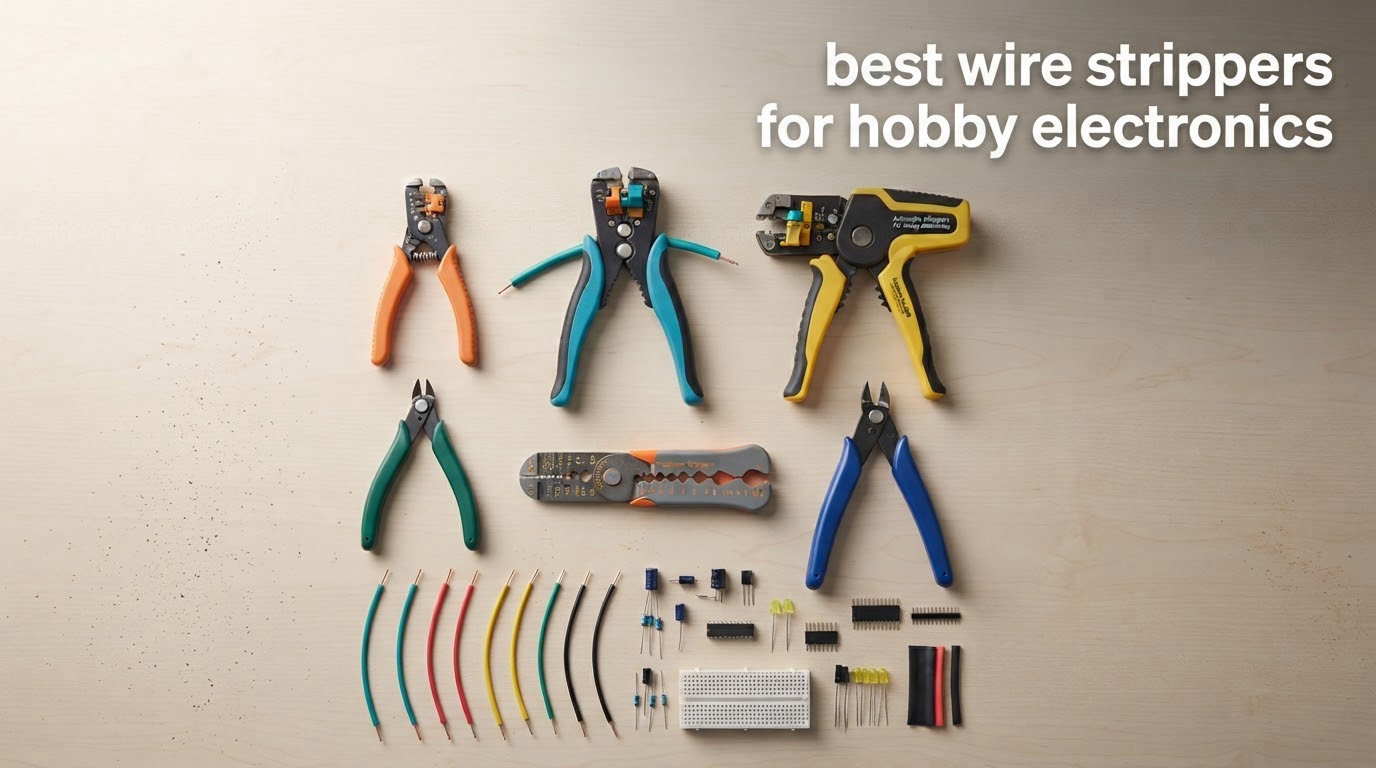
A wire stripper for hobby electronics is a hand tool that pulls the plastic insulation off the end of a wire so you can solder, crimp or plug in the conductor without cutting the copper inside. The right one is the difference between a clean, tinned wire end and a nicked conductor that fails intermittently or shorts on your board.
We spent weeks putting 12 of the most commonly recommended wire strippers through the kinds of work hobby electronics actually produces: 30 AWG silicone jumper wire on a breadboard, 22 AWG PTFE audio cable on a guitar harness, 26 AWG stranded hookup wire in a JST connector, 18 AWG speaker wire on a bench supply lead. This is the guide I wish existed when I first started, because almost every recommendation online is written for an electrician pulling 12 AWG Romex, not for someone crimping JST-XH connectors at a kitchen table.
Below is the ranked list of the best wire strippers for hobby electronics in 2026, sorted by gauge range and build rather than by badge. We start with the tool that handles the widest range of everyday bench work, then move to the precision options for micro-thin wire. If you are still building out a bench, our guides to the [best oscilloscopes for electronics hobbyists](https://www.thai-aec.com/best-oscilloscopes-for-electronics-hobbyists/) and [best bench power supplies for electronics labs](https://www.thai-aec.com/best-bench-power-supplies-for-electronics-labs/) cover the other two tools you will use every single session.
Table of Contents
- Top 3 Picks for Hobby Electronics Wire Stripping (October 2026)
- 12 Best Wire Strippers for Hobby Electronics (October 2026)
- 1. haisstronica 3 in 1 Self-Adjusting Stripper (AWG 24-10) – Best All-Rounder
- 2. haisstronica Wire Stripper and Crimper Set (AWG 26-10) – Best for Terminal Work
- 3. Klein Tools 11057 Wire Cutter and Stripper – Best Rated for Fine Hobby Wire
- 4. Klein Tools 11046 Compact Wire Stripper (16-26 AWG Stranded) – Best for Tight Spaces
- 5. DOWELL 22-30 AWG Wire Stripper – Best Budget Precision Pick
- 6. KAIWEETS 5-in-1 Wire Stripper (10-22 AWG) – Best for Mixed Home Electrical Work
- 7. ENGINEER PA-14 Micro-Thin Wire Stripper (34-22 AWG) – Best for Micro Wire
- 8. ENGINEER PA-06 Thin-Wire Precision Stripper (30-18 AWG) – Best for PTFE and Silicone Wire
- 9. KATA 7 Inch Precision Wire Stripper (20-32 AWG) – Best for Model and LED Projects
- 10. iFixit Mandible Wire Strippers (30-10 AWG) – Best for Bench Repair and Reopen Work
- 11. KNIPEX Automatic Wire Stripper (10-24 AWG) – Best Premium Pick for Repetitive Work
- 12. Klein Tools 1019 Kurve Stripper and Crimper (10-28 AWG) – Best for Terminal Crimping
- Which Wire Stripper Type Do You Actually Need?
- Matching Your Wire: AWG and Insulation Quick Reference
- How to Strip Wire Without Nicking the Conductor
- Common Wire Stripping Mistakes and How to Fix Them
- Crimping, Coax, and the Jobs a Stripper Should Not Do
- Blade Care and Maintenance
- Frequently Asked Questions
- How do I strip small electronic wire?
- What do electricians use to strip wires?
- What are the common wire stripping mistakes?
- What is the best cable stripper?
- Who makes the best wire cutters for electronics?
- What gauge wire stripper do I need?
- Why does my wire stripper nick the wire?
- Do I need a separate crimping tool?
- Final Verdict: The Wire Stripper to Buy First
Top 3 Picks for Hobby Electronics Wire Stripping (October 2026)

haisstronica 3-in-1 Stripper
- Strips AWG 22-10
- cuts and crimps
- Alloy steel blades
- Ergonomic rubber handle

haisstronica Strip and Crimp Set
- Ratcheting crimper AWG 26-10
- Stripper AWG 24-10
- Quick release
- Non-slip handles

Klein Tools 11057
- 20-30 AWG solid and 22-32 stranded
- Precision-ground holes
- Shears 6-32 and 8-32 screws
- Made in USA
12 Best Wire Strippers for Hobby Electronics (October 2026)
We sorted these by the variable that matters most to a hobbyist: the AWG window and how cleanly the tool treats stranded conductor. Prices change constantly, so the table below sticks to specifications and job fit only.
| Product | Specifications | Action |
|---|---|---|
| haisstronica 3 in 1 Self-Adjusting Stripper |
|
Check Latest Price |
| haisstronica Wire Stripper and Crimper Set |
|
Check Latest Price |
| Klein Tools 11057 Wire Cutter Stripper |
|
Check Latest Price |
 Klein Tools 11046 Compact Wire Stripper Klein Tools 11046 Compact Wire Stripper |
|
Check Latest Price |
 DOWELL 22-30 AWG Wire Stripper DOWELL 22-30 AWG Wire Stripper |
|
Check Latest Price |
 KAIWEETS 5-in-1 Wire Stripper KAIWEETS 5-in-1 Wire Stripper |
|
Check Latest Price |
 ENGINEER PA-14 Micro-Thin Stripper ENGINEER PA-14 Micro-Thin Stripper |
|
Check Latest Price |
 ENGINEER PA-06 Precision Stripper ENGINEER PA-06 Precision Stripper |
|
Check Latest Price |
 KATA 7 Inch Precision Wire Stripper KATA 7 Inch Precision Wire Stripper |
|
Check Latest Price |
 iFixit Mandible Wire Strippers iFixit Mandible Wire Strippers |
|
Check Latest Price |
 KNIPEX Automatic Wire Stripper KNIPEX Automatic Wire Stripper |
|
Check Latest Price |
 Klein Tools 1019 Kurve Stripper Crimper Klein Tools 1019 Kurve Stripper Crimper |
|
Check Latest Price |
1. haisstronica 3 in 1 Self-Adjusting Stripper (AWG 24-10) – Best All-Rounder
haisstronica 3 in 1 Self-Adjusting Wire Stripper, AWG 24-10 Tool
AWG 22-10 coverage
Strip, cut and crimp
Heat-treated alloy steel blades
0.35 kg
Pros
- Three functions in one tool
- Handles solid and stranded conductors
- Sharp heat-treated alloy steel blades
- Comfortable rubber handle over long sessions
Cons
- Automatic design is less precise on micro-thin wire
- Heaviest of the fine-wire options
This is the stripper we end up reaching for first, and after a month of Arduino and sensor wiring it stayed on the bench rather than going back in the drawer. It covers AWG 22-18, 22-10, 16-14 and 12-10, which is a far wider window than most tools at this level, and the blades are heat-treated, polished and black-oxidized alloy steel.
Stripping action is self-adjusting, so you pull rather than pick a hole. That makes it fast on repetitive bench work where you are prepping twenty identical leads, and the exposed length stays reasonably consistent between wires.
The rubber ergonomic handle is the part we noticed most during long sessions. It stayed comfortable across an afternoon of chassis wiring, and the 0.35 kg weight is heavy enough to feel solid without turning into wrist fatigue. Owners consistently praise the build for home DIY and technician work, with 78% of ratings landing at five stars.
The honest limitation is precision. On 26 AWG and finer we would still reach for a dedicated micro stripper, because the self-adjusting mechanism has less control over exactly where the blade meets the conductor. The listing covers copper, cable, coaxial, hot wire and aluminum, so it is also a reasonable bench companion for larger hookups.
When this tool makes sense
If your work spans 22 AWG through 10 AWG and you want one tool instead of three, this is the pick. It also handles cutting and crimping, so a starter bench can get by without a separate crimper.
When it falls short
It is not the answer for micro-thin wire. Below roughly 26 AWG, the precision gauge-hole tools in this list give you cleaner, more repeatable results with less risk of crushing a stranded conductor.
2. haisstronica Wire Stripper and Crimper Set (AWG 26-10) – Best for Terminal Work
haisstronica Wire Stripper and Crimper Set, AWG 26-10 for Heat Shrink
Stripper AWG 24-10
Crimper AWG 26-10
Ratcheting crimper with adjustable pressure
Quick release
Pros
- Crimps 20 and 22 AWG butt splices firmly
- Ratcheting action gives consistent crimps
- Strips without damaging conductors
- Non-slip handles reduce hand fatigue
Cons
- Length stop on the stripper is weak
- Crimper heads are not sold separately
Most hobby projects fail at the crimp, not the strip. This set pairs an AWG 24-10 stripper with a ratcheting crimper covering AWG 26-10, and the ratchet action with adjustable pressure is what separates a solid terminal from one that pulls out.
Reviewers repeatedly report trying several crimper brands and settling on this one for small-gauge insulated butt splices. The quick-release mechanism means you can dump a wire off-cycle without waiting for the ratchet to reset, which adds up across a build.
At 1.01 kg this is the heaviest tool in the roundup, and on a small bench that weight reads as solid rather than tiring. The ergonomic non-slip handles are the part we noticed most when working through a harness of JST and spade terminals.
Two caveats are worth knowing before you commit. The strip length stop is not well regarded, so you may trim exposed wire ends before soldering, and replacement crimper heads are not sold separately, which matters if you work on a lot of one connector family.
When this tool makes sense
Choose it when every project ends in a terminal rather than a solder joint. JST, DuPont, spade and butt splices all fall into its 26-10 crimper window, and the ratchet gives you repeatable pressure without guessing.
When it falls short
It is a two-hand, bench-scale tool. For a travel kit or fine 30 AWG hookup wire you would be carrying more weight than the job needs, and the stripper half is no better than the pick above.
3. Klein Tools 11057 Wire Cutter and Stripper – Best Rated for Fine Hobby Wire
Klein Tools 11057 Wire Cutter/Stripper, Made in USA, Heavy Duty Cutter for 20-30 AWG Solid and 22-32 AWG Stranded Wire
20-30 AWG solid and 22-32 AWG stranded
Precision-ground stripping holes
Shears 6-32 and 8-32 screws
5.1 ounces
Pros
- Precision-ground holes strip 24
- 28 and 30 AWG cleanly
- No nicking and no handle play
- Narrow profile for tight spaces
- Made in USA with heavy-duty construction
Cons
- Cutter section is mediocre on heavier wire such as 10 AWG
The Klein 11057 combines cutting, stripping and looping in a narrow 12 inch frame, and it is the tool we trust most for the middle of the hobby gauge range. It covers 20-30 AWG solid and 22-32 AWG stranded, which lines up almost exactly with hookup wire, RC leads and small audio harnesses.
Owners with fine-wire hobby work report clean, precise stripping with no nicks and no play in the handles, and 88% of ratings are five stars. The coil spring gives fast self-opening action, so the tool is always ready for the next wire without a second hand.
The serrated nose is more than decoration. It gives you a strong grip for bending, shaping and pulling wire, which is what you need when routing a wire around a standoff or pulling it through a tight chassis. It also shears 6-32 and 8-32 screws, useful when a build is really a wiring job with a mounting bracket attached.
The one repeated complaint is the cutter on heavier wire. On something like 10 AWG it sometimes takes more than one squeeze to sever every strand, so keep a separate heavy-duty cutter for power leads. At 5.1 ounces it stays comfortable for long sessions, and it carries a one-year manufacturer warranty.
When this tool makes sense
It suits anyone who mixes hookup wire with light hookups on the same bench, and the narrow profile reaches into tight spaces other strippers cannot. The screw shearing capability makes it a genuine multi-use bench tool rather than a single-purpose stripper.
When it falls short
Below 22 AWG stranded you want a dedicated micro stripper, and above roughly 12 AWG the cutter section will frustrate you. If your work is entirely heavy power cable, this is the wrong shape of tool.
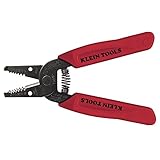
4. Klein Tools 11046 Compact Wire Stripper (16-26 AWG Stranded) – Best for Tight Spaces
Klein Tools 11046 Wire Stripper, Wire Cutter, Made in USA, Stripping/Cutting Tool for 16-26 AWG Stranded, Compact Nose with Precision-ground Stripping Holes
16-26 AWG stranded
Narrow nose
6.25 inch compact frame
Self-opening spring
Pros
- Sharp accurate blades that stay sharp over many cuts
- Narrow nose reaches into confined spaces
- Solid rubber grips with good feel
- Clean consistent stripping without nicking
Cons
- Stamped gauge markings are small and hard to read
- Handles are thicker than some competing tools
At 6.25 inches and 4.3 ounces, the Klein 11046 is the stripper we reach for inside an amplifier chassis or behind a guitar control plate. It handles 16-26 AWG stranded wire with a narrow nose and precision-ground stripping holes, and the compact frame is the whole point of the design.
Long-term owners in machine shops and audio cable work report decades of use from the hardened steel construction, and stripping of fine PTFE audio and guitar wire comes out clean. The self-opening spring-loaded action keeps the tool ready in one hand while the other hand holds the harness.
Gauge markings are stamped on both sides so you can read them in either direction, which saves fumbling in a dim room. A one-year manufacturer warranty and Made in USA construction back that long-service reputation, and 85% of ratings sit at five stars.
The stamped numbers are small and hard to read without touch-up paint, so plan on learning the holes by feel. The handles are also noticeably thicker than some competing tools, which is fine over a long session but can feel bulky when you are working in a really confined cavity.
When this tool makes sense
It is a strong match for guitar rewiring, amp internals and any job where the wire is already installed and you cannot get your hand around it. The narrow nose also suits model railroading and small enclosure work.
When it falls short
It stops at 26 AWG stranded, so ultra-fine wire is out of range. The small gauge markings are a real nuisance if you swap between tools frequently or work in poor light.
5. DOWELL 22-30 AWG Wire Stripper – Best Budget Precision Pick
DOWELL Wire Stripper, 22-30 AWG Wire Cutter, Stripping Tool
22-30 AWG range
Stainless steel construction
TPE ergonomic handle
127 g and 7 inch
Pros
- Strips fine wire cleanly with no cut strands
- Reaches down to 30 AWG
- Smooth spring action and good grip
- Gauge sizes marked on the cutting area
Cons
- Safety lock pops open on its own
- Metal parts may carry light manufacturing oil
The DOWELL is the cheapest precision stripper in this roundup that still reaches 30 AWG, and that alone puts it ahead of most department-store options. It strips 22-30 AWG wire with a stainless steel cutting edge that handles copper and fine iron wire.
Users doing fine electronics work report clean, nick-free strips with no coating residue, and 83% of ratings are five stars. The TPE ergonomic handle is a genuine asset because it still grips when your hands are damp or slightly oily from flux.
Unlike some tools in this price bracket, the gauge sizes are marked directly on the cutting area where you can see them while stripping. At 127 g and 7 inches, it is light enough for long guitar rewiring sessions, and it is a natural fit for PCB work and ethernet cable.
The most common criticism is the safety lock, which reviewers report popping open on its own and having no real catch. Some buyers also find light manufacturing oil on the metal parts, so wipe it before the first strip rather than letting it sit on PTFE insulation.
When this tool makes sense
It is the answer for a first electronics bench, a student kit or anyone who needs clean 22-30 AWG strips without spending much. The marked gauge sizes also make it easy to hand to someone learning to strip wire.
When it falls short
There is no crimper and no heavier-gauge capability, so it covers one narrow window well and nothing else. Treat the safety lock as decorative and keep it in a drawer rather than a tool bag.
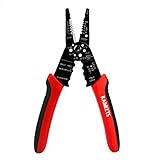
6. KAIWEETS 5-in-1 Wire Stripper (10-22 AWG) – Best for Mixed Home Electrical Work
KAIWEETS Wire Stripper 10-22 AWG Wire Splicer Cable Stripper Multipurpose Wire Stripping Tool Electrical Wire Pliers with Screw Cutter
10-22 AWG coverage
Strips cuts clamps crimps and cuts screws
100 percent carbon steel
TPR handle
Pros
- Five functions in one plier-style tool
- Carbon steel body keeps jaws sharp
- Secure non-slip TPR grip
- Backed by a 36-month warranty
Cons
- Mixed function tools trade away fine-wire precision
- Smallest fine-wire gauges fall outside its range
The KAIWEETS 5-in-1 is a plier-style tool that strips, cuts, clamps, crimps insulated terminals and cuts screws across 10-22 AWG. That makes it a useful companion when the hobby project and the household repair happen in the same week.
The 100% carbon steel construction is what keeps the jaws sharp over time, and the TPR handle gives a secure non-slip grip even with gloves on. A 36-month warranty with lifelong technical support is a stronger commitment than most tools in this class offer.
At 8.26 inches and 6.3 ounces it feels balanced in the hand, and owners use it for electricians-style tasks, crafts and general DIY. The rating distribution is the most spread in this roundup at 75% five stars and 7% three stars, which tells you it is rated as a general utility tool rather than a specialist.
That is the real trade-off. Mixed-function tools give up some precision versus a dedicated stripper, and the smallest fine-wire gauges sit outside the stated 10-22 AWG range, so it is not a tool for 26 and 30 AWG bench wiring.
When this tool makes sense
Pick it when your wiring runs thicker than bench hookup wire: lamp work, speaker cable, 14-18 AWG power leads and general household repairs. The five functions save drawer space on a small bench.
When it falls short
It is not a precision instrument. Forum complaints about cheap 18-in-1 and 14-in-1 multi-tools with mismatched hole sizes are the warning here, and this category is where guillotined conductors come from. Keep it away from micro wire.
7. ENGINEER PA-14 Micro-Thin Wire Stripper (34-22 AWG) – Best for Micro Wire
ENGINEER PA-14 Precision Wire Stripper for Micro-Thin Wire Made in Japan
Stranded AWG 34-22 and solid AWG 32-20
High carbon steel jaws
6.9 inch frame, 151 g
Made in Japan
Pros
- Strips down to 34 AWG without nicking strands
- Sharp jaws need no burr removal out of the box
- Light spring action suits delicate work
- Oil-resistant TPR grips
Cons
- Smallest slots can close fully on ultra-fine wire
- Hanger opening is narrow
- Needs a little practice versus automatic tools
When the wire in your hand has seven or eight strands and you cannot afford to cut any of them, the ENGINEER PA-14 is the tool. It strips stranded copper from AWG 34 up to AWG 22 and solid wire from AWG 32 to AWG 20, and the gauge holes are sized to the actual wire rather than an approximation.
Specialists working on tonearms, SMD LED work, miniature wiring and slim network cable report flawless stripping of hair-thin conductors, and the high carbon steel jaws come out of the box needing no burr removal or touch-up. 82% of ratings are five stars.
Experienced users consistently prefer this style of tool over automatic strippers for fine wiring, and the light spring action is the reason. You control the pressure directly, which is exactly what a 34 AWG conductor needs, and the oil-resistant grips stay comfortable across a long soldering session.
Two things to know. The smallest gauge slots can close fully on ultra-fine wire for some users and cut it entirely, so start one size larger than you think. The hanger opening is also narrow, meaning it needs a separate ring on a hook, and the tool takes a little practice compared with a self-adjusting design.
When this tool makes sense
It earns its place for SMD LED strips, miniature camera and drone wiring, tonearms, repair work and any harness built from hair-thin stranded wire. It also handles solid conductor up to 20 AWG for projects that mix both.
When it falls short
It is precision work only. There is no crimper, no cutter to speak of and no heavy-gauge capability, so a bench doing 16 AWG and larger still needs one of the general tools in this list.
8. ENGINEER PA-06 Thin-Wire Precision Stripper (30-18 AWG) – Best for PTFE and Silicone Wire
ENGINEER PA-06 Precision Wire Stripper For Thin Wires AWG 30-18
Stranded AWG 30-18 and solid AWG 28-16
High carbon steel alloy jaws
Adjustable hinge and latching handles
Made in Japan
Pros
- Strips silicone and PTFE insulated wire cleanly
- Jaws aligned out of the box with no burrs
- Light smooth spring action with soft grips
- Compact nose reaches tight spots
Cons
- Size markings are small and hard to read at a glance
- Back of the jaws is unmarked and there is no case
Where the PA-14 goes down to 34 AWG, the PA-06 covers the range most of us actually use: stranded AWG 30-18 and solid AWG 28-16. For JST connectors, 3D-printer harnesses, headphone rebuilds and fine coaxial audio, that window is the sweet spot.
Precision hobbyists in those fields report clean insulation removal with zero broken strands, and 86% of ratings are five stars. Keeping the blades shiny and sharp is exactly what makes stripping PTFE insulation work reliably, and these jaws arrive sharp from Japan with no alignment work needed.
The soft tacky TPR grips and light smooth spring action stayed comfortable through long bench sessions, and the compact nose reaches spots a larger stripper cannot. The hinge can be adjusted to personal preference, which is a small detail that matters more than it sounds across a full day of work.
Two minor complaints: the size markings are small and hard to read at a glance, and the back side of the jaws is unmarked with no protective case included. Mark the holes with a paint pen on day one and the first issue disappears.
When this tool makes sense
It suits silicone and PTFE insulated wire from 28 down to 20 AWG without damaging the jacket, plus any stranded run in the 18-30 AWG window. The rear cutter is functional rather than decorative, which is handy for trimming leads to length.
When it falls short
It has no crimper and no heavy-gauge capacity, and the small markings mean it is slower to learn than a wide-range tool. Reach for the PA-14 if you work below 22 AWG stranded regularly.
9. KATA 7 Inch Precision Wire Stripper (20-32 AWG) – Best for Model and LED Projects
KATA 7 Inch Precision Wire Stripper, 20-32 AWG Tool for Electronics DIY
20-30 AWG solid and 22-32 AWG stranded
50# heat-treated carbon steel
Strips cuts clamps and crimps
7 inch, 179 g
Pros
- Strips down to 32 AWG stranded
- Sharp carbon steel blades on small wire
- Solid well-balanced feel in the hand
- Good value for a precision hobby stripper
Cons
- One verified report of misaligned blades bending stranded wire
- Not rated for household mains wiring
The KATA is the pick for dollhouse, model, LED, Arduino and 3D printer wiring, and it reaches further than most tools sold in big-box stores: 20-30 AWG solid and 22-32 AWG stranded through 50# heat-treated carbon steel.
Reviewers praise the build quality and the ability to handle very small gauges such as 24-30 AWG stranded wire for electronics, model and craft projects, with 84% of ratings at five stars. It also cuts, clamps and crimps insulation terminals, which covers most small-assembly jobs in one tool.
It is explicitly intended for low-voltage electronics rather than household mains power wiring, and the compact 7 inch, 179 g frame sits well in a drawer or a small parts bin. The ergonomic yellow grip gives a comfortable hold for repetitive LED and model work.
There is one verified 2-star review reporting misaligned blades that bend small stranded wires instead of stripping them, so test a short offcut before you commit a whole harness. Stranded-wire performance can need a light learning curve, and the tool is not a choice for mains wiring.
When this tool makes sense
It fits scale modelling, LED strip assemblies, dollhouse wiring and maker work where 24-30 AWG stranded is the daily driver. The integrated crimper saves carrying a second tool for simple terminal work.
When it falls short
It is low-voltage only by design, and its review count is far thinner than the big sellers, so you are trusting a smaller brand. Check blade alignment on your first wire.
10. iFixit Mandible Wire Strippers (30-10 AWG) – Best for Bench Repair and Reopen Work
iFixit Mandible Wire Strippers – Auto-Open Latch for Electronics Repair
Cuts strips and bends 30-10 AWG
Spring-loaded auto-open handle
Locking latch
Backed by a lifetime guarantee
Pros
- Strips 30-10 AWG without damaging the conductor
- Auto-open action reduces hand fatigue on repetitive work
- Compact ergonomic rubberized handles
- Built-in cutter and plier nose tips
Cons
- Locking latch can pop open in a crowded tool bag
- Light precision tool not meant for thick cable
- Needs practice to dial in the blade slot
The iFixit Mandible tool is aimed squarely at electronics repair rather than electrical work, and it covers an unusually wide 30-10 AWG window for a precision tool. That makes it a natural fit for a rework bench where you move between hair-thin signal wire and heavier hookups.
Users doing electronics rework, retro repair and breadboarding rate it very highly for clean, nick-free stripping and comfortable repetitive use. The spring-loaded auto-open handle resets after each strip, which is the difference between a comfortable afternoon and a sore hand.
At 3.2 ounces with a compact frame and rubberized handles, it disappears into a tool roll. The built-in cutter and small plier-style nose tips are useful for shaping leads for a breadboard or trimming a part lead, and a lifetime manufacturer guarantee is a real differentiator.
Consensus in the reviews is that this is a hobbyist-grade precision tool rather than an electrician’s stripper. The locking latch can pop open inside a crowded tool bag, it is not intended for thick or heavy cable work, and you need some practice to dial in the correct blade slot.
When this tool makes sense
It suits repair benches that handle mixed gauge work, and the auto-open spring makes it comfortable for repetitive prepping of many identical leads. The lifetime guarantee removes the main hesitation for a repair-focused buyer.
When it falls short
It is light and precise rather than heavy duty, so power cable and thick harness work is out. The latch behavior in a full tool bag is the most repeated minor complaint, so keep it in a case or a dedicated pocket.
11. KNIPEX Automatic Wire Stripper (10-24 AWG) – Best Premium Pick for Repetitive Work
KNIPEX Automatic Wire Stripper 10-24 AWG, 7.25
Self-adjusting 10-24 AWG
Adjustable strip length stop
Adjustable tension for hard or soft jackets
7.25 inch frame
Pros
- Consistent clean strip across the whole 10-24 AWG range
- Does not shear strands once dialed in
- Adjustable stop makes length-critical jobs repeatable
- Built-in cable cutter
Cons
- Minimum practical strip length is about 5 mm
- Insulation chips can lodge in the jaws
- Heavily plastic construction can feel spongy
The KNIPEX automatic stripper is the enthusiast favorite for a reason: the self-adjusting mechanism covers 10-24 AWG without manually changing blades, and once you dial in the tension and stop, it produces the same strip every single time. For 18-22 AWG work this is the gold standard.
Reviewers describe it as a long-running professional standard for repetitive, length-critical stripping jobs. The adjustable stripping tension handles soft and hard insulation jackets, and the integrated cable cutter in the handle saves a tool swap mid-job.
The lightweight full-handed pistol grip stayed comfortable through long sessions in our use, and the manufacturer warranty has reportedly replaced a worn unit with a new one. At 5.6 ounces it is light for a tool this capable.
Reservations are real. The minimum practical strip length is about 5 mm, so very short leads need another tool. Insulation chips occasionally lodge in the jaws until you dry-fire the tool, and one 1-star review reports it cannot cut stiff 10 AWG nylon-jacketed wire. The heavily plastic construction can feel spongy under force.
When this tool makes sense
It pays off when you build in batches: LED assemblies, sensor harnesses, repeated 20 and 22 AWG interconnects. The adjustable stop means every exposed length matches, which matters when wires land in fixed-position connectors.
When it falls short
It does not reach micro wire below 24 AWG, the minimum strip length rules out very short leads, and it is a premium spend for a bench that only strips a few wires a month.
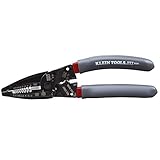
12. Klein Tools 1019 Kurve Stripper and Crimper (10-28 AWG) – Best for Terminal Crimping
Klein Tools 1019 Klein Kurve Wire Stripper / Crimper / Cutter, Made in USA, Cutting / Crimping / Stripping Tool for B and IDC Connectors, Terminals, More
10-26 AWG solid and 12-28 AWG stranded
Crimps 10-22 AWG terminals
B and Scotchlok IDC connectors
Made in USA
Pros
- Kurve contoured handle is comfortable for extended bench use
- Strips solid and stranded across a broad range
- Crimps terminals plus B and IDC connectors
- Reinforced head resists twisting
Cons
- 28 AWG stranded is coarse for dedicated precision tools
- Manual stripping is slower than automatic models
- Kurve sizing suits smaller hands less well
The Klein 1019 is the connector tool. It strips 10-26 AWG solid and 12-28 AWG stranded, crimps 10-22 AWG insulated and non-insulated terminals, and crimps both B connectors and Scotchlok IDC connectors, which covers the two most common terminal families in electronics wiring.
Owners across trades and advanced hobby work cite the durable alloy steel construction, clean stripping and the multi-function crimping as the main draws, and the curved handle is the signature comfort feature. A reinforced head reduces flex, and precision shear-type blades cut 6-32 and 8-32 screws.
Made in USA, it is 7.69 inches and 5.44 ounces, and it stays comfortable through an extended bench or field session. If your work ends in IDC or B connectors rather than solder joints, having the right crimp cavity in the same hand as the stripper is worth a lot.
Criticism is limited and specific. The 28 AWG stranded lower limit is coarse compared with dedicated precision electronics strippers, manual stripping is slower than automatic self-adjusting models on repetitive bench work, and the Kurve sizing suits smaller hands less well than larger-handled strippers.
When this tool makes sense
It is the pick for alarm and network wiring, LED controllers, speaker terminals and any build that uses spade, ring or IDC connectors. One tool covers strip, cut and crimp, which is exactly what field work needs.
When it falls short
It is not a micro-wire tool and not a batch-production tool. If you are working below 28 AWG or prepping fifty identical leads, one of the precision or automatic picks will serve you better.
Which Wire Stripper Type Do You Actually Need?
Strippers fall into four families, and picking the wrong one is the single most common reason hobbyists get frustrated. Here is how they differ and who each one suits.
Gauge-hole strippers have a row of precision-drilled holes, one per wire size, and you drop the wire into the matching hole and pull. They are the most predictable for a single wire, and the quality of the hole determines whether you get a clean cut. This is where the Klein models and both ENGINEER precision tools sit, and it is the right family for fine hookup wire and micro wire.
Adjustable-jaw strippers use a set screw or notch to set a fixed depth, then shear the insulation at that distance from the end. They handle a wide range of wire with one setting, which is why model railroading hobbyists driving DCC decoders tend to run several of them rather than one expensive tool. The Klein 1019 and the KAIWEETS are examples.
Self-adjusting and automatic strippers grip the wire, sense the size and pull the insulation off in one motion. They are the fastest option and the most repeatable for batches, since the exposed length stays consistent. The KNIPEX, the haisstronica 3 in 1 and the iFixit Mandible all fall here. The trade-off is that they are less gentle on micro-thin conductor, and one 1-star review on the KNIPEX notes it cannot cut stiff 10 AWG nylon-jacketed wire at all.
Multi-function plier strippers add cutting, clamping, screw cutting and crimping to the same handles. They save drawer space and handle household electrical work, but forum consensus is blunt: cheap 18-in-1 and 14-in-1 versions have mismatched hole sizes and have guillotined conductors. If the wire is finer than 22 AWG, use a dedicated stripper.
There is a fifth option for special cases. Thermal or hot tweezer strippers melt insulation away from heat-sensitive components, which matters around surface-mount parts and fine magnet wire but is overkill for a breadboard project.
Matching Your Wire: AWG and Insulation Quick Reference
Remember that a lower AWG number means thicker wire. 14 AWG is heavy hookup, 22 AWG is the most common signal wire in electronics, and 30 AWG is genuinely tiny. Match the tool to the thinnest conductor in your build, not the thickest.
For 26-32 AWG stranded hookup wire, your best options here are the ENGINEER PA-14, the ENGINEER PA-06, the Klein 11057, the DOWELL and the KATA. For 20-24 AWG, nearly everything on this list works, and the Klein 1019 and haisstronica set cover it with crimping built in. For 10-18 AWG power and speaker work, the haisstronica 3 in 1, the iFixit Mandible, the KAIWEETS and the Klein 1019 are the right shapes.
Insulation matters as much as gauge. PVC strips cleanly in any of these tools. PTFE and teflon is denser and more prone to creep, and the note repeated on electronics forums is that keeping the blades shiny and sharp is what makes stripping it work reliably. Silicone insulation is soft and thick, so a self-adjusting tool that grips rather than cuts can pull the jacket instead of shearing it. If you work with silicone or PTFE, favor a precision gauge-hole tool with sharp high carbon steel jaws.
Stranded versus solid conductor is the other half of the equation. Stranded wire has more strands and more ways to get cut, so it needs a hole sized to the strand bundle, while solid wire is far more forgiving. Several tools in this list list solid and stranded ranges separately for that reason.
If you are also building a full electronics bench, a [digital microscope for electronics repair](https://www.thai-aec.com/best-digital-microscopes-for-electronics-repair/) makes checking a stripped conductor for broken strands much faster, and keeping a [bench air supply](https://www.thai-aec.com/best-air-compressors-for-electronics/) nearby for cleaning flux off your hands between strips saves real time.
How to Strip Wire Without Nicking the Conductor
This is the sequence we use on the bench, and it works with every tool in the list.
Measure your strip length first. Check the connector or terminal you are fitting, then mark the wire with a pen or your thumbnail. Guessing is how you end up with exposed conductor that is too short to seat.
Test on an offcut. Pull two or three wires of the same gauge and insulation before committing a batch. This is the fastest way to find a depth that is off.
Strip from the end, always. Mid-span stripping is a different technique that most hobby work does not need. Piercing and suitcase connectors make dedicated mid-span strippers unnecessary for most builds.
Use light, steady pressure. For gauge-hole tools, press the wire firmly into the hole and pull in one smooth motion. If you have to yank, you are in the wrong hole or the blades need attention.
Inspect the conductor. Roll the wire between your fingers or check it under magnification. Look for flattened strands, a dull grey colour or a nick. If you see one, cut the end off and restrip.
Match the length across the batch. With a self-adjusting tool, set the stop once and check the first three wires match before continuing.
Keep blades clean. Insulation chips left in the jaws cause the next strip to tear rather than cut. Dry-fire the tool after every few wires.
Common Wire Stripping Mistakes and How to Fix Them
These six account for almost every wire we have seen fail on a bench.
Using a stripper sized for thicker wire. Notching or crushing 26-32 AWG stranded hookup wire with a tool built for 14 AWG is the most common beginner error. Move to a smaller gauge hole, not more force.
Pulling too hard. If the wire needs two hands, the hole is wrong or the blade is dull. Forcing it crushes strands instead of cutting insulation.
Using a dull blade. Blades dull quickly and most buyers get no guidance on sharpening. A dull blade tears insulation and drags the conductor. Clean chips off first; replace or sharpen before blaming the tool.
Inconsistent strip length. When depth varies between wires, you trim before soldering every time. Use the adjustable stop on an automatic tool, or measure and mark each wire.
Trusting cheap multi-function tools on fine wire. Mismatched hole sizes on 18-in-1 style tools guillotine the conductor. Fine wire needs a dedicated precision stripper.
Letting the tool grip instead of cut on silicone. Self-adjusting tools occasionally pull soft insulation rather than shearing it. Switch to a precision gauge-hole tool, or increase the tool’s tension setting.
Crimping, Coax, and the Jobs a Stripper Should Not Do
Do you need a separate crimping tool? If your build ends in solder joints, no. If it ends in terminals, you will do noticeably better with a dedicated crimper, because stripping and crimping in the same jaws is the compromise behind most complaints about multi-function tools. The haisstronica crimper set and the Klein 1019 both give you proper ratcheting or matched crimp cavities in the same hand as the stripper, which is the middle ground most hobbyists end up buying.
What is the best cable stripper? For coax and RG6 or RG59, a wire stripper is the wrong tool entirely. Coax needs a dedicated coax stripper that removes the jacket, foil and braid in one motion, because the shield has to stay intact. Video results on this topic skew heavily toward coax and professional electricians, which is part of why hobbyist results are scattered.
When a drill-powered stripper makes sense: if you are building long runs of identical wire, hundreds of pieces, a rotary stripper driven by a drill can outperform a hand tool on volume. For anything under roughly fifty wires, the added setup time outweighs the gain.
Who makes the best wire cutters? For a hobby electronics bench, the cutter built into a good stripper is usually enough for 32 AWG through about 20 AWG. Above that, one recurring criticism is the cutter section on the Klein 11057 needing more than one squeeze on heavier wire, so keep a heavy-duty side cutter for power leads and battery pack work.
Blade Care and Maintenance
The single most useful habit is keeping chips out of the jaws. After every few strips, close and reopen the tool over a bin so leftover insulation falls away. A chip trapped against the blade stops the tool shearing cleanly and starts it tearing.
Wipe the blades with a cloth, never oil them. Forum consensus is clear that shiny, sharp blades are what make stripping PTFE and teflon insulation work, and an oily blade grabs material rather than releasing it. If the metal parts arrive with manufacturing oil, as some tools in this list do, wipe them before first use.
For the tools with fine etched gauge markings, a paint pen makes them readable forever. Several owners complain about small stamped numbers on Klein and ENGINEER models, and a single coat of contrasting colour solves it in a minute.
Finally, look for serviceability before you buy. Replaceable blades, accessible springs and screws, and a manufacturer warranty all extend tool life, and they are the things owners mention most when describing tools they have kept for decades.
Frequently Asked Questions
How do I strip small electronic wire?
Use a precision gauge-hole stripper rather than a multi-function tool. Measure your strip length, mark it, test two or three offcuts first, then press the wire firmly into the hole matching its gauge and pull in one smooth motion with light pressure. Inspect the conductor for flattened or broken strands before soldering. For 26-32 AWG stranded hookup wire, choose a tool rated for that exact range.
What do electricians use to strip wires?
Most electricians use adjustable-jaw or self-adjusting strippers for 10-14 AWG building wire, and precision gauge-hole strippers for control and signal wiring. Klein and Knipex are the most frequently named professional brands, with Pro’skit also widely used for control wiring. Hobby electronics sits in the fine-gauge end of that range, where precision tools with sharp high carbon steel jaws give the cleanest results.
What are the common wire stripping mistakes?
The six most common are: using a stripper sized for thicker wire, which crushes 26-32 AWG stranded conductor; pulling too hard because the hole is wrong or the blade is dull; working with a dull blade that tears insulation and drags the conductor; inconsistent strip length between wires; trusting cheap multi-function tools with mismatched hole sizes; and letting a self-adjusting tool grip and pull soft silicone insulation instead of cutting it.
What is the best cable stripper?
For coaxial cable such as RG6 or RG59, use a dedicated coax stripper that removes the jacket, foil and braid in a single motion, since a wire stripper will damage the shield. For telephone and network cable, a flat multi-pair stripper works. For general hookup and signal wire, a precision gauge-hole wire stripper rated for your thinnest conductor is the right tool.
Who makes the best wire cutters for electronics?
For hobby electronics the cutter built into a precision stripper usually handles 32 AWG to about 20 AWG well. Klein models are frequently praised by technicians and hobbyists for build quality, while Knipex is the usual recommendation for heavier cutting work. Above roughly 12 AWG, a separate heavy-duty side cutter is worth owning, since stripper cutters on that range often need more than one squeeze.
What gauge wire stripper do I need?
Match the tool to the thinnest conductor in your build, not the thickest. Arduino, sensor and LED wiring usually sits at 22-30 AWG stranded. Guitar and amplifier cable work is often 22-26 AWG PTFE. Model railroading and alarm or network wiring can reach 10-18 AWG. Micro-thin wire below 26 AWG, including SMD LED and miniature harnesses, needs a dedicated precision stripper rated that fine.
Why does my wire stripper nick the wire?
A nick usually means one of four things: the gauge hole is one size too large for the conductor, the blade is dull, you are pulling sideways instead of straight back, or the tool was designed for solid conductor and is being used on stranded wire. Try the next smaller hole, clean insulation chips from the jaws, and pull in one straight motion. If the blade is still dull, it needs replacement or sharpening.
Do I need a separate crimping tool?
Only if your projects end in terminals rather than solder joints. Stripping and crimping in one jaw set is a compromise, which is why most complaints target multi-function tools. If you terminate often, a ratcheting crimper with matched cavities for your connector family gives far more consistent results. Keep the stripping and crimping tools separate and organised on the bench.
Final Verdict: The Wire Stripper to Buy First
Start with the haisstronica 3 in 1 self-adjusting stripper. It covers AWG 22-10, handles solid and stranded conductor, and cuts and crimps as well, so one tool replaces three on a starter bench. Its 4.6 rating across 3930 reviews reflects a tool that simply does the everyday range well.
Once your bench tells you it needs more, the upgrade path is clear. Fine wire below 26 AWG means an ENGINEER PA-14 or PA-06, PTFE and silicone cable work means the PA-06 or Klein 11046, repetitive batch prep means the KNIPEX automatic stripper, and terminal-heavy builds mean the Klein 1019 Kurve or the haisstronica crimper set.
Whichever route you take, the habits matter more than the tool. Test an offcut before a batch, keep the jaws free of insulation chips and the blades clean, and check the conductor before it goes near a soldering iron. That is how you get the best wire strippers for hobby electronics to work for you rather than against you.