
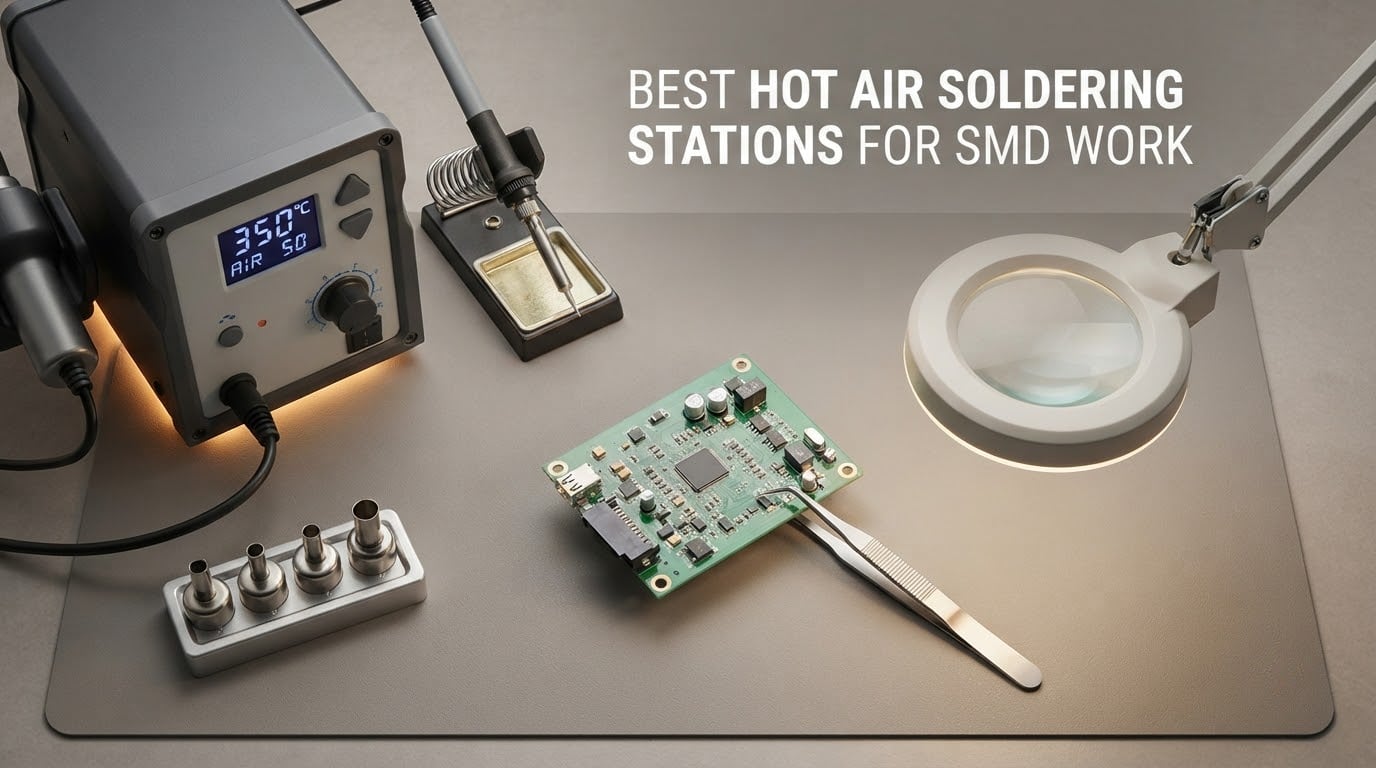
Surface-mount work punishes guesswork. A component sitting flush on a board has no pin to hook, no through-hole to lever against, and no tolerance for a soldering iron that lingers a second too long. That is exactly why the best hot air soldering stations for SMD work have become the first tool most repair benches buy and the second tool most beginners regret not buying sooner.
We spent weeks putting ten of the highest-rated stations on the bench, working through 0805 passives, QFN pads, phone-board connectors and shield cans, and comparing how each one behaved when the airflow was dialled back. The results matter because a hot air rework station is not simply a hot iron with a blower attached. Temperature is only half the equation, and the stations that survive fine-pitch work are rarely the ones with the biggest number on the box.
Below you will find every station we tested, ranked, with the package sizes each one handles cleanly and the jobs where it struggles. If you are still choosing an iron rather than a rework gun, start with our soldering iron picks for PCB work and our soldering station guide for circuit repair, then come back here for the hot air side of the bench.
Table of Contents
- Top 3 Hot Air Stations for SMD Work in 2026
- 10 Best Hot Air Soldering Stations for SMD Work (October 2026)
- What Is a Hot Air Soldering Station?
- 1. YIHUA 862BD+ – The Most Complete Bench Station
- 2. YIHUA 8786D I – Best Value for a New Bench
- 3. WEP 882D – The Best Small-Bench Starter
- 4. YIHUA 959D – Best for Large SMD Packages
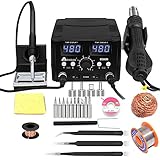
- 5. MYPOUOS 8588D – Best for Fast Heat-Up
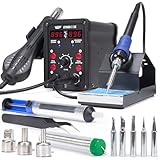
- 6. WEP 8786D-I SE – Best for Light Duty SMD Work
- 7. WEP 8858-V – Best for a Small or Shared Workbench
- 8. MeFix 8586 – Best for Standard-Size Tips and Nozzles
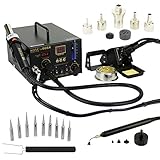
- 9. Aoyue 968A+ – Best for a Full Repair Shop Bench
- 10. LRT 858D – Best Value Hot Air Only for BGA and Port Work
- How to Choose a Hot Air Station for SMD Work in 2026
- 1. Temperature range and PID stability matter more than wattage
- 2. Airflow is the second control, not an afterthought
- 3. Nozzle and tip selection by component package
- 4. Preheaters and thermal shock on large boards
- 5. 2-in-1 versus hot air only
- 6. Clones, genuine units and the support question
- 7. Budget tiers and how to spend the money
- 8. Consumables and safety
- Frequently Asked Questions
- The Best Hot Air Soldering Station for SMD Work in 2026
Top 3 Hot Air Stations for SMD Work in 2026
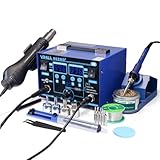
YIHUA 862BD+ 2-in-1 Station
- 2-in-1 soldering iron and hot air rework
- ETL certified
- PID with 20ms sensing cycle
- Three digital displays

YIHUA 8786D I 2-in-1 Station
- Dual tool system with dual displays
- PID fast temperature compensation
- ESD safe anti-static design
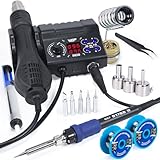
WEP 882D 2-in-1 Station
- 2-in-1 in a compact body
- PID with adjustable air volume
- Calibration and auto shutdown
10 Best Hot Air Soldering Stations for SMD Work (October 2026)
| Product | Specifications | Action |
|---|---|---|
| YIHUA 862BD+ |
|
Check Latest Price |
| YIHUA 8786D I |
|
Check Latest Price |
| WEP 882D |
|
Check Latest Price |
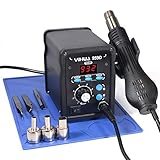 YIHUA 959D YIHUA 959D |
|
Check Latest Price |
 MYPOUOS 8588D MYPOUOS 8588D |
|
Check Latest Price |
 WEP 8786D-I SE WEP 8786D-I SE |
|
Check Latest Price |
 WEP 8858-V WEP 8858-V |
|
Check Latest Price |
 MeFix 8586 MeFix 8586 |
|
Check Latest Price |
 Aoyue 968A+ Aoyue 968A+ |
|
Check Latest Price |
 LRT 858D LRT 858D |
|
Check Latest Price |
What Is a Hot Air Soldering Station?
A hot air soldering station is a rework tool that blows a stream of heated air from a temperature-controlled nozzle onto a joint, melting the solder without touching the component. That contactless approach is what makes it the standard way to remove and replace surface-mount parts.
Inside the handle sits a heating element and a small blower. Air is drawn through the element, heated to the setpoint, and pushed through a ceramic or metal nozzle sized to the part you are working on. The solder melts on its own, the component loosens, and you lift it out with tweezers.
Two controls decide the outcome. Temperature sets how quickly the joint goes molten, and airflow sets how aggressively that heat is delivered. Push airflow too high on a 0402 capacitor and the part launches off the board before the solder even finishes flowing.
1. YIHUA 862BD+ – The Most Complete Bench Station
YIHUA 862BD+ SMD ESD Safe 2 in 1 Soldering Iron Hot Air Rework Station °F /°C with Multiple Functions
2-in-1 soldering and hot air
392-896F solder,200-896F air
3 digital displays
ETL certified
Pros
- Three separate readouts for iron temperature
- hot air temperature and air volume
- PID sensing every 20 milliseconds
- Non-volatile memory recalls your C and F settings
- Detachable gun and iron replace individually
- ETL certified with a very complete accessory kit
Cons
- Airflow at full blast can strip small components
- Heating runs a few degrees below the setpoint out of the box
- Delicate multi-pin gun connector
The 862BD+ is the station we kept reaching for, and the reason is unglamorous: it is the only one in this group that shows you all three numbers at once. Iron temperature on one display, hot air temperature on the second, simulated air volume on the third. On a real repair that difference is enormous, because you can dial airflow down to a third and watch it register without guessing.
The PID loop samples every 20 milliseconds, which is a tighter cycle than most of the field. In practice the recovery is quick enough that a second component on the same board comes off at the same temperature as the first, and the non-volatile memory means a job interrupted for lunch comes back to the same numbers.
The kit list is the strongest argument for it. Five SGS-certified tips, four nozzles, solder roll, ESD tweezers, a desoldering pump, brass wool, a sponge and an IC popper arrive in the box, so you are not ordering consumables before your first job. The hot air gun and the iron both detach into separate safety receptacles, which matters when a cable frays and you do not want to replace the whole station.
Owners report years of continuous service and responsive manufacturer support, and the ETL certification is a genuine differentiator in a category where certification is often missing. Dimensions of 4.88 by 9.8 by 7.36 inches mean it fits a normal bench shelf without stealing the whole surface.
When this station earns its price
It earns it the moment you stop working on one board type. The air volume readout and the tight PID loop are what make fine-pitch QFN work repeatable rather than a coin flip, and the 0-99 minute sleep timer protects the iron during long inspection sessions. If your work runs past 0805 parts, this is the one to build a bench around.
Two-channel architecture is also why it appeals to a mixed workload. Through-hole assembly on the iron and SMD rework on the gun happen at the same time, on two different temperature programs, without either one being an afterthought.
Where it will frustrate you
The setpoint offset is real and uncalibrated from the factory, so check actual tip temperature with a probe before you trust a datasheet-critical board. And the airflow warning is worth learning: the gun will happily blow a 0402 resistor off a pad if you run it wide open, so start at low volume and add air only when the joint is not moving.
The multi-pin connector between gun and station is the part reviewers flag as delicate. Treat the cable gently at the base and it will not be an issue over a normal service life.
2. YIHUA 8786D I – Best Value for a New Bench
YIHUA 8786D I 2 in 1 Hot Air Rework and Soldering Iron Station with 10 Solder Iron Tips, 4 Hot Air Nozzles, °F /°C, Cool/Hot Air Conversion and Sleep Function
2-in-1 solder and hot air
200-896F range
Dual displays
ESD safe
Pros
- Dual displays and independent power switches for both tools
- PID with fast temperature compensation
- 1.8F temperature stability is the tightest figure in this group
- Airflow-loss fail-safe cuts power when the gun stops blowing
- Ten iron tips
- four nozzles
- IC extractor
- pump and solder included
Cons
- Single channel with one readout for two tools
- Compact footprint leaves little bench storage
- 110-127V mains only
With more than 2600 ratings and 73 percent five-star results, the 8786D I is the most thoroughly exercised station here. The stability figure of 1.8 degrees Fahrenheit is the tightest published number in this roundup, and on a 740W combined draw that stability holds up under load rather than only at idle.
Fast temperature compensation is the underrated feature. The gun is lifted, pointed at a pad, and the element corrects hard in the first second, which is the difference between a clean lift and thirty seconds of waiting with the board cooking.
The accessory count is the quiet winner here. Ten soldering tips, four hot air nozzles, an IC extractor, a desoldering pump and lead-free solder wire cover everything from through-hole joints to small SMD passives without a second order. For a first bench, that completeness removes the most common beginner stall, which is not the station but not having the right tip on hand.
Owners repeatedly single out the airflow control as genuinely useful for component removal, and the ESD-safe anti-static design is a sensible default for boards that carry sensitive parts. The UL compliant listing is another point in its favour.
When this station is the right buy
It is the right buy for a hobbyist or a technician building a first bench, because the accessory kit removes a whole category of early frustration. The 1.8F stability also makes it a solid choice for anyone doing repetitive connector replacements where consistency matters more than raw power.
Pair it with the tip approach we recommend in our beginner soldering kit guide and you have a workable bench the same afternoon.
Where it will frustrate you
One readout for two tools is the compromise. If you regularly switch between iron and gun at different temperatures, you are re-setting more than you would on a two-channel station, and a misread setpoint is easy under bright bench lighting.
The chassis is compact at 5.8 by 3.9 by 5.3 inches, which is a win for a small desk and a loss for accessory storage. Plan on a separate holder for tips and nozzles rather than expecting the unit to hold everything.
3. WEP 882D – The Best Small-Bench Starter
WEP 882D Soldering Iron Station 2-IN-1 SMD Hot Air Rework Station with 2 Spools of Solder Wire, 5 Soldering Tips, 3 Hot Air Nozzles, Brass Wool Tip Cleaner, Tweezers, Desoldering pump
2-in-1 solder and hot air
392-896F iron,212-896F air
1.1 kg
Top-10 category rank
Pros
- Individual LED displays
- power switches and temperature buttons for both tools
- PID on the iron and the gun with variable air volume
- Sleep mode
- standby
- C/F conversion
- auto shutdown and calibration
- Kit includes two spools of solder
- five tips
- brass wool
- pump
- tweezers and three nozzles
- Ranked in the top ten of its category so parts are easy to find
Cons
- Single shared display channel
- Very small 5.9in footprint
- 110-127V rated
The 882D is the smallest complete bench package we found, and at 3.54 by 5.9 by 2.28 inches with a 1.1 kg weight it is the one we would actually put on a cramped desk. Both tools get their own LED display, power switch and temperature buttons, which is more control surface than most units in this size class offer.
That set of built-in functions is what separates it from generic clones. Sleep mode for the iron, standby for the gun, Celsius to Fahrenheit conversion, automatic shutdown and a calibration function all live in the firmware rather than in a manual you will not read.
Variable air volume matters more than the wattage figure suggests. A 750W element that can be throttled to a gentle stream removes 0402 parts cleanly, while the same element at full output would scatter them. Dialing air down and temperature up is the correct pairing for fine SMD work.
The bundled kit is unusually complete for a compact model: two spools of solder, five tip types including I, B, K, 3.2D and 3C, brass wool, a desoldering pump, tweezers and three nozzles. With 75 percent five-star ratings, reviewers describe straightforward controls, quick heat-up and a package you can start SMD work with immediately.
When this station is the right buy
It suits a small desk, a shared workbench or a first repair kit for a family member. The combination of separate controls per tool and a full accessory set means nothing is missing on day one, and the calibration function gives you a way to correct the setpoint without opening the case.
Its category sales rank is unusually high for a compact unit, which means replacement tips and nozzles are straightforward to find when you need them. That matters more than most buyers realise.
Where it will frustrate you
The shared display channel is the same limitation as the 8786D I, and the footprint that makes it attractive also makes it cramped the moment you spread out a large board. Do not buy it for laptop logic board work where you need bench space to rotate the assembly.
Everything here is rated for 110-127V. Outside North America you will need to check the local supply before committing.
4. YIHUA 959D – Best for Large SMD Packages
YIHUA 959D-Digital Hot Air Rework Station, High Power with 3 Memories, Airflow Efficiency, °F /°C Display, Accurate Temp.(212°F~932°F), Brushed Aluminum Panel & Safety Features
Hot air only
120L/min airflow
3 memory channels
Up to 932F
Pros
- 120L/min airflow clears heat off large components and bigger boards
- Three preset memory channels recall saved temperatures in one press
- Reaches up to 932F for shielded and potted assemblies
- Brushed aluminum panel resists scorch marks
- In-holder standby cools the gun automatically
Cons
- Hot air only so a separate soldering iron is required
- Looser temperature stability than the 8786D I
- Larger chassis for a bench
Where the 2-in-1 stations split their airflow budget between two tools, the 959D devotes the entire system to rework. That is why it reaches 120L/min, and why it is the pick here for large packages, big ground pads and the heat-sinking jobs that stall a smaller blower.
The three preset memory channels are the feature we use most. A phone board rework session might cycle between 380F for a connector, 420F for an IC and a lower soak setting, and having all three one press away removes the fumbling that causes pad damage.
The brushed aluminum front panel is a small but real quality detail. Iron resting against a plastic faceplate leaves a scorch; this one shrugs it off. In-holder standby means the gun cools automatically when you park it, which extends element life and stops the nozzle cooking itself.
At 12.01 by 8.35 by 7.48 inches and 1.88 kg it is the largest chassis here, which is a fair trade for airflow. The box includes a detachable gun, a silicone work mat, two ESD-safe tweezers and three nozzles.
When this station is the right buy
Buy it if your work includes big thermal masses, shielded assemblies or repeated heating of the same board, because airflow authority is what keeps a large joint moving instead of cooking the surrounding laminate. The preset channels also suit anyone who alternates between component families all day.
It pairs well with a dedicated iron for assembly work. Our hobbyist soldering iron picks cover that half of the bench if you need one.
Where it will frustrate you
There is no soldering iron in the box. If your work includes any through-hole assembly, you are buying a second bench tool regardless, so factor that into whether the airflow advantage justifies it.
The published temperature stability is looser than the 1.8F figure on the 8786D I. In practice the recovery is fine for large work, but if you run very fine pitch work you will want to work closer to the setpoint and watch the readout.
5. MYPOUOS 8588D – Best for Fast Heat-Up
MYPOUOS 2 IN 1 750W LED Digital Soldering Station Hot Air Gun Rework Station Electric Soldering Iron For Phone PCB IC SMD BGA Welding SET 110V (8588D SET1)
750W 2-in-1
100C-480C range
Tolerance within 2C
Ceramic core element
Pros
- Ceramic-core element holds temperature more consistently than mica-core budget designs
- Reaches usable soldering temperature in about 10 seconds
- Separate power switches and readouts for both tools
- Fully grounded internal wiring
- Very large bundle of tips
- nozzles
- tweezers
- puller
- solder and pump
Cons
- Blue LED display is hard to read in direct light
- Bundled wick and brass wool are low quality
- No master power switch
- Display can read below actual temperature
The 8588D reaches usable soldering temperature in roughly ten seconds, and that speed comes from the ceramic-core element rather than from raw wattage. Ceramic elements recover faster and hold their curve better than the mica cores most budget stations use, and you feel the difference on the second and third component of a job.
Setpoint increments of one degree Celsius across a 100C to 480C range give fine control, with a stated tolerance within 2C. Dual control switches and separate readouts keep the iron and the gun independently manageable, and the handle induction system cools the gun automatically when you park it.
Owners who have opened the unit report fully grounded internal wiring, which is reassuring on a tool that sits on an ESD-sensitive bench for hours. Long-term owners report more than four years of reliable service, and the bundle includes ten tips, four nozzles, three tweezers, an IC puller, solder and a desoldering pump.
The anti-static design with fault self-detection and warning is a sensible inclusion for SMD work, where a static event costs a part that costs more than the board did.
When this station is the right buy
Short bench sessions are where it shines. If you do a handful of SMD repairs a week rather than a full day of production rework, the ten-second heat-up and the one-degree setpoint steps remove the dead time that makes budget stations feel slow.
It is also a good match for anyone who likes the fast correction of a ceramic element but does not want to pay for a dedicated hot air only station.
Where it will frustrate you
The untinted blue LED is genuinely hard to read in daylight, and a misread setpoint on a fine-pitch job is exactly the mistake that lifts a pad. Angle a bench lamp off the panel if you work in a bright room.
There is no master power switch, so the station has to be switched off at the outlet after cooling, and the iron sleep mode cannot be disabled. Several reviewers also report the bundled wick and brass wool are low quality, so plan to replace the consumables rather than trust them.
6. WEP 8786D-I SE – Best for Light Duty SMD Work
WEP 8786D-I SE Hot Air Soldering Iron Station Kit 2-IN-1 for Rework, Desoldering with Lead-Free Solder Wire, 5 Soldering Tips, 3 Hot Air Nozzles,Tweezers, Desoldering Pump
2-in-1 with PID
392-896F iron,212-896F air
1.69 kg
Compact
Pros
- Light
- compact and sturdy with quick heat-up
- PID stabilisation on the iron and the gun plus a dedicated air volume knob
- Standby in the holder cools the gun to 212F
- Clean removal of small parts reported by owners
- Kit includes enough consumables to start immediately
Cons
- Weak heat transfer to larger components and heavy copper
- Some supplied tips do not fit the storage rack
- No guidance on where to order replacement tips
The 8786D-I SE is a light-duty station and behaves like one, honestly. Owners report clean removal of an eMMC from a phone board, and the PID stabilisation on both tools plus a dedicated air volume knob is more control than most units at this weight offer.
Standby cooling in the holder takes the gun down to 212F and stops heating, which does real work for element longevity. A ten-minute iron sleep mode covers the other half of the bench.
At 1.69 kg and 5.91 by 3.94 by 5.12 inches it is easy to move, which matters if you work between a bench and a kitchen table. The kit supplies solder wire, a desoldering pump, tweezers, three nozzles and five tips in I, B, K, 3.2D and 3C shapes.
Reviewers rate it as good value for light SMD and rework, with several calling out the air volume knob and temperature control as standouts. The 4.4 rating with 74 percent five-star results reflects a station that does a defined job well.
When this station is the right buy
It suits hobby work: connector swaps, shield can removal, small passive replacement, prototype fixes. If a session lasts an hour or two rather than a full day, the light build is an advantage and the thermal limits never come up.
It also works well as a second station on a bench that already has a heavy hitter, dedicated to small parts so the big station never has to be dialled down to delicate settings.
Where it will frustrate you
Heat transfer from heater to tip is the recurring complaint. On larger components and heavy copper the iron lags, and some owners worked around it with copper tape or thermal compound, which tells you the tool was not designed for that class of joint.
It is not rated for professional high-volume desoldering, and quality control is uneven: some tips do not fit the storage rack, one nozzle retaining nut was improperly tapped, and there is no guidance on where to order replacements.
7. WEP 8858-V – Best for a Small or Shared Workbench
WEP 8858-V Hot Air Rework Station Kit with Compact Size, Integrated Nozzle Holder, 3 Nozzles, 2 Tweezers, Adjustable Temperature& Air Volume, PID Program, °C/°F Conversion and More
Hot air only
3.5 by 4.6 by 2.4 in
PID control
Digital calibration
Pros
- Palm-sized body with integrated gun and nozzle holders
- Single panel knob for air volume with no menu navigation
- Digital temperature calibration plus C/F conversion
- Hot air fail-safe during rework
- Includes three extra nozzles and bent and straight tweezers
Cons
- Hot air only with no soldering iron
- Listed 22W figure limits sustained bulk work
- Small LCD is harder to read at a glance
This is the smallest station here, and the design shows it was built around a real constraint: benches that are already crowded. At 3.5 by 4.6 by 2.4 inches with the hot air gun holder and nozzle holder moulded into the top, it keeps its accessories attached instead of scattered.
The air volume control is a single knob on the panel. No menu, no mode button, no second press to confirm, which is exactly the kind of detail that matters when you are doing small SMD work one-handed while holding a board in the other.
Digital temperature calibration is a genuine convenience at this tier, because a small station is also usually an uncalibrated one. Being able to correct the readout against a known reference takes a minute rather than a teardown.
With 76 percent five-star ratings, buyers consistently point to the small footprint, the tidy integrated holders and the no-menu air control. The 4.5 rating is consistent with a station that knows its limits.
When this station is the right buy
It fits a shared bench, a dorm room or a repair trolley where footprint is the binding constraint. For intermittent small-part work, 0201 and 0402 passives, and light touch-ups, the controls are all genuinely there.
It is also a sensible travel unit. Pack it with the three extra nozzles and both tweezers and you have a working rework corner out of a bag.
Where it will frustrate you
The listed wattage is 22W, far below the 700W and 750W figures the other stations here carry. That is fine for delicate work with pauses, and it is not fine for sustained bulk reflow or large ground pads. Judge it on duty cycle, not on peak temperature.
There is no soldering iron in the box, and the small LCD is less readable than the larger displays on the bigger units when you are changing settings quickly.
8. MeFix 8586 – Best for Standard-Size Tips and Nozzles
MeFix 8586 Soldering Station 2 in 1 Functions Electric Iron SMD Hot Air Rework Station
2-in-1 solder and hot air
200-500C range
PID on both tools
Auto sleep
Pros
- Both tools heat up quickly and the iron holds a good tin
- Multiple airflow nozzle patterns focus air on different component sizes
- Standard replacement tip sizing makes spares easy to find
- Control box stays cool to the touch after hours of work
- Compact footprint suits a hobby electronics bench
Cons
- Hot air safety cut-off only allows downward-pointing use
- Several buyers report the hot air gun failing within a year
- Darkened tip residue or a faulty switch on some examples
The 8586 covers a 200C to 500C range, which covers the working range for most SMD rework. The SET button toggles the single display between the hot air gun and the iron, so one readout serves both tools without a second channel.
Standard sizing on the replacement tips is the underrated advantage. When a tip oxidises or a nozzle cracks, you replace the consumable instead of hunting for a proprietary part, and the kit ships with five tips in I, B, K, 2.4D and 3C shapes plus four hot air nozzles.
Owners note the control box staying cool to the touch after three hours of continuous reflow work, which is a reasonable indicator that the case is not trapping heat where it matters. Multiple nozzle patterns let you concentrate air on a small connector or spread it across a wide pad.
With 76 percent five-star ratings, hobbyists cite fast heat-up, compact size and standard tip sizing as the reasons they keep coming back to it for daily light board work.
When this station is the right buy
It is a good daily driver for hobby electronics where the work is board-level and mostly top side. The auto sleep when the gun goes back in the stand is exactly right for intermittent sessions, and standard tips mean your consumables cost stays low.
Choose it over a generic kit when tip availability is your concern, because that is where no-name stations quietly cost you more in spares over a year.
Where it will frustrate you
The auto sleep is tied to the gun’s orientation, so hot air only works when the gun points downward. That makes heating the underside of a board, or working on a stacked assembly, genuinely hard. Plan your board orientation around it.
Several buyers report the hot air gun failing within days to a year, and some arrived with a darkened tip, residue or a non-functioning switch. Buy it for occasional work rather than as a production tool.
9. Aoyue 968A+ – Best for a Full Repair Shop Bench
New Aoyue 968A+ SMD Digital Hot Air Rework Station… (110)
4-in-1 platform
70W soldering iron
Built-in smoke absorber
1-year warranty
Pros
- Only station here combining hot air
- a 70W iron
- vacuum pickup and smoke absorber in one box
- Integrated smoke absorber cuts fumes during long rework sessions
- Established workshop brand with a 1-year manufacturer warranty
- Digital readout for temperature
- Suited to SMD
- PCB and through-hole repair
Cons
- Hot air gun permanently docked in the base so it is not portable
- Soldering iron is only 70W
- Large and heavy at 11 pounds
The 968A+ solves a problem none of the other nine address: fumes. The built-in smoke absorber, paired with a vacuum pickup tool, keeps a bench usable through a long session of lead-free rework, and in a shared room that is worth more than another hundred watts of heating element.
It is the only true four-in-one here, combining hot air rework, a 70W soldering iron, the vacuum pickup and the smoke absorber in a single base. Buyers consistently identify the absorber and the pickup as what separate it from a basic two-tool station.
Aoyue is a recognised workshop brand and the unit carries a 1-year manufacturer warranty, which is meaningful when your income depends on the tool. With 75 percent five-star ratings the owner satisfaction is solid for a platform of this type.
The tradeoff is permanence. At 11 pounds and 5.91 by 12.17 inches it is a bench fixture, not a portable tool, and the gun stays docked in the base rather than living on a cradle you can move.
When this station is the right buy
It makes sense for a repair shop or a shared electronics room where air quality is a real constraint and you want hot air, iron and extraction in one footprint. The vacuum pickup also speeds up handling of loose SMD parts, which is where small components usually get lost.
If you work on larger mixed boards, the combination means you are not shuttling between three boxes at the bench.
Where it will frustrate you
The soldering iron is 70W, which is modest next to the iron in most of the 2-in-1 stations here. Heavy through-hole joints and large thermal masses will outrun it, so plan on a separate iron for that work.
It is also the largest and most fully equipped platform in this roundup while carrying a much lower category sales rank than the entry-level units, so expect fewer spare parts listings. And because the gun is docked, this is a station you dedicate to one bench rather than carry around.
10. LRT 858D – Best Value Hot Air Only for BGA and Port Work
LRT 858D 700W Digital Hot Air Rework Station for PCB IC SMD Repair
700W heating
100-450C range
Brushless blower fan
Lead-free rated
Pros
- 700W element heats fast and recovers temperature quickly on repeated jobs
- Brushless fan gives steadier and quieter airflow than brushed-motor budget units
- Adjustable temperature and airflow for delicate SMD parts
- Lead-free compatible element rated for continuous operation
- Suited to PCB repair
- IC removal
- BGA rework and USB-C port replacement
Cons
- Hot air only with no soldering iron in the box
- Low category sales rank versus the better-reviewed units
The LRT 858D is the spec standout in the hot air only group. A 700W heating element and a brushless blower fan together give steadier airflow and faster temperature recovery than the brushed-motor budget units at a similar level, and that combination is what makes it the one we would pick for BGA and connector port work.
Airflow consistency is the reason. A brushless fan does not pulse the way a cheap brushed motor does, so the air column stays even, which is what allows a large footprint nozzle to heat a wide BGA array without one corner lagging.
The lead-free compatible element is rated for continuous operation, which matters if you run long reballing sessions rather than one-off fixes. The digital LED readout with adjustable temperature and airflow covers a 100C to 450C range, and the ergonomic handle is comfortable across a full session.
Reviewers cite it as suited to PCB repair, IC removal, BGA rework and USB-C port replacement, which is a broad list for a rework-only unit.
When this station is the right buy
It fits a repair bench that already has a good iron and only lacks rework capability. The 700W element with a brushless fan is a genuine step up from the small hot air only kits, and its airflow consistency is the deciding factor on large-footprint parts.
For BGA work and port replacement, the even air column matters more than raw peak temperature, and this unit delivers it.
Where it will frustrate you
There is no soldering iron in the box, so through-hole and assembly work needs a second tool. The 3-pound weight is heavier than the palm-sized alternative but still portable enough to move between benches.
Its category sales rank is much lower than the better-reviewed units here, so expect fewer spare parts listings. Check nozzle availability before committing to it as your only station.
How to Choose a Hot Air Station for SMD Work in 2026
1. Temperature range and PID stability matter more than wattage
Every station here reaches the temperatures SMD work needs. The difference is how tightly they hold them. A station listed at 1.8F stability keeps the same joint temperature for the whole lift, while a looser figure drifts as the element cycles, and drifting heat is what turns a clean removal into a pad you have to repair.
Useful ranges cluster around 200C to 500C for rework, and 100C to 480C gives you a low soak setting for heat-sensitive parts. Look for a PID loop with a short sensing cycle, because that is what makes recovery between components fast rather than merely possible.
2. Airflow is the second control, not an afterthought
Most buying guides talk about temperature and ignore airflow, which is a mistake. Airflow decides how aggressively heat is delivered: too much and a 0402 resistor is blown off the board, too little and a large ground pad never reaches melting point no matter what temperature you set.
For fine SMD work the correct pairing is high temperature with low to medium air volume. For large packages and shielded assemblies, drop the temperature and open the airflow so you move heat away from the board instead of into it. Stations with a real air volume readout make this far easier to get right.
3. Nozzle and tip selection by component package
Matching the nozzle to the package is the single highest-leverage decision in SMD rework. The nozzle should be roughly the same width as the part’s footprint, so heat lands on the joint and the surrounding board stays cool.
0201 and 0402 passives: the smallest nozzles, 2 to 3 mm, with low airflow. Work at the higher end of the temperature range or the joint will not move.
0805 and 1206 passives: a 4 to 5 mm nozzle with moderate airflow. This is the comfortable middle ground for most bench work.
SOD and SOT packages: a 5 to 6 mm nozzle. Wide feet need broad, even heat rather than a focused jet.
QFN and DFN: a nozzle matched to the exposed pad, with airflow reduced so neighbouring components stay put.
QFP and TQFP fine pitch: a wide flat nozzle that heats the whole perimeter evenly. One SparkFun community user pairs a 900M-T-B tip for general SMD work with a 900M-T-K chisel for fine-pitch TQFP, which is the same logic applied to iron tips.
BGA arrays: the largest nozzle you can fit around the package, with steady airflow to keep the whole array molten at once.
For iron-tip questions rather than nozzle questions, a fine chisel or conical tip around 1.2 to 1.5 mm paired with a fine nozzle is the starting point for micro soldering.
4. Preheaters and thermal shock on large boards
Large PCBs with heavy ground planes and multilayer construction absorb heat fast, so the underside of the board cools while the top heats. That gradient is thermal shock, and it shows up later as delamination or a crack running through the laminate. A preheater brings the whole board up to temperature slowly before you apply hot air, which reduces the gradient.
None of the ten stations here includes a dedicated preheater platform, so the practical substitutes are a heat lamp or a controlled warm plate under the board, plus patience with the ramp. Raising the air temperature to compensate is the wrong lever; it widens the gradient rather than narrowing it.
5. 2-in-1 versus hot air only
A 2-in-1 station packages an iron and a hot air gun in one chassis. Six of the stations here do that, and for a beginner it removes an entire decision, an extra power cord and an extra bench footprint. The compromise is usually one shared display channel and a smaller heating element per tool.
Hot air only stations such as the 959D, the 8858-V and the LRT 858D put the full element and blower budget behind rework. That is the right choice if you already own a good iron, or if rework is most of what you do. The wrong choice is buying a hot air only station as your very first tool and then discovering you cannot solder a through-hole joint at the bench.
6. Clones, genuine units and the support question
The most argued topic in the forums is whether a low-cost unit that shares a design with an established model is good enough. One r/soldering user reported buying an 861DW clone to play around with and found after about two years that it works just as well as a genuine unit, which is a common verdict. An EEVblog user recommended the genuine Atten AT-858D+ as a good hot air choice at a modest cost.
Both experiences are real, and the honest summary is this: for board-level SMD rework, a well-built unit in this class performs comparably to a genuine one. Where the difference shows up is support, spare parts and calibration, not heat output. If your income depends on the tool, buy the station with a warranty and a replaceable handle, because a failed heater on a no-support unit is an entire re-purchase rather than a part.
7. Budget tiers and how to spend the money
The ten stations here fall into three natural tiers, and the decision inside each tier is about which control you refuse to give up. In the entry tier, the choice is between a full 2-in-1 kit and a compact hot air only unit. In the middle tier, you are paying for temperature stability, air volume control and detachable handles. In the upper tier, you are paying for fume extraction and a warranty.
Spend within the tier rather than across it. Adding a hundred watts of heating does not help a desk that has no room for a preheater or a holder, and a stability figure twice as tight will change your results far more than a faster heat-up on the first component. Buy the accessories that match your actual package sizes, because a station with the right temperature and the wrong nozzle still fails.
8. Consumables and safety
Replace nozzles when the inner wall scores, not when they look dirty, because a scored nozzle disrupts the air column and makes temperature readings unreliable. Keep tips tinned, park the gun in its holder so standby cooling works, and never point a hot air gun at a plastic bench mat while it is at temperature.
Work on an ESD-safe surface with a grounded bench, and treat any board with a large exposed pad as a heat source in its own right. Our circuit repair station guide covers the surrounding bench setup in more detail.
Frequently Asked Questions
What is the best soldering station for SMD soldering?
For SMD soldering specifically, the best all-round choice is the YIHUA 862BD+, because it is a 2-in-1 station that shows soldering temperature, hot air temperature and air volume on three separate displays while running a PID loop with a 20 millisecond sensing cycle. That third readout is what lets you remove 0402 and 0805 parts without blowing them off the board. For purely through-hole and general assembly work, any of the compact 2-in-1 kits here will do the job.
What is the best soldering station for micro soldering?
Micro soldering under a magnifier rewards a fine chisel or conical tip, steady temperature and a light hand rather than a powerful station. The YIHUA 862BD+ suits it because the iron and the hot air gun hold independent settings, so you can drop to 392F for fine work without disturbing a job parked on the gun. Keep a 1.2 to 1.5 mm tip in the kit for fine-pitch work and use a small nozzle with reduced airflow whenever hot air is involved.
What is the best hot air soldering station?
The YIHUA 862BD+ is the best hot air soldering station overall, rated 4.6 stars across 2273 reviews, with a 20 millisecond PID sensing cycle and the highest published temperature stability in this group. If you want hot air only, the YIHUA 959D leads on airflow at 120L/min and preset memory channels, while the LRT 858D is the pick for large footprints because its brushless fan produces the steadiest air column.
Which soldering tip for SMD?
Use a fine chisel or conical tip of roughly 1.2 to 1.5 mm for general SMD work, and a wider chisel for fine-pitch packages such as TQFP. For hot air work, match the nozzle to the component footprint: 2 to 3 mm for 0201 and 0402 passives, 4 to 5 mm for 0805 and 1206, 5 to 6 mm for SOD and SOT, and the largest nozzle that fits around a QFP or BGA so the whole area heats evenly.
Do I need a hot air station for SMD work?
Yes, for removal. Surface-mount components sit directly on the board with no through-hole and no pin to lever against, so an iron cannot get underneath to desolder them. Hot air heats the solder from above uniformly, which is what makes BGA removal, QFP lift-off and fine-pitch rework possible at all. A soldering iron remains the better tool for placing and soldering small new parts, so a 2-in-1 station covers both halves of the job.
The Best Hot Air Soldering Station for SMD Work in 2026
The YIHUA 862BD+ takes our Editor’s Choice for one reason: it is the only station here where air volume, iron temperature and hot air temperature are all visible at the same time, and that visibility is what makes fine-pitch SMD work repeatable. Its 20 millisecond PID cycle, ETL certification and detachable handles make it the safest long-term bench to build around.
Match the buyer to the job instead. The YIHUA 8786D I is the strongest first bench, with the tightest published stability in the group and the most complete accessory kit. The WEP 882D is the pick when bench space is the binding constraint. The YIHUA 959D leads on airflow for large packages, the LRT 858D for brushless airflow consistency on BGA and port work, and the Aoyue 968A+ is the only one of the ten that solves fume extraction for a shared repair room.
Whichever you choose, the nozzle has to match the footprint and the airflow has to come down for small parts. Get those two right and the station choice matters much less than most roundups will tell you. Test the setpoint with a probe on your first job, and check the latest listing details before you commit.