
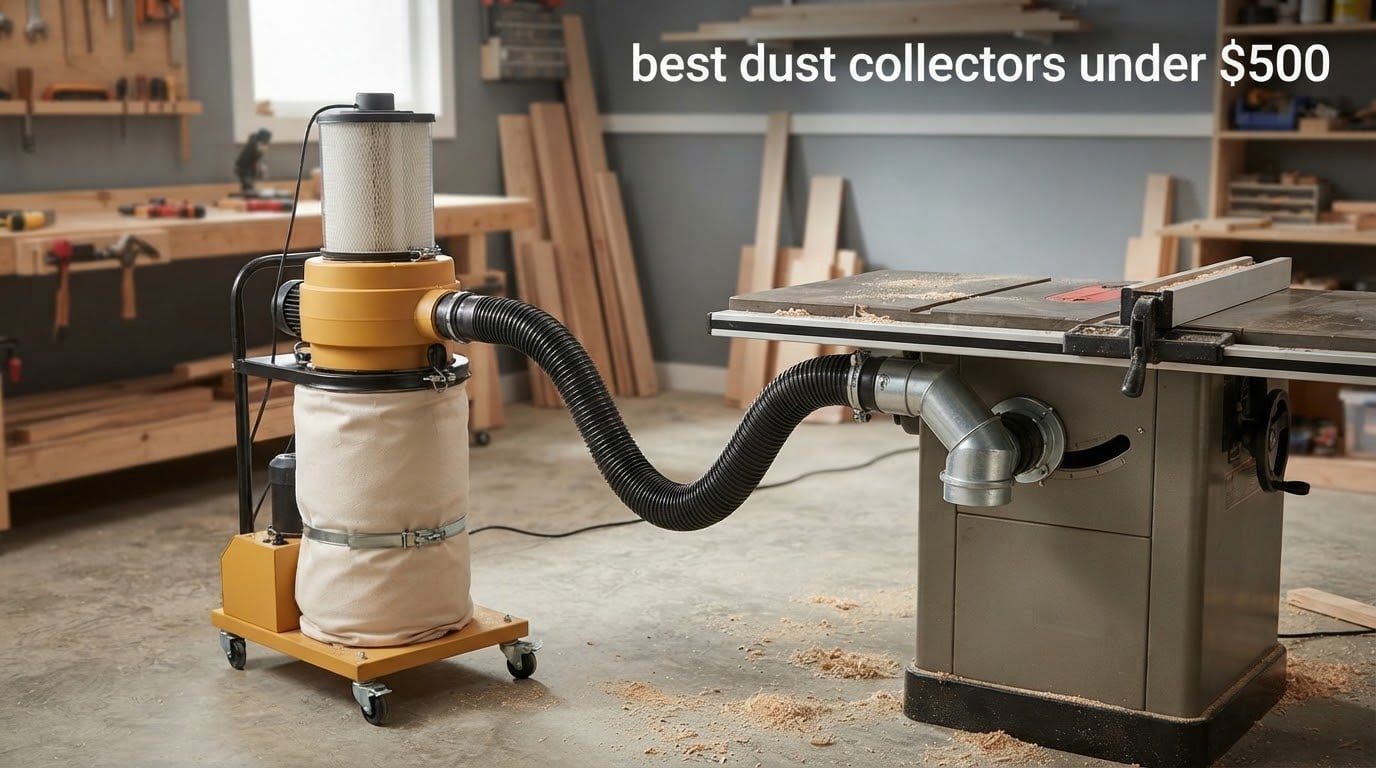
Most dust collector roundups quietly ignore the number in the search box. This one does not. Every machine below was picked against a hard ceiling of 500 dollars, and I kept the list to collectors you can actually buy today rather than a wish list of commercial equipment priced in the thousands.
Wood dust is the quiet hazard in a small shop. It stays airborne for hours, it settles into your finishes, and it packs your lungs with particles you cannot see. Capturing it at the machine is the only approach that works, and a collector below the 500 dollar ceiling is now a realistic option for a one-car garage or a spare-room workshop. Our wider guide to dust collectors for woodworking shops covers the whole category, including machines that cost several times this budget.
Here is the short version before the detail. If you want my direct answer: the best dust collector under 500 dollars is the one whose motor matches the biggest chip-making machine you own and whose amperage fits the circuit you can dedicate to it. Everything else is preference.
Best overall: WEN DC1300, 1300 CFM on a 14-amp motor with two 4-inch inlets.
Best value: POWERTEC DC1081, 1 HP with a 1-micron bag already in the box.
Best for a small shop: Shop Fox W1826, all steel, wall mountable, 7.2 inches of water static pressure.
Best for quiet running: WEN DC3474, a 7.4-amp induction motor that shares a 15-amp circuit easily.
Best for one machine plus a second tool: BUCKTOOL DC50, with a built-in auto-start outlet.
Best for air quality: DEWALT DWXAF101, an H11 HEPA ceiling unit rather than a chip collector.
Best for carving and turning: PSI DC725, a tabletop box drawing 1.29 amps total.
Two quick definitions before the reviews, because this is where most confusion happens. A dust collector moves a large volume of air, typically 500 to 1300 CFM, through 4-inch ducting at low static pressure to pull chips and sawdust off a table saw, planer, jointer, or drum sander. A dust extractor is a smaller high-suction machine with a sealed tank, hose, and HEPA filter, built to attach directly to a handheld sander. A shop vac sits in between, and none of the three connect the same way.
Table of Contents
- Top 3 Dust Collector Picks Under $500 in 2026
- 10 Best Dust Collectors Under $500 (October 2026)
- 1. WEN DC1300: The Most Air You Can Move Below the Cap
- 2. POWERTEC DC1081: 1 HP and 1-Micron Bags in One Box
- 3. Shop Fox W1826: Steel, Compact, and Wall-Mounted
- 4. WEN DC3474: Quieter Induction Motor on a 15-Amp Circuit
- 5. BUCKTOOL DC50: Built-In Outlet Removes the Second Switch
- 6. BUCKTOOL DC30A-1: Remote-Start Wall Unit for One Machine
- 7. WEN DC3401: The Collector That Mounts Or Rolls
- 8. DEWALT DWXAF101: Air Cleaning Instead of Chip Collection
- 9. PSI DC725: Bench-Top Power for Carving and Turning
- 10. Abestorm 780S: Miter Saw Dust on a Timer
- Buying Guide: Match Airflow, Circuit, and Filter to Your Shop
- Frequently Asked Questions
- Conclusion
Top 3 Dust Collector Picks Under $500 in 2026
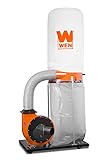
WEN DC1300 1300 CFM Collector
- 1300 CFM airflow
- 14-amp motor
- 50-gallon bag
- Dual 4-inch inlets

10 Best Dust Collectors Under $500 (October 2026)
| Product | Specifications | Action |
|---|---|---|
| WEN DC1300 1300 CFM Dust Collector |
|
Check Latest Price |
| POWERTEC DC1081 1 HP 800 CFM |
|
Check Latest Price |
| Shop Fox W1826 Wall Dust Collector |
|
Check Latest Price |
 WEN DC3474 600 CFM Induction Collector WEN DC3474 600 CFM Induction Collector |
|
Check Latest Price |
 BUCKTOOL DC50 750 CFM Auto-Start BUCKTOOL DC50 750 CFM Auto-Start |
|
Check Latest Price |
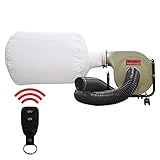 BUCKTOOL DC30A-1 550 CFM Wall Mount BUCKTOOL DC30A-1 550 CFM Wall Mount |
|
Check Latest Price |
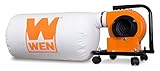 WEN DC3401 660 CFM Rolling Collector WEN DC3401 660 CFM Rolling Collector |
|
Check Latest Price |
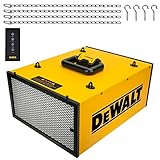 DEWALT DWXAF101 Air Filtration System DEWALT DWXAF101 Air Filtration System |
|
Check Latest Price |
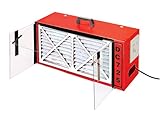 PSI DC725 Tabletop Dust Collector PSI DC725 Tabletop Dust Collector |
|
Check Latest Price |
 Abestorm 780S Tabletop Collector Abestorm 780S Tabletop Collector |
|
Check Latest Price |
1. WEN DC1300: The Most Air You Can Move Below the Cap
WEN DC1300 1,300 CFM 14-Amp 5-Micron Woodworking Dust Collector with 50-Gallon Collection Bag and Mobile Base , Black
1300 CFM airflow
14-amp motor with 10-inch steel impeller
50-gallon bag
Dual 4-inch inlets
Pros
- Moves 1300 CFM and captures most table saw and CNC dust
- Dual 4-inch inlets run two tools from one machine
- Far quieter than several portable shop vacs at once
- Rolls on a mobile base with four swivel casters
- Long bag service interval of about a month or two
Cons
- Tall profile can hit overhead clearance in a low shop
- Three vertical bag supports feel under-built
- Bag support arm is fixed height and not adjustable
Out of every collector under the 500 dollar line, the DC1300 moves the most air by a wide margin. A 14-amp motor spinning a 10-inch steel impeller up to 3450 RPM is a different class of hardware from the 1 HP machines in this list, and the difference shows up the moment you attach a hose to a table saw or a CNC router.
The dual 4-inch inlets are the feature I did not expect to matter as much as they do. You can run a saw and a sander at the same time, or feed a benchtop sanding box from the second port while the first handles the saw. Owners report replacing multiple shop vacs with this one machine and seeing a dramatic change in capture rate.
Noise is the other surprise. For something moving 1300 CFM, owners consistently describe it as far quieter than running two portable vacs at once, and 71 percent of ratings sit at five stars. The 50-gallon vertical bag means you are not emptying it every weekend either.
What you give up is build refinement in the bag assembly. The three vertical support posts feel thin, and the fabric bag loop can slip off its hook often enough that owners reach for tape. The bag support arm is a fixed height, so repositioning under a low ceiling or into a tight corner is not possible without moving the whole base.
Who this collector suits
This is the one to buy if you own a table saw plus a second chip-making machine, or if you run a CNC router. Two inlets and that much airflow let you stop negotiating with a blast gate every time you change jobs.
It also suits anyone who has been fighting a shop vac setup and wants one machine instead of three. You give up nothing that matters at a table saw, and the 14-amp draw fits a standard 15-amp circuit on its own.
Who should skip it
Skip it if your shop has a low ceiling or you plan to store it away between sessions. The tall profile and the fixed-height bag arm are real inconveniences in a garage where the car still lives.
Also skip it if fine dust filtration is your priority. A 5-micron fabric bag is fine for chips and coarse sawdust, but it is not the machine to chase airborne particulate. Look at the POWERTEC or the DEWALT for that.
2. POWERTEC DC1081: 1 HP and 1-Micron Bags in One Box
POWERTEC 1 HP Dust Collector with 1 Micron Dust Collector Bags and Mobile Base, Dust Collectors with 800 CFM for Woodworking Dust Collection System (DC1081)
800 CFM
1 HP 120V and 240V motor at 3450 RPM
1-micron bag
55 lb caster base
Pros
- 800 CFM from a genuine 1 HP motor
- 1-micron bag filters finer than a typical fabric bag
- Quick-release clamps make bag changes fast
- Dual-voltage motor adds installation flexibility
- Caster base serves mobile and central setups
Cons
- At 55 pounds it is heavy to reposition by hand
- Large floor footprint compared with wall-mount or tabletop models
This is the pick I recommend to anyone whose problem is the dust in the air rather than the pile on the floor. Most collectors in this budget include a 5-micron fabric bag, and the POWERTEC includes a 1-micron bag in the box, clamped on with quick-release fasteners. That is the whole reason it is worth the step up in size.
Underneath the bag you get a real 1 HP single-phase motor that runs on 120V or 240V at 3450 RPM and moves 800 CFM. That dual-voltage capability matters more than it sounds, because it gives you a path to 240V later if you end up wanting more headroom, and it makes the machine usable in a shop where you have only a standard outlet available today.
Owners highlight two things repeatedly: the bag clamp convenience and the ability to move the machine between a mobile single-tool setup and a central station feeding several machines. With 66 percent of ratings at five stars and a 4.4 average, the satisfaction is broad rather than concentrated in one use case.
The catch is physical. At 55 pounds this is not a machine you lift onto a shelf, and the base footprint is generous for a garage bay. If your floor space is measured in inches, a wall-mount model will suit you better even with coarser filtration.
When the 1-micron bag earns its cost
It earns its cost if you work with MDF, plywood, or anything that produces a fine, flour-like dust that hangs in the air after the cut. A 5-micron bag lets that material through and back into the room, which defeats the point of running a collector at all.
It also earns its cost if you sand a lot and dislike the fine haze that settles on benches and shelves. The clamp design means a swap takes seconds, so you can run a coarse bag for chips and a fine one for sanding without hunting for tools.
Where it falls short
For heavy chip work from a planer or jointer, 800 CFM is adequate for one machine but not generous. Long duct runs will eat into that number, and the manufacturer does not publish a static pressure figure to help you plan.
If you are starting from nothing and your only machine is a miter saw, this is more machine than you need. Save your floor space and start smaller.
3. Shop Fox W1826: Steel, Compact, and Wall-Mounted
Shop Fox W1826 Wall Dust Collector, 2.5 Micron Filtration,White
537 CFM
1 HP 7-amp motor
7.2 inches of water
4-inch intake
2.5-micron bag
Pros
- All-steel body in a compact footprint
- Wall mount frees up valuable floor space
- Publishes 7.2 inches of water static pressure
- Bag has a viewing window and a bottom zipper
- Easy to rewire from 120V to 240V
Cons
- Suction falls off if the hose steps down too early
- Inlet safety cage traps long shavings until removed
- Some owners report dented shrouds and bent plates on arrival
Most sub-500 collectors are built from plated steel with plastic in a few places. The W1826 is all steel, and it is one of the very few machines in this price band that publishes a static pressure figure. A rated 7.2 inches of water tells you far more about real-world performance than a free-air CFM number, and it is the reason this unit behaves like a collector instead of a very large fan.
It hangs on the wall, which in a one-car garage is the difference between having a collector and having a collector in the way. The bracket uses a locking screw system so it stays put, and at 19.5 by 18 by 44 inches it leaves the floor free for a mobile base or a machine cart.
Owners describe it as markedly quieter than a shop vac system of comparable performance, at a rated 85 dB. The 2.5-micron bag with a viewing window and a bottom zipper is a nicer design than most, because you can see the fill level without guessing and empty from the bottom.
There is a recurring shipping-quality complaint, though. Owners report units arriving with dented shrouds and bent mounting plates. It is cosmetic sheet-metal damage rather than a functional failure, but inspect the box before you sign for it.
How to get the rated performance out of it
The dominant lesson across owner reports is that this behaves as a dust collector, not a vacuum. Use 4-inch hose end to end and keep one blast gate open at a time. When you step the hose down too early, the suction drop is immediate and obvious.
Adding a drum-mounted cyclone separator or a Thien baffle upstream keeps the bag clean and is the single most recommended companion upgrade on woodworking forums. Steel here is a good reason to do it, since a drum setup needs a rigid, stable housing.
What to watch out for
The inlet safety cage is the most common frustration. It traps long shavings from a jointer or planer until you snip it out, which is a five-minute job but catches new owners by surprise.
Also note that the published intake size is a 4-inch hole with no stated inside diameter, so hose fitting takes a little measuring. Buy your hose before the collector, not after.
4. WEN DC3474: Quieter Induction Motor on a 15-Amp Circuit
WEN Woodworking Dust Collector, 7.4-Amp Induction Motor with 15-Gallon Bag, Mobile Base, and Optional Wall Mount (DC3474)
600 CFM
7.4-amp induction motor
9-inch impeller
15-gallon 5-micron bag
Wall mount capable
Pros
- Induction motor is noticeably quieter than a brushed motor
- Uses far less power than a shop vac for more air movement
- Keeps up with a small planer on hardwood
- Wall mount keeps the casters on the unit
- Two-year warranty included
Cons
- Supplied fabric bag is thin and leaks fine dust
- Bag zipper seam can split over time
- Non-locking casters let it roll when switched on
The motor type is the story here. A 7.4-amp induction motor running a 9-inch impeller at 600 CFM is a different design from the brushed motors used in cheaper collectors, and owners upgrading from a shop vac report roughly four times the air movement at about half the power draw and roughly half the noise.
That efficiency is what makes this the most circuit-friendly capable machine in the list. At 7.4 amps it shares a 15-amp household circuit with a table saw in a way the 14-amp machines here cannot, which matters a great deal in a garage with two receptacles.
It holds its own against a small planer on hardwood without clogging, provided you keep hose runs short and respect the 600 CFM ceiling. The wall mount retains the wheels, so you can hang it in the corner and still roll it out when you need the floor.
The single most repeated recommendation across reviews is to replace the supplied fabric bag. It is thin enough to leak visible fine dust, and owners who swap in a thicker 5-micron bag or a canister filter report the leakage disappears entirely.
Why induction motor design matters here
Brushed motors wear through carbon bushings, generate heat, and get loud as they go. Forum owners estimate replacement bushings at roughly every 250 hours on a brushed unit, and the noise curve rises as they wear. An induction motor has no brushes to replace.
For a hobbyist running a few hours a week, that difference in maintenance and noise is larger than the raw CFM gap between this and a 2 HP machine suggests. You are buying predictability, not peak airflow.
Where the supplied design falls down
Two build issues recur. The bag zipper seam can split, and one owner reported the zipper itself failing within a year. The casters are also not locking, so the machine rolls when the switch is flipped, which you will want to fix with a caster lock or a chock.
One more caution: the product photos are mirrored and imply a reversible discharge, which this model does not have. Confirm your hose exit direction against the manual before you plan your duct run.
5. BUCKTOOL DC50: Built-In Outlet Removes the Second Switch
BUCKTOOL 750 CFM Auto-Start Dust Collector,1.2HP 13-Gallon Capacity
750 CFM
1.2 HP 120V motor at 3450 RPM
6.5A full load
Auto-start tool outlet
13-gallon capacity
Pros
- 750 CFM from a compact 1.2 HP motor
- Auto-start outlet removes the hunt for a second switch
- Soft PET bag clamp will not cut your hand
- Accessory kit includes hose and five reducers
- Base works as mobile or stationary
Cons
- Several bags mean more surfaces to maintain and replace
- Tall 65-inch form factor uses vertical shop space
The auto-start feature is the reason to look at this machine. The DC50 has a powered outlet on the collector itself, and when you plug a tool into it, the collector starts. That removes the single most common annoyance in a small shop, which is walking back to a switch every time you change machines.
Underneath, it is a 1.2 HP 120V motor at 3450 RPM pushing 750 CFM on 6.5 amps of full-load draw, CSA listed. That is real capacity for a compact machine, and 6.5 amps leaves plenty of headroom on a shared 15-amp circuit. The support ceiling is machines up to 7 amps, which covers most portable tools.
The accessory kit is unusually generous: five reducers, a 5-foot 4-inch flexible hose, a plastic lower bag, a cloth lower bag, a 2-micron cloth upper bag, and a PET bag clamp. The soft PET clamp is a small design touch that owners single out, because a metal clamp that cuts your hand is a common complaint on this category.
The rating distribution tells you this is a machine whose results depend on what you connect. Planer duty produces the most disappointment, because planer shavings load the bags faster than 750 CFM can clear them. Table saw and sanding duty draw the positive reviews.
What auto-start actually changes in a working shop
It removes a habit, not just a switch. The failure mode in most small shops is running the collector while the saw is off, or forgetting to start it, and both cost you money in filters and cleanup time. A tool-activated outlet removes the decision from the workflow entirely.
It also means one receptacle can serve the saw and the collector together, which is a genuine advantage in a garage where adding a 20-amp outlet is a project you would rather not do.
Where it disappoints
Planer and jointer owners are the group most likely to be let down. Long stringy shavings overwhelm the bag faster than the airflow can strip them, and the 13-gallon capacity fills sooner than you would expect on heavy stock removal.
Two smaller issues: multiple bags mean more surfaces to keep clean, and at 65 inches tall the machine uses a lot of vertical space, which is worth checking against your joist height before you commit.
6. BUCKTOOL DC30A-1: Remote-Start Wall Unit for One Machine
BUCKTOOL 1HP 6.5AMP Wall-mount Dust Collector with Remote Control and 2-micron Dust Filter Bag 550CFM Air Flow DC30A-1
550 CFM
1 HP TEFC induction motor at 6.5A
Steel impeller
49-foot remote
Braked casters
Pros
- TEFC induction motor runs cooler and quieter with no brush replacement
- 49-foot remote starts it from across the shop
- Wall mount plus braked casters for flexibility
- 550 CFM suits one table saw jointer or sander
- Strong value for a 1 HP induction motor
Cons
- 550 CFM is limited once hose runs and reductions are added
- 2-micron bag is a recommended match rather than a confirmed included item
This is the wall-mount option with the motor to back it up. The TEFC induction motor is fully enclosed and fan-cooled, which owners describe as more durable, lower noise, and maintenance-free compared with a brushless alternative. No brushes means no replacement schedule to remember.
At 1 HP and 6.5 amps delivering 550 CFM through a steel impeller, it is matched to a single machine at a time. That is the correct scope for a table saw, a jointer, or a sander in a one-car garage, and pretending otherwise only leads to frustration.
The 49-foot remote is the feature owners praise most. Once the unit is on the wall and out of reach, a remote changes the workflow completely, and that single convenience is often the reason people keep the switch on instead of walking over to start it.
The wall bracket and the braked wheels are a good pairing, because you can hang it high in the corner for storage and roll it down when you need the floor. Buyers consistently frame this as strong value for a 1 HP induction-motor unit.
When 550 CFM is the right number
It is the right number when you run one machine. A 4-inch hose from a table saw or jointer is a short, low-resistance path, and that is exactly the condition under which a 550 CFM collector performs as rated.
It is also the right number for a shop learning its craft. You are not committing to a central system yet, and a machine you can hang on the wall is far easier to justify than a floor unit you have to move around.
What the rating does not tell you
The published 550 CFM is a free-air figure, and it drops meaningfully once you add hose length and any reduction. If you plan to run a long duct line to a remote machine, budget your airflow downward or you will be disappointed.
One practical detail: the 2-micron bag is described as a recommendation to pair with the unit rather than a confirmed included item. Budget for the filter separately, and check what ships in the box before you order.
7. WEN DC3401: The Collector That Mounts Or Rolls
WEN Woodworking Dust Collector, 5.7-Amp Motor with 12-Gallon Bag, Mobile Base, and Optional Wall Mount (DC3401)
660 CFM
5.7-amp brushed motor with 6-inch impeller
12-gallon 5-micron bag
Lockable casters
Pros
- Moves far more air than a shop vac for a fraction of the cost
- Light at 17 pounds with an onboard carry handle
- Lockable swivel casters plus an optional wall mount
- Zippered bag empties easily and can be swapped for a 1-micron bag
- Two-year warranty
Cons
- Inlet clogs with planer shavings unless the screen is removed
- Loud enough to be heard through a shop wall
- Suction drops noticeably with small-diameter hose runs
With 676 owner reviews, the DC3401 has the largest owner base in this roundup by a wide margin, and that is genuinely useful information. It is a brushed 5.7-amp motor with a 6-inch impeller moving 660 CFM, which is a step change from a shop vac for a small fraction of what a 2 HP machine costs.
It is also the easiest machine here to place. At 17 pounds with an onboard carry handle it moves around a bench without a fight, and the lockable swivel casters plus an optional wall mount mean you can use the same unit in three positions over the course of a project.
Owners upgrading from a shop vac report a clear improvement, and the wall-mount option is popular in small shops where floor space is the binding constraint. The zippered 12-gallon bag empties easily and can be swapped for a 1-micron bag if you need finer filtration later.
At 4.1 stars, the complaints are real and specific: the inlet clogs with planer shavings unless you remove the screen, the noise carries through a shop wall, and a retaining nut on the impeller can work loose on the first run. Check that nut after your first hour of use.
Is the brushed motor a problem?
Over a few hours a week, no. The carbon bushings are rated for roughly 250 hours before they need attention, which for a weekend woodworker is a couple of years of ordinary use. You are trading some noise and a future service item for a much lower entry point and real portability.
The noise is the part you will notice most. It is loud enough to be heard outside the shop wall, so if you work evenings or share a wall with a bedroom, an induction motor like the DC3474 is the better choice at a similar price level.
When to buy something else instead
Choose a different machine if a planer is a primary tool for you. The inlet screen clogs with planer shavings, and the fix is to remove it, which is a workaround rather than a solution. Drum sander work is similar.
Also step up if fine MDF dust is your main concern. The 5-micron bag is serviceable, and the 1-micron swap is available, but the airflow number will not sustain fine work the way a 1 HP machine can.
8. DEWALT DWXAF101: Air Cleaning Instead of Chip Collection
DEWALT Air Filtration System Dust Collector for Woodworking DWXAF101
H11 HEPA plus cotton pre-filter
0.3 micron capture
64 dB rated
1 to 8 hour timer
Ceiling mount
Pros
- Finest filtration in this group capturing 0.3 micron particles
- Ceiling mount keeps the floor completely free
- Timer runs for 1 2 4 or 8 hours after you leave
- AUTO mode adjusts speed to measured air quality
- Washable pre-filter with a replacement indicator
- Quiet at a rated 64 dB
Cons
- Filter changes need a ladder or a bench
- Hangs overhead and is not a hose-fed point-of-use collector
Let me be precise about what this machine is, because the category confusion is the main reason people buy the wrong thing. The DWXAF101 is an air filtration system, not a chip collector. There is no hose port and no collection bag. It hangs from your ceiling and cleans the dust already suspended in the room.
What it does exceptionally well is that suspended dust. Two-stage filtration combines a static cotton pre-filter with an H11 HEPA filter that captures over 95 percent of 0.3 micron particles, which is the finest performance in this roundup by a wide margin. With 75 percent of ratings at five stars and a 3-year warranty, owners are broadly satisfied. The same ceiling-mounted logic appears in heavier trades too, where our write-up on industrial surface grinders with dust collection covers the ducting side of the problem.
The practical advantages are real. It runs at a rated 64 dB, which is quieter than most collectors here. The 1 to 8 hour timer means you can run it after you leave the shop, and AUTO mode adjusts the fan speed to measured air quality, which is more useful than a fixed setting.
It also weighs 20.9 pounds and has a flip handle, so relocating it between sessions is easy. The washable pre-filter and the filter replacement indicator take the guesswork out of upkeep.
How this fits into a working shop
It pairs well with a chip collector, and the sequence matters. A dust collector captures the bulk at the machine, and this unit handles what escapes into the room air. Plenty of owners run both, one on the saw and one overhead.
For a beginner with no stationary machines, it is also a reasonable first purchase. You can run your cutting on a bench, turn on the filtration, and get a meaningful improvement in air quality without committing to ducting.
What it cannot do for you
It will not clean your floor. Chips still land on the shop floor and you still need a broom or a shop vac for cleanup, which is the entire job a dust collector exists to do.
Filter changes also mean standing on a ladder or a bench, since it hangs overhead. That is the recurring complaint in reviews, and it is a safety consideration worth respecting.
9. PSI DC725: Bench-Top Power for Carving and Turning
PSI Woodworking DC725 Portable Tabletop Dust Collector
725 CFM maximum
Three variable-speed fans
1.29A total draw
23 by 8 inch footprint
Two 115V outlets
Pros
- Three independent fans give real airflow for a tabletop box
- Variable speed suits carving and sanding alike
- 24 pounds with a top carry handle
- Two side outlets run a pair of handheld tools
- Only 1 percent of ratings sit at one star
- Two-year warranty
Cons
- Built for fine dust rather than table saw chips
- Small 2 by 10 by 20 inch filter needs regular replacement
This is the odd one out in the best way. Instead of a single impeller, the DC725 uses three computer-grade, quiet, maintenance-free fans, each on its own 110V variable-speed motor, for a maximum of 725 CFM. The total running draw is 1.29 amps, which is remarkably low for that much air.
That low draw is why it can sit on a bench and run continuously without any circuit planning at all. It is also why the three-fan approach makes sense for its actual job, which is fine dust from carving, sanding, grinding, woodburning, and small tabletop turning projects. It is a point-of-use machine, not a whole-shop sawdust system.
The rating profile is unusually flat. With 141 reviews, 90 percent sit at four stars or above and only 1 percent sit at one star, which is a remarkably flat distribution for a product this old and this well known in hobby woodworking circles.
Owners like the airflow for the size, the quiet variable-speed control, and the portability at 24 pounds with a top carry handle. Two grounded 115V outlets on the side panel let it power a pair of handheld tools, and the adjustable clear polycarbonate hood and side doors let you direct airflow toward the work.
Why variable speed matters at a bench
At a carving bench or a lathe, you are not moving chips, you are capturing fine dust that the work is throwing directly at you. Dialing the speed down to a low setting for shaping and up to high for sanding reduces the noise and stops the unit from pulling air past your face unnecessarily.
It also extends filter life. Running full blast against light dust loads the media faster than it needs to be loaded, and the small 2 by 10 by 20 inch filter on this unit is the part most in need of that restraint.
Where the scope ends
This is not the machine for a table saw. Fine dust capture and chip capture are different engineering problems, and forcing a tabletop unit onto a saw produces a floor full of chips and a bag full of fibers, which is a common and disappointing outcome.
The filter is also the maintenance reality. A 2 by 10 by 20 inch cartridge needs replacing more often than a large fabric bag, so factor that into your running costs before you commit.
10. Abestorm 780S: Miter Saw Dust on a Timer
Abestorm Tabletop Dust Collector with Timer for Woodworking Shops
580 and 780 CFM two speeds
115V at 0.9A
120-minute timer
MERV-13 filter
Circuit breaker
Pros
- Punchy airflow for a tabletop footprint
- 120-minute timer prevents the forgotten-run mistake
- Metal housing with cord wrap and carry handle
- Circuit breaker protects the motor from overload
- Auxiliary outlet for a second collector
Cons
- MERV-13 filter clogs quickly with larger debris
- Replacement filter packs are small and pricey
- Advertised 6-month filter life does not hold up in dusty use
At 0.9 amps and two speed settings of 580 and 780 CFM, the Abestorm 780S is the least demanding machine electrically and one of the cheapest to add to a shop. If your only goal is to stop fine dust falling off a miter saw, this does that job without touching your circuit plan.
The 120-minute timer is the detail that turns out to matter most in practice. The single most common error with a small collector is leaving it running for hours after you finish, and a timer removes the decision entirely. Some owners mount it directly above the miter saw so the capture happens at the source.
The housing is metal rather than plastic, at 19.96 pounds with a sturdy handle and a side cord wrap for the 11.5-foot power cord. A backward-tilt motor with a circuit breaker adds protection, and the auxiliary outlet lets you chain a second Abestorm collector under panel control.
The recurring complaint, and the reason for the three-star ratings, is the supplied MERV-13 filter. It is restrictive, loads up with larger particles faster than expected, and replacement packs are small and pricey relative to their size. The advertised 6-month service life does not survive contact with a genuinely dusty shop.
When this is the right buy
It is right when your dust problem is fine particulate from a miter saw, a track saw, or a random orbital sander, and you have a bench or shelf to put it on. The 14.57 by 9.45 by 11.87 inch footprint suits a 400 square foot shop where nothing larger would fit.
It is also right as a second machine. Owners frequently run one above the saw and one at a sanding station, which the auxiliary outlet makes straightforward.
When to buy something else
Step up if you generate chips. This is a fine-dust machine, and a restrictive MERV-13 filter is the wrong media for planer shavings or sawdust off a rip cut. Buy a fabric-bag collector for chips and keep this one for airborne dust.
Also weigh the filter economics. Replacement packs are undersized for the claimed service life, so over a few years the ongoing cost of this machine can exceed what you saved on the machine itself.
Buying Guide: Match Airflow, Circuit, and Filter to Your Shop
What CFM actually means once you attach a hose
CFM is cubic feet of air per minute, and the number printed on a box is a free-air figure measured with nothing attached. The moment you connect 4-inch hose, a blast gate, and an elbow to a table saw, friction eats into that number. Long runs and tight elbows cost more than short straight ones, and stepping the diameter down early costs the most of all.
Static pressure, measured in inches of water, is the more honest number because it describes how hard the machine pushes against resistance. Only the Shop Fox W1826 in this list publishes one, at 7.2 inches of water, which is one reason I rate it highly for a compact unit. As a working rule, match the collector to one machine at a time and keep runs under about 10 feet before you expect a drop.
15-amp versus 20-amp circuits, the practical version
This is where first-time buyers get surprised, and the forums are full of stories about tripped breakers. Amp draw in this list ranges from 0.9 amps on the Abestorm to 14 amps on the WEN DC1300, and that single number decides whether you can share a receptacle with your table saw.
The rule that works: add the amps of your machine and your collector, and keep the total under 15 amps for a standard household circuit. A 7-amp table saw plus a 5.7-amp collector clears that with room to spare. A 7-amp saw plus a 14-amp collector does not, and you need a 20-amp dedicated outlet for the collector alone.
Forum advice is consistent on one point: never run a collector and a table saw on the same 15-amp circuit, and do not use an extension cord. A dedicated 20-amp receptacle is cheap electrical work and avoids the single most common complaint in this category.
Filtration tiers and what a canister upgrade costs
Micron ratings tell you what passes through the media. A 30-micron bag catches sawdust and coarse shavings but lets the fine material that is actually harmful into the room. A 5-micron fabric bag is the common baseline here. A 2-micron cloth bag improves on it. A 1-micron or canister filter catches the fine flour-like dust from MDF and plywood.
Before you upgrade, look at what is actually included. The POWERTEC DC1081 includes a 1-micron bag, and the Shop Fox W1826 and BUCKTOOL DC30A-1 work best with 2-micron media. By contrast, the WEN DC3474 and DC3401 come with thin 5-micron fabric bags that owners consistently replace, and the Abestorm comes with a MERV-13 filter that clogs faster than its advertised life.
For single-stage versus two-stage: a cyclone separator spun off the collector turns the main bag into a coarse-chip catcher and pushes the filter job downstream into a drum or a Thien baffle. Workshop forum members call a Oneida Dust Deputy style separator the best-value upgrade in the category. If you have a few hundred dollars of headroom beyond the collector itself, that is where it goes.
What you give up below 500 dollars
Be honest about the ceiling. Under this budget you rarely get an all-steel body with a published static pressure figure, you almost never get a large impeller, and you will often receive a thin fabric bag that needs replacing. Impeller quality and impeller diameter are the two specifications that separate collectors that hold their performance from those that do not.
You also give up the option of feeding several machines from one central station. Dual inlets like those on the DC1300 are an exception at this price, not a rule. And add-ons are real money: a canister filter, a separator, hose, blast gates, and reducers together can approach the price of the collector itself. Decide which single add-on matters most before you buy, rather than planning to get everything.
Collector, extractor, or shop vac
A dust collector is high volume and low pressure, designed for 4-inch ducting and stationary machines. A dust extractor is low volume and high suction with a sealed tank and HEPA filter, designed to clamp onto a handheld sander. A shop vac sits between them and is versatile but limited on any single duty. Compact versions of the same idea show up in other trades, where we look at manicure tables with dust collectors as a case of point-of-use capture at a much smaller scale.
If you own a table saw, planer, jointer, or drum sander, you need a collector. If you only own random orbiters, an extractor will keep up with you at a fraction of the cost. Running both, as many owners here do, gives you chip capture at the machine and airborne filtration in the room.
Frequently Asked Questions
What is the best and most affordable dust collector under 500?
The best and most affordable dust collector below 500 dollars is the WEN DC1300, which moves 1300 CFM on a 14-amp motor with two 4-inch inlets. The cheapest effective option is the WEN DC3401 at 660 CFM on a 5.7-amp motor. The right pick depends on your biggest machine and the circuit you can dedicate.
Are dust collectors worth the money?
Yes, if you own at least one chip-making stationary machine such as a table saw, planer, jointer, or drum sander. Fine wood dust stays airborne for hours, coats finishes, and damages lungs, and capturing it at the machine is the only approach that works. Below the 500 dollar ceiling you get roughly 500 to 1300 CFM of real capacity.
Is a dust collector more powerful than a shop vac?
A dust collector moves several times more air at much lower static pressure than a shop vac, which is what lets it pull chips through 4-inch hose and ducting. A shop vac delivers higher suction at a single point but far less total volume, so it captures less dust across a whole shop and runs until the filter loads.
How many amps does a dust collector use?
It depends entirely on the motor. In this roundup the Abestorm 780S draws 0.9 amps, the PSI DC725 draws 1.29 amps, the WEN DC3401 draws 5.7 amps, the BUCKTOOL DC50 draws 6.5 amps, the WEN DC3474 draws 7.4 amps, the Shop Fox W1826 draws 7 amps, and the WEN DC1300 draws 14 amps.
What is the best dust collector for a small shop?
The Shop Fox W1826 suits a small shop best because its all-steel wall-mounted body frees up floor space and it publishes a static pressure figure of 7.2 inches of water. It draws 7 amps at 120V, so it can share a household circuit more easily than a 14-amp machine. Budget for a 2-micron bag and a 4-inch hose separately.
Are Harbor Freight dust collectors any good?
Woodworking forum regulars describe Harbor Freight collectors as impossible to beat on price and easily upgradable to a two-stage setup with a better bag. Forum users also note the cheap option is shrinking, with their 2 HP models moving sharply higher in recent years. None of the collectors in our list come from that brand, so we have not tested one here.
Conclusion
Ten collectors, all inside the 500 dollar ceiling, and the differences between them come down to three questions: how much air your biggest machine needs, how many amps your circuit can spare, and whether your real problem is chips on the floor or dust in the air.
The WEN DC1300 is the best dust collector under 500 dollars for most shops with more than one machine, thanks to 1300 CFM and dual inlets. For fine dust, the POWERTEC DC1081 includes the filter you would otherwise have to buy. For tight spaces, the Shop Fox W1826 hangs on the wall and tells you its static pressure. Pricing in this category moves week to week, so confirm current figures on the product pages before you order, then pick the machine that matches your floor space and your electrical panel rather than the largest number on the box.