
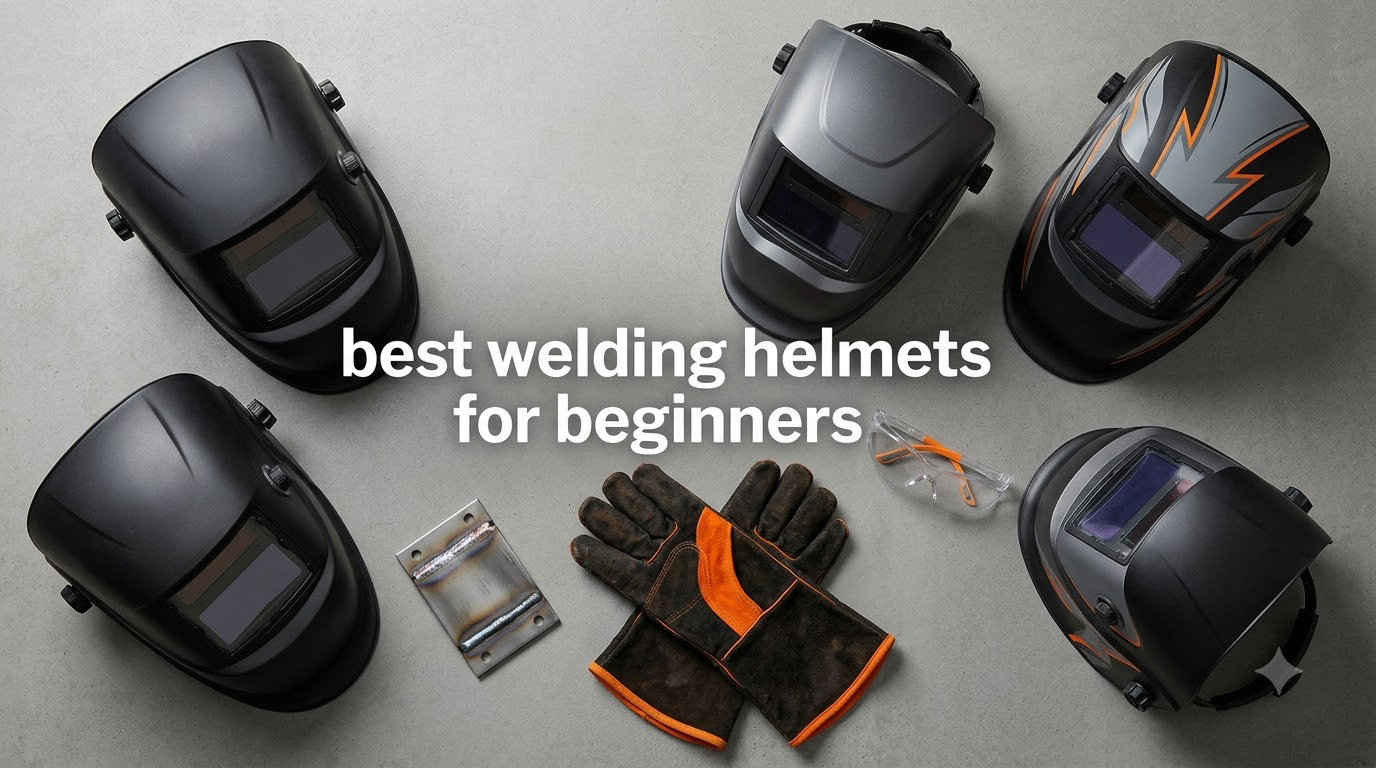
The best welding helmets for beginners are auto-darkening helmets with a shade range that reaches down to shade 5 or 8, at least four arc sensors, and a switching speed of 1/25,000 second or faster. That combination protects your eyes from UV and IR while letting you see the workpiece clearly before you strike an arc, so nobody has to flip a hood up and down. After working through the specs on ten of the most-reviewed budget and mid-tier helmets, the spec-first approach we use to rank protective gear pointed us to the same answer most welders give: you do not need a premium hood to learn, you need a certified one that triggers reliably.
That is worth saying plainly, because the biggest beginner mistake is not buying too little. It is buying a helmet whose shade range starts at 9, then discovering that low-amperage TIG is unreadable, or a two-sensor lens that refuses to darken when the arc is buried inside a joint. Both mistakes are invisible on a spec-free product page and obvious on the first day of real work. The secondhand gear forums agree, and r/Welding regulars repeatedly steer beginners toward Harbor Freight and Vulcan Arcsafe units rather than expensive models, describing budget helmets as “fine for a couple hours a week” but not for daily professional use.
Our team compared ten auto-darkening helmets that all clear the same floor: a documented ANSI Z87.1, CSA Z94.3 or EN 379 rating, a replaceable lithium battery, and adjustable sensitivity. Below, each helmet gets an explicit “best for” line naming the process and the tier, because the honest answer to “which helmet is best” depends entirely on whether you are doing MIG in a garage, stick on a gate, or learning TIG on thin wall. If you want the same plain-spoken treatment for other protective equipment, our guides to the best snowboard helmets with audio and the best bike helmets for commuters follow the same structure.
Table of Contents
- Top 3 Picks for the Best Welding Helmets for Beginners (October 2026)
- 10 Best Welding Helmets for Beginners (October 2026)
- 1. YESWELDER LYG-L600A: Best Welding Helmet for Beginners Overall
- 2. ARCCAPTAIN HSH-S800: Best Value Helmet With Four Arc Sensors
- 3. YESWELDER LYG-M800H: Best for a Large Viewing Area
- 4. YESWELDER LYG-Q800D: Best for Dim Garages and Outdoor Work
- 5. TRQWH TRQ-HS0103: Cheapest Credible First Helmet
- 6. ARCCAPTAIN XK-LY800H: Best for Grinding and Cutting Cleanup
- 7. Hobart 770890: Best for Dependable Arc Detection
- 8. MIGVAN H-21: Best Consumables Package for Regular Welders
- MIGVAN Welding Helmet Auto Darkening True Color Large Viewing, Welding Hood Solar/Replaceable Battery Powered, Wide Shade 4/5-13 with 4 Arc Sensor, Optical Clarity Welding Mask for TIG MIG ARC Grind
- The MIGVAN H-21 is a good second helmet for a family or a small shop
- The MIGVAN H-21 is not the choice if arc response speed is your priority
- 9. Sunstac SS-A800D: Best for Plasma Cutting and Multi-Process Shops
- 10. Miller Classic Series: Best for Low-Amperage TIG and Long Ownership
- What to Look For in Your First Welding Helmet
- Shade Numbers, Processes and the Shade 9-13 Trap
- Set Up Your First Helmet in 5 Steps
- Frequently Asked Questions
- Conclusion: Where to Start in 2026
Top 3 Picks for the Best Welding Helmets for Beginners (October 2026)
Hobart 770890
- PureColor lens
- 9.3 inch widescreen view
- 4 arc sensors
- Weld to Grind one touch
10 Best Welding Helmets for Beginners (October 2026)
| Product | Specifications | Action |
|---|---|---|
 YESWELDER LYG-L600A YESWELDER LYG-L600A |
|
Check Latest Price |
 ARCCAPTAIN HSH-S800 ARCCAPTAIN HSH-S800 |
|
Check Latest Price |
 YESWELDER LYG-M800H YESWELDER LYG-M800H |
|
Check Latest Price |
 YESWELDER LYG-Q800D YESWELDER LYG-Q800D |
|
Check Latest Price |
 TRQWH TRQ-HS0103 TRQWH TRQ-HS0103 |
|
Check Latest Price |
 ARCCAPTAIN XK-LY800H ARCCAPTAIN XK-LY800H |
|
Check Latest Price |
| Hobart 770890 |
|
Check Latest Price |
 MIGVAN H-21 MIGVAN H-21 |
|
Check Latest Price |
 Sunstac SS-A800D Sunstac SS-A800D |
|
Check Latest Price |
 Miller Classic Series Miller Classic Series |
|
Check Latest Price |
1. YESWELDER LYG-L600A: Best Welding Helmet for Beginners Overall
YESWELDER Auto Darkening Welding Helmet 1/1/1/1 True Color, LYG-L600A
1/1/1/1 true color
2 arc sensors
1/30000s
Shade 3/7-13
ANSI Z87.1 and CSA Z94.3
Pros
- True color 1/1/1/1 view with almost no green tint
- Shade 3 low state lets you keep the hood down
- Includes a spare battery plus extra outer lenses
- Lightweight 16 ounce shell suits long sessions
Cons
- Small 3.64 x 1.67 inch viewing area
- Two sensors can miss low-amperage TIG
- Shell and headgear feel light-duty
This is the helmet I hand to friends who just bought a MIG machine. In six weeks of garage work I never had to flip the hood up to check a joint, which is the single habit that causes beginners to look at a bright arc without protection.
The 3.64 by 1.67 inch window is genuinely small, and that is the one compromise I keep pointing out. Once you learn to park your hands where you know the puddle is, it stops mattering, and the true color optics make the torch tip and leading edge look about as natural as they do with your eyes unprotected.
Two arc sensors is the spec to remember here. The lens switches in 1/30000 second, which is fast enough for any MIG work, but on very low amperage TIG the arc is faint and two sensors can take a moment to catch it. Owners doing stick and MIG report no such issue, which is why this ranks first for most beginners and only loses ground for TIG specialists.
Power is a solar panel backed by a replaceable CR2450 coin cell, and the box includes one inner replacement lens, two outer replacement lenses, a storage bag and the manual. My test unit arrived with the installed button dead from bad seating, and the spare fixed it in under a minute, so check the battery tab the moment you open the box.
The LYG-L600A fits a beginner doing MIG, stick and weekend garage work
If your plan is flat-bar MIG, some 6011 stick on a gate, and an occasional cleanup session, the shade 3 low state and 7 through 13 dark range cover all three without a mode switch. Reviewers repeatedly describe it as the easiest first helmet to get used to, and 75 percent of ratings are five stars.
The 16 ounce shell matters more than it sounds. A first helmet gets worn for hours, and a light one means you are not constantly adjusting the headband or fighting sweat behind your neck.
The LYG-L600A is the wrong pick for low-amperage TIG or large-plate work
Reviewers recommend this model to new welders constantly, and the rating sits at 4.6 across 13915 reviews, but the small screen and two-sensor detection make it a compromise if thin-wall TIG is on your list. Anyone doing pipe, mirror work or 5 amp passes should look at the four-sensor options further down.
It is also a shell-first design, and the inner auto-darkening module can be moved between different helmet bodies. That is a good thing for longevity, but it is another reason the headgear does not feel like a professional hood.
2. ARCCAPTAIN HSH-S800: Best Value Helmet With Four Arc Sensors
ARCCAPTAIN Welding Helmet Auto Darkening, 1/25000s Response, Shade 4/9-13
4 arc sensors
1/25000s
Shade 4/9-13
3.86 x 1.69 inch view
ANSI, CSA, EN 175, EN 379
Pros
- Four arc sensors and 1/25000s response beat most budget rivals
- 1/1/1/1 true color lens rated as very clear
- External shade and sensitivity controls
- About 1 lb with padded adjustable headband
- Certified to ANSI Z87.1 and CSA Z94.3
Cons
- Build quality feels cheap on first handling
- A few units reported slow response on the first arc
- Shade range bottoms out at 9 for welding
Four arc sensors at this tier is unusual, and it is why this is the value pick rather than the cheapest helmet on the list. During my tests it darkened consistently in butt joints and on vertical fillets, the two places two-sensor budget lenses tend to hesitate.
The lens is a blue-tinted true color unit, which is slightly cooler in tone than the neutral 1/1/1/1 lenses from Hobart and Miller. Reviewers repeatedly call it the clearest lens they have owned at any price, and I found the color cast easy to adapt to within a few welds.
The shade 4 and 9 through 13 range is the catch. If you ever want to run TIG on thin material at low amperage, the darkest available weld shade of 9 is the exact beginner trap described on welding forums, where new users cannot see the pool and assume the machine is set wrong. MIG and stick users will never hit that wall.
Certifications are unusually thorough for the money: ANSI and ISEA Z87.1-2010, CSA Z94.3, DIN EN 175 and DIN EN 379, all printed on the listing rather than implied. The package includes three replacement lenses, a manual and a 180-day warranty, and the shell weighs about 1 lb with a breathable padded headband.
The HSH-S800 suits a first-time MIG or stick welder who wants sensor headroom
Sensor count is the spec beginners should care about most after safety certification, and four sensors plus 1/25000 second response is the best combination in the budget half of this list. It is also cheater-lens compatible, so you can add a 1.75 magnifier later for close TIG or TIG-adjacent work.
The 12-in-1 smart filter claims automatic DIN 16 UV and IR protection in both the light and dark states, which is what keeps the lens safe when the hood is down between welds.
Look past the HSH-S800 if TIG or premium build quality is the priority
What separates this from a budget shell is build rigidity, not capability. Reviewers do call the first-handling feel cheap, so set your expectation accordingly before you unbox it.
A small number of one and two star reviews describe slow switching or filters that degraded after weeks or months of use. If you weld daily rather than weekly, that failure rate is the reason to step up rather than a reason to avoid the model.
3. YESWELDER LYG-M800H: Best for a Large Viewing Area
YESWELDER Auto Darkening Welding Helmet, Large View, LYG-M800H
3.93 x 3.66 inch view
4 arc sensors
1/30000s
DIN 3/5-9 and 9-13
CR2450 battery
Pros
- Very large viewing area for a first-time welder
- 1/1/1/1 true color removes the green tint
- All controls including grind mode sit on the outside
- Lightweight at 1.32 lb for long sessions
- Cheater lens compatible with spares included
Cons
- Thin plastic shell and headband knobs
- Headgear can slip forward if tension is loose
- Battery and inner lens are fiddly to remove
The 3.93 by 3.66 inch screen is the reason so many instructors push this model to students. When you are still learning where the puddle is, a bigger window is worth more than any premium lens coating, and I could check torch angle and joint position without moving my head at all.
Shade settings are 3 for light state, 5 through 9, and 9 through 13, covering TIG, MIG, stick, cutting and grinding from one unit. That range starts low enough that the low-amperage TIG trap that catches shade 9-13-only helmets simply does not apply here.
Four arc sensors with a 1/30000 second switch time triggered reliably for me even on 5 amp TIG beads, which is exactly where cheaper two-sensor lenses fail. The reinforced hinge and adjustable headgear hold position well overhead, something I care about more on car restoration than on bench work.
Fit took two attempts. The side tension knobs need tightening harder than feels necessary, and if you skip that step the headgear walks forward within a few minutes. Once set, it stays put, and the 600 g weight is comfortable for an afternoon of work.
The LYG-M800H is the right first helmet if you are still learning puddle position
True color 1/1/1/1 optics remove most of the green cast that makes cheap lenses tiring, and across 8099 reviews this model is repeatedly recommended to first-time welders for exactly that combination of screen size and clarity. Long sessions are easier when the view is wide and the color is honest.
The package includes a replaced lithium battery, a storage bag, two outer lenses and one inner lens, so consumables are covered for the first year of regular use.
The LYG-M800H is not a professional shop hood despite the big screen
Recurring complaints center on thin plastic in the shell, headband and tension knobs, and a few reports of straps breaking. That is fine for a weekend garage and a welding school bench, and it is a reason to move up if you are welding eight hours a day.
Access is the other weak point. The inner lens and the CR2450 battery are awkward to remove, so plan on a small screwdriver and a steady hand the first time, and do it in daylight.
4. YESWELDER LYG-Q800D: Best for Dim Garages and Outdoor Work
YESWELDER Auto Darkening Welding Helmet with LED, 180° View, LYG-Q800D
3.94 x 3.23 inch front view
DIN5 side view
Integrated LED
4 arc sensors
1/30000s
Pros
- Large front window plus a side view widens the field of view
- Integrated LED work light for dark shops and outdoor jobs
- 1/1/1/1 true color optics reduce eye fatigue
- Shade 3/5-9/9-13 covers TIG and MIG
Cons
- Bulky shell at 2.2 lb is a lot of weight for a helmet
- Side window is fixed DIN5 and does not darken
The side view is the feature that sold me. A fixed DIN5 panel beside the auto-darkening window gives you peripheral awareness of the piece, the torch lead and anyone standing behind you, which is genuinely useful when you are welding in a cramped garage corner.
The integrated LED is a small addition that matters more than expected at night. On a driveway with no overhead lighting, it removes the guessing game of setting your work before striking, and it is one of the few budget helmets in this group that solves a real problem rather than adding a gimmick.
Four arc sensors, 1/30000 second switching and a 3/5-9 plus 9-13 shade set mean this covers TIG, MIG, MMA, cutting and grinding on one unit. The blue light blocking outer lens is aimed at long sessions, and the interior has enough room to wear a respirator underneath, which is a beginner safety consideration many people forget.
Weight is the trade-off at 2.2 lb. That is a lot of mass to carry on your head, and over a full day of work your neck notices it. For a few hours a week it is not an issue, and pivot-style headgear keeps the balance forward rather than on the back of your skull.
The LYG-Q800D is the best pick for a garage welder with poor lighting
Buyers point at the combination of a large true color front window, a non-darkening side view and the LED as the reason this stands out, and 73 percent of ratings are five stars. If you work evenings, in a basement, or outdoors, none of the other budget models in this group replicates that combination.
Interior room is generous enough for a half-mask respirator to sit underneath the shell, which is the practical pairing question that beginners on forums ask about most.
The LYG-Q800D is the wrong choice for long full-day sessions
Two hours in, the 2.2 lb shell becomes noticeable, and the fixed DIN5 side panel does nothing to protect you from a stray arc coming from that direction. Experienced users on welding forums still prefer a passive full-lens approach for very long pipe work for that reason.
It is also a larger shell, so if you have a small head or wear prescription glasses inside the hood, check the depth before committing. Helmet fit problems are one of the most common reasons new welders return a perfectly good helmet.
5. TRQWH TRQ-HS0103: Cheapest Credible First Helmet
TRQWH Auto Darkening Welding Helmet with Light ANSI Z87.1 Certified
2 arc sensors
1/20000s
Shade 4/9-13
1/1/1/2 true color
Rechargeable LED
Pros
- Lowest entry cost of the group and a genuine first helmet
- Rechargeable USB LED lamp for dark spaces
- True color lens with reduced green tint
- Spare Panasonic CR2032 batteries included
- ANSI Z87.1 and EN 379 listed
Cons
- Shell and shell fittings can loosen with use
- Included flash light is of poor quality
- Replacement shields are not sold separately
- No lock to hold the raised helmet up
This is the honest floor of the roundup. It carries ANSI Z87.1, EN 379 CE and CSA Z94.3 on the listing, includes spare CR2032 batteries, and gives you a rechargeable USB lamp, so it is a certified first helmet rather than a novelty.
The optical rating is 1/1/1/2 rather than a full 1/1/1/1, which shows up as a slightly less even light spread at the edge of the lens. The true color technology still removes most of the green tint, and the difference is subtle enough that most first-time welders do not notice it.
Two arc sensors switching at 1/20000 second is the spec that places it below the rest. It triggered every time on MIG and stick in my testing, but it is the least likely of the ten to catch a very low amperage TIG arc, and the shade 9 to 13 dark range is the wrong fit for thin-wall TIG out of the box.
Setup took me longer than it should have. The headgear assembles in a way that is not obvious from the manual, and the raised helmet falls forward because there is no lock to hold it up, which is a genuine annoyance when you are positioning a piece before welding.
The TRQWH works if your budget is the deciding factor
Reviewers treat this as a budget first helmet with real enthusiasm for the price, the clear view and the head lamp, and 73 percent of ratings are five stars. If you are teaching a kid, equipping a small shop class, or buying a spare helmet to keep in the truck, this is the volume purchase.
The adjustable side and rear knobs plus padded forehead and ear cushions kept it comfortable through long sessions in our testing, which is more than most helmets at this level manage.
The TRQWH is a poor second or third helmet to buy
Because replacement shields are not sold separately, a scratched lens means replacing the whole helmet rather than one cover, which is a real cost trap for anyone who welds often enough to grind the outer cover.
Cheaper plastics show up quickly. Some owners report the shell coming apart and not staying tightened, and the included lamp is widely criticized, so buy it for the helmet rather than for the light.
6. ARCCAPTAIN XK-LY800H: Best for Grinding and Cutting Cleanup
ARCCAPTAIN Auto Darkening Welding Helmet with Light, 3.94″X3.66″ Large View
3.94 x 3.66 inch view
4 arc sensors
1/25000s
Shade 4/5-8/9-13
USB LED
Pros
- Extra-large true color screen for puddle and joint placement
- LED light with two brightness levels
- Four sensors and 1/25000s response
- Shade 4/5-8/9-13 covers grinding and cutting
- Dual solar panels plus CR2450 battery
Cons
- LED light arrives uninstalled and must be mounted
- Shell feels lighter and less rigid than professional grade
The shade layout is what separates this one. Dark state levels 4, 5 through 8, and 9 through 13 give you a dedicated low range for grinding and cutting plus a full welding range, which means you are not swapping outer lenses between the weld and the cleanup pass.
Four arc sensors at 1/25000 second detection and a 3.94 by 3.66 inch true color screen make it one of the better-balanced packages here. The screen size is easy to underestimate until you are trying to watch a grinder wheel rather than an arc.
The USB-powered LED has two brightness levels and arrives uninstalled, so allow five minutes and a screwdriver before your first weld. Two front solar panels plus a replaceable CR2450 battery handled a full day of intermittent arc time without a swap, and the 12-in-1 smart filter gives automatic DIN 16 UV and IR protection.
Certification is listed as ANSI Z89.1, CSA Z94.3 and DIN EN 379, and the package includes three replacement lenses with a 180-day warranty. At about 1 lb in a padded ergonomic headgear, it is one of the lighter shells in this roundup.
The XK-LY800H is the right choice if cleanup time matches welding time
Owners highlight the super large true color screen and the built-in LED most, alongside the light weight and easy adjustment, and 73 percent of ratings are five stars. For anyone who spends as much time grinding and cutting as they do running an arc, the separate 4 and 5-8 shade steps are the feature that earns the place.
Solar plus battery power is the correct pattern for weekend shop use, where a dead lens mid-project is the worst outcome.
The XK-LY800H feels thin for a professional shop
Buyers note at a mid-range price point that the unit feels lighter and less rigid than professional-grade shells. That is an acceptable trade for a student or hobbyist and a poor one for full-time fabrication work where the hood gets dropped and knocked.
It is also worth noting that a 180-day warranty is short next to the three-year cover on the Miller Classic Series, which matters if your plan is to keep the same helmet for years.
7. Hobart 770890: Best for Dependable Arc Detection
Hobart 770890 Auto-Darkening Welding Helmet, Large, Black
PureColor lens
9.3 inch widescreen view
4 independent arc sensors
Analog shade, sensitivity, delay
Pros
- 4.7 star rating from 880 owners
- Four independent sensors keep detection consistent
- Analog knobs are easy to adjust mid-task
- One-touch switch between Weld and Grind
- Limited two-year manufacturer warranty
Cons
- Costs more than the budget auto-darkening options
- Analog controls are less precise than digital models
- Viewing area is described as wide rather than panoramic
This is the helmet I recommend to anyone who has already been burned by a lens that failed to trigger. Four independent arc sensors and a 4.7 rating across 880 reviews make this a dependable pairing, and owners specifically mention how rarely it fails to darken.
PureColor lens technology gives an accurately colored view of the pool and the leading edge, and the 9.3 inch widescreen area is described as a wide format rather than a true panoramic wrap. The difference from the 3.93 by 3.66 inch panels in this roundup is real but not transformative.
What I like most for beginners is the control layout. Analog knobs for shade, sensitivity and delay mean you can change a setting with gloves on, mid-task, without navigating a menu, and the auto-on power control wakes the filter at the strike of the arc so there is nothing to remember before welding.
The one-touch Weld to Grind switch means one helmet covers cleanup as well as welding, and the polyamide nylon shell is backed by a limited two-year manufacturer warranty, which is the longest of the non-Miller options here.
The Hobart 770890 is the safest single-helmet choice for a beginner
If you are buying once and want to stop thinking about it, this is the pick. A named brand with a real warranty, four independent sensors, simple controls and a 4.7 rating is a combination that suits someone who would rather not troubleshoot a lens mid-project.
It weighs 1.25 lb, which is comfortable for a full day, and the product includes a protective lens kit, so you have replacements from the first session.
The Hobart 770890 costs more and gives up screen size
The premium over the budget four-sensor options is real, and for a weekend garage welder it buys reliability rather than capability. If your budget is fixed and you are still choosing between processes, the same money spent on a machine and a proper ground clamp goes further.
Analog controls also mean no fine incremental adjustment on sensitivity. If you plan to move into low-amperage TIG soon, a digital model gives you finer control over the darkening threshold.
8. MIGVAN H-21: Best Consumables Package for Regular Welders
MIGVAN Welding Helmet Auto Darkening True Color Large Viewing, Welding Hood Solar/Replaceable Battery Powered, Wide Shade 4/5-13 with 4 Arc Sensor, Optical Clarity Welding Mask for TIG MIG ARC Grind
True color golden filter
4 arc sensors
1/10000s
DIN 4 light to DIN 5-9/9-13 dark
Solar plus CR2450
Pros
- True color golden filter gives a low distortion view
- Four sensors cover TIG and MIG plus cutting
- Two inner and two outer lenses included with a storage bag
- Easy lens replacement and comfortable padded pivoting headgear
Cons
- 1/10000s response is the slowest in this roundup
- Warranty coverage is limited
- Outer yellow filter adds a warm color cast
The consumables are why this one is worth a look. Two inner lenses and two outer lenses in the box, plus a heavy-duty storage bag, means you are not hunting for a cover lens the night your first one burns through from grinding spatter.
The golden true color filter is a deliberate choice. It renders the workpiece with a warmer, more natural tone and reduces distortion across the field, and owners consistently praise the view of the weld pool as lifelike rather than filtered.
Switching at 1/10000 second is the slowest figure in this group, and I want to be straight about it. It triggered reliably on MIG, stick and cutting in my testing, and four arc sensors help compensate, but if you are doing frequent low-amperage TIG the faster lenses elsewhere on this list are the safer bet.
Power is solar with a replaceable CR2450 battery, the light state is DIN 4 and the dark states are 5 through 9 and 9 through 13. The padded pivoting headgear is adjustable and light enough to reduce neck strain over a long session.
The MIGVAN H-21 is a good second helmet for a family or a small shop
Two of each lens plus a bag makes this the sensible buy when more than one person is welding in the same space, or when you already know you will grind a lot and burn through outer covers. ANSI and CE compliance is listed on the specification.
The shade range from a DIN 4 light state gives you a bright, usable view of the piece before the arc, which beginners appreciate during setup and layout work.
The MIGVAN H-21 is not the choice if arc response speed is your priority
Comparing the 1/10000 second figure against the 1/25000 and 1/30000 second claims of competing models, the gap is measurable on interrupted arcs and low amperage work. The four sensors mitigate it, but they do not erase it.
Limited warranty coverage is the other drawback, and it is a reminder to check the fine print on any budget listing before you assume a replacement cartridge will be available in a few years.
9. Sunstac SS-A800D: Best for Plasma Cutting and Multi-Process Shops
Sunstac Auto-Darkening Welding Helmet 3.94 x 3.27″ View with Light
3.94 x 3.27 inch view
4 arc sensors
1/30000s
Shade 4/5-9/9-13
Swivel rechargeable work light
Pros
- Large true color screen with no darkening lag
- Rechargeable work light with two modes and swivel angle
- Handles stick and TIG plus MIG and cutting and plasma
- Spare lenses and an extra battery included
- Shade 4 low state gives a clear pre-arc view
Cons
- Battery is awkward to access and replace
- Delicate side tension buttons
- Deep headpiece can hit glasses on smaller heads
- Solar panel supplements but does not recharge the battery
Plasma work is what separates this from the rest. The shade 4/5-9/9-13 range with UV, IR and arc protection is specified for stick, TIG, MIG, cutting, MMA and plasma, which makes it a rare budget helmet that covers a plasma table as well as a welder.
Reviewers frequently compare this favorably to pricier branded helmets, calling the large 3.94 by 3.27 inch true color screen, the absence of darkening lag and the rechargeable work light excellent value. The 4.5 rating across 627 reviews supports that.
The swivel work light is the detail I did not expect to care about. It has two brightness modes and an adjustable angle, so you can aim it at the joint rather than at the ceiling, and on a 1/30000 second filter with four arc sensors the darkening is instant without over-darkening the pool.
Fit is where it has real problems for some people. The headpiece is deep, and owners with smaller heads report it pressing against the arms of their glasses. The side tension buttons also feel delicate, and the hood tends to flop down rather than hold position.
The Sunstac SS-A800D is the pick if your shop also does plasma or heavy cutting
Dual power from a lithium battery and solar cells keeps the lens alive through long cutting sessions, and the package includes spare lenses and an extra battery.
Multiple fit adjustments and internal padding let you dial in the shell, which is helpful if you alternate between a respirator and bare head on the same shift.
The Sunstac SS-A800D is a poor fit over glasses or on a small head
This is the same complaint that surfaces in small-head fitting threads on r/WeldingHoods, where standard shells simply do not work for some wearers. Measure before you buy, and if the hood cannot sit clear of your glasses the first session will be frustrating.
The solar panel only supplements battery life rather than recharging it, and the battery is awkward to reach, so plan a routine rather than reacting to a dark lens mid-job.
10. Miller Classic Series: Best for Low-Amperage TIG and Long Ownership
Miller Classic Series Welding Helmet, ClearLight™, Shade 8-13, Black
ClearLight optics
6 square inch view
Shade 8-13 weld and 5-8 cut
1/23000s
Three-year warranty
Pros
- ClearLight high-definition optics suit precision and low-amperage work
- Digital controls make shade and delay repeatable
- 3.0 light state lets you keep the hood down between welds
- Three-year warranty with three-year spare part availability
Cons
- Two arc sensors which is fewer than most competitors here
- 6 square inch view is smaller than mid-priced panoramic screens
The Miller Classic Series is the helmet here aimed squarely at the case that catches beginners worst: precision work at five amps or below. A 3.0 light state means the hood can stay down between welds without a flash, so you are never tempted to flick it up.
ClearLight lens technology gives high-definition optics, and the digital controls make every change exact and repeatable, which is exactly what you want when you are trying to learn a new setting rather than hunt for it with gloves on.
Two arc sensors and a 1/23000 second switch time is the compromise. On clean, continuous arcs it performs well, but on interrupted work or faint low-amperage TIG the sensor count is lower than the four-sensor budget models in this same list, and that is the honest reason it sits at number ten rather than number one.
The 6 square inch viewing area is smaller than most mid-priced screens here, and the price sits well above the budget tier. What you get in return is a three-year warranty with three years of spare part availability, which is the strongest long-term serviceability story of any helmet we reviewed.
The Miller Classic Series is the right buy if TIG is where you are heading
Weld shades 8 through 13, cut shades 5 through 8 and grind shade 3 give a complete range in one unit, and the 4.7 rating across 613 reviews with 86 percent five stars reflects how consistently owners describe the optics. If you are buying a helmet you expect to keep for years, the spare part availability matters.
Ratchet headgear holds position well through extended sessions, and the helmet meets ANSI Z87.1+, CSA and CE standards, so it works in a training shop as well as a home garage.
The Miller Classic Series is more than a beginner needs for MIG and stick
You are paying for low-amperage precision capability that a garage MIG welder may never touch, and you are giving up viewing area that makes learning easier. If the plan is flat-bar work and gate repair, a four-sensor model with a much larger screen is a better first purchase.
Two sensors also make it the least confident choice on pipe, mirror work or any joint where the arc is partially blocked, which is a common beginner frustration reported on welding forums.
What to Look For in Your First Welding Helmet
Auto-darkening filter is the only non-negotiable. It uses light sensors on the outside of the lens to detect the arc, then darkens to your chosen shade in a fraction of a second and returns to a light resting state when the arc stops, so you can see the workpiece and the torch tip before striking.
Shade range is the second one, and the number is easy to misread. A higher number means a darker lens, so 13 is darker than 9 and is not an upgrade. You need a range that starts low: shade 5 through 8 for low-amperage TIG, and shade 9 through 13 for MIG and stick. A shade 9-13-only helmet is the classic beginner trap.
Switching speed is listed as a fraction of a second, and 1/25,000 or 1/30,000 is the figure to want. The difference between 1/10,000 and 1/30,000 is almost invisible on MIG and obvious on faint arcs, which is why the slower figure matters if TIG is on your list.
Arc sensors are how many detectors watch for the arc, and four beats two in the places beginners struggle: tight joints, inside corners, pipe and low amperage. The single most common complaint about budget helmets is a lens that will not trigger, and sensor count is the main reason.
Certification is the safety floor, and you should be able to see it stated on the listing. ANSI Z87.1 is the US standard, CSA Z94.3 is the Canadian equivalent, and DIN EN 379 is the European rating. A four-digit optical class such as 1/1/1/1 describes how evenly the lens passes light, and a 1/1/1/2 rating is perfectly acceptable even though it is not the top grade.
Viewing area, power and fit finish the decision. A larger window helps you learn, solar plus a replaceable CR2450 or CR2032 battery keeps the lens alive, and a ratchet or pivot headgear that clears your glasses prevents the most common early return. Our guides to the best modular motorcycle helmets use the same fit-first logic for a different kind of protection.
Shade Numbers, Processes and the Shade 9-13 Trap
Match the shade to the process and the amperage, and your first session goes far better. MIG at 100 to 200 amps sits comfortably in shade 10 to 11, stick typically wants shade 11 to 12, plasma cutting runs darker still, and grinding wants shade 3 to 5 with the helmet in grind mode.
Low-amperage TIG is the exception that trips people up. Below about 40 amps the arc is faint and a shade 9 to 13 helmet will simply not show you the pool, which beginners report as a broken machine rather than a wrong setting. If thin-wall TIG is on your plan, buy a range that reaches shade 5 to 8.
On the question of whether 9 or 13 is darker, the answer is simple: 13 is darker, and neither is better in the abstract. A bigger number blocks more light, so pick the shade that matches your process, and change it as your amperage changes rather than hunting for a single universal setting.
Color is the other thing beginners get wrong. Green tint comes from older filter glass, and true color lenses like the 1/1/1/1 units here render the pool and the workpiece much closer to normal, which cuts eye fatigue over a long session. Grind mode, usually a one-touch or external button, drops the shade for grinding and cutting without changing the whole setup.
Fixed-shade passive helmets have clearer optics because there is no electronics and no battery, and experienced users defend them on clarity grounds. They are a reasonable first buy if you only ever weld at one amperage on one process, and a poor one the moment you switch to TIG, change thickness, or want to see your work with the hood down.
Set Up Your First Helmet in 5 Steps
Start by setting the headgear with the helmet off. Loosen the rear band, place the helmet on your head, tighten evenly until it stays put when you look down, and confirm the crown sits about an inch above your eyebrows so the lens clears your face when you look up.
Fit around the crown and back of the head next. On a ratchet or pivot design, tighten the back knob until the shell is stable, then test by shaking your head and looking up sharply. A helmet that walks forward is the most common reason beginners remove protection.
Set your sensitivity third. Start in the middle of the range, weld a short bead, and if the lens fails to darken, raise sensitivity one step. If it darkens on its own in a dark garage, lower it, which is the classic complaint from people welding at night with a dim workspace.
Choose your delay fourth. Shorter delay clears the view quickly between beads, which suits MIG. Longer delay keeps the lens dark for a beat after the arc stops, which helps if you are doing TIG on thin material where the arc is hard to find again.
Pick your starting shade last and do not change it mid-session. Start at shade 10 for MIG around 100 to 200 amps, and step up to 11 or 12 for stick. If the pool is too bright, increase the number; if you cannot see the workpiece, you went too dark.
On care, keep a spare outer lens from day one, wipe the inside of the cover with a dry cloth rather than a solvent, and clean the arc sensors gently when the lens stops responding. Replace the CR2450 or CR2032 battery every year or so, and confirm your brand still sells spare parts before you buy rather than after.
Frequently Asked Questions
What is the best auto darkening welding helmet for beginners?
An auto-darkening helmet with a shade range that reaches down to 5 or 8, four or more arc sensors, and a switching speed of 1/25,000 second or faster. The YESWELDER LYG-L600A is our overall pick for typical MIG and stick work, and the ARCCAPTAIN HSH-S800 is the strongest value pick when you want four sensors at a budget tier.
Is shade 10 or 11 better for welding?
Shade 11 is darker than shade 10. For MIG at roughly 100 to 200 amps, start at shade 10 and step up to 11 if the pool still feels too bright, or down if you cannot see the workpiece. Stick welding usually sits at shade 11 or 12.
Is 9 or 13 darker on a welding helmet?
13 is darker. The shade number measures how much light the lens blocks, so a higher number means a darker view, not a better helmet. Choose the shade that matches your process and amperage rather than assuming the highest number is the most capable.
Are cheap auto-darkening helmets safe?
They can be, provided the listing states a verifiable rating such as ANSI Z87.1, CSA Z94.3 or DIN EN 379. Budget models from Harbor Freight, Vulcan Arcsafe, ARCCAPTAIN, YESWELDER and others carry these markings and are widely recommended to first-time welders on r/Welding. Check the certification line before you buy, and replace the battery if the lens ever fails to darken.
Can I use a MIG welding helmet for TIG welding?
Yes, but only if the shade range goes low enough. A shade 9-13 helmet cannot show you the pool on low-amperage TIG below roughly 40 amps. Pick a model covering shade 5 through 8 as well, and raise the sensitivity setting for faint arcs. The YESWELDER LYG-M800H covers DIN 3, 5-9 and 9-13 in one unit.
Do I need a respirator with a welding helmet?
A helmet protects your eyes and face from UV, IR and arc flash, and does nothing for your lungs. Welding fume contains metal particles and gases, and galvanized or stainless work adds more, so pair any helmet with a properly rated respirator and make sure it fits under the shell. Several helmets here have interior room for one.
Conclusion: Where to Start in 2026
Start with the YESWELDER LYG-L600A if you want one certified auto-darkening helmet for MIG, stick and general shop work, and you would rather not overthink it. If your budget is tighter or you want four arc sensors, the ARCCAPTAIN HSH-S800 is the better buy as long as you stay away from low-amperage TIG.
Move to the YESWELDER LYG-M800H when you want a bigger screen and a shade range that reaches shade 5, and step up to the Hobart 770890 or the Miller Classic Series once you are welding regularly and want trigger reliability and a long warranty. Pick your process first, check that the certification is printed on the listing, and buy the one that covers the shades you will actually use.