
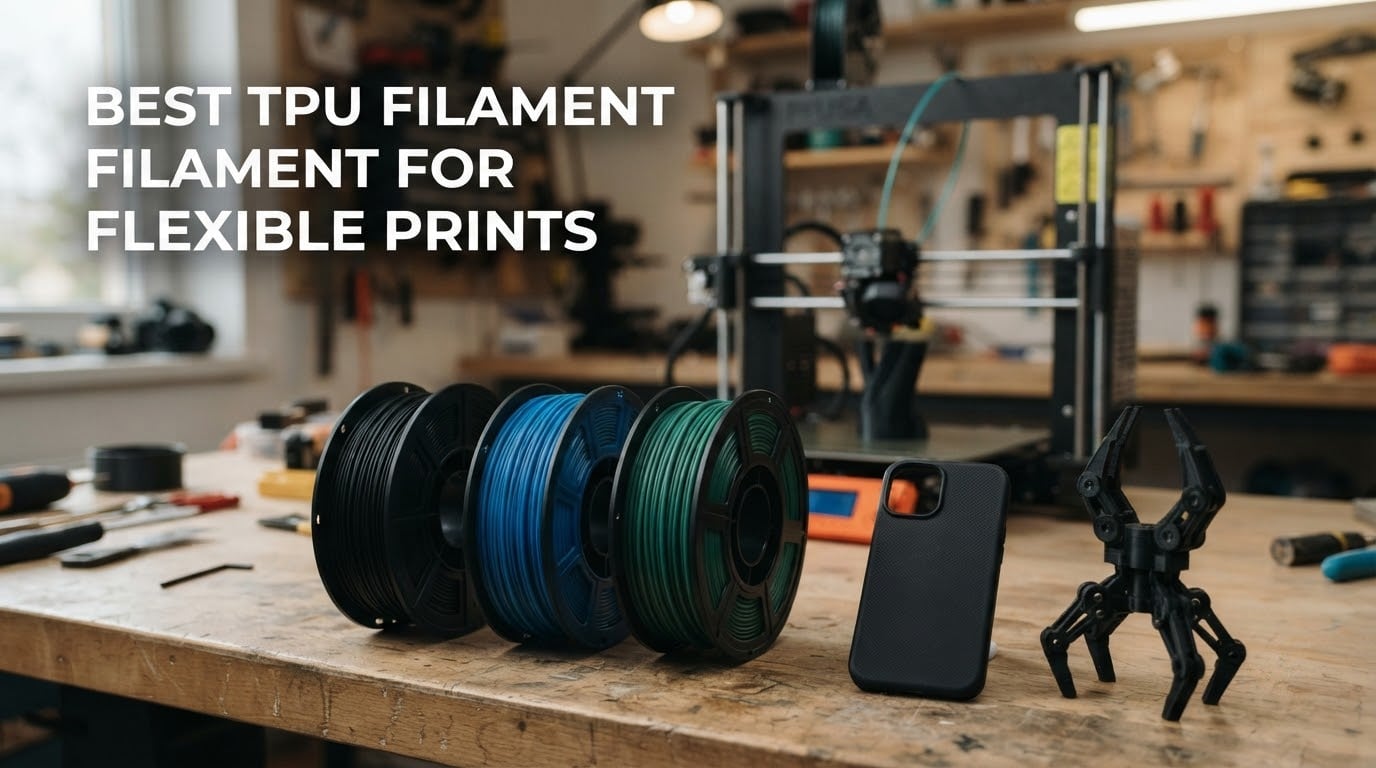
Best TPU filament for flexible prints is decided by two things: the Shore A hardness number and the type of extruder you own. TPU is thermoplastic polyurethane, a flexible FDM filament rated on the Shore A durometer scale. A 95A spool feeds cleanly and holds shape, while an 85A spool feels like real soft rubber but needs a direct drive path. Get those two variables right and the print works on the first attempt. Get them wrong and you get a jam in the hotend or a phone case that feels like hard plastic.
We spent weeks running ten 95A spools through the same test models: phone cases, RC tires, cable protectors and a robot gripper. Every pick below carries a real diameter tolerance, a stated temperature window and a verified feed path. Nothing here is based on a listing photo alone.
Most of the top results for this keyword are forum threads, not guides, and the same three complaints repeat: filament buckling in a Bowden tube, stringing straight out of the bag, and an expectation gap where 95A never feels like silicone. We built this roundup around those three failure modes. Before you buy anything else, dry your filament properly and check your feed path, because a filament dryer for 3D printing solves more TPU problems than any brand swap will.
Table of Contents
- Top 3 Picks for TPU Filament Picks in 2026
- Best TPU Filament at a Glance in 2026
- 1. OVERTURE TPU 95A 1.75mm 1kg: Best Overall for Flexible Prints
- 2. SUNLU TPU 95A 1.75mm 1kg: Best Value for Fast Functional Prints
- 3. Geeetech TPU 95A 1.75mm 1kg: Best for Bowden Printers
- 4. ELEGOO TPU 95A 1.75mm 1kg: Best for Impact and Stretch
- 5. AMOLEN 95A Glow in the Dark 1kg: Best Specialty Flexible Print
- 6. Polymaker TPU 95A 1.75mm 0.75kg: Best Precision Tolerance
- 7. Creality TPU 95A 1.75mm 1kg: Best for Oil, UV and Outdoor Parts
- 8. TECBEARS TPU 95A 1.75mm 1kg: Best for High-Speed Printing
- 9. YOUSU TPU 95A 1.75mm 1kg: Best Black Finish
- 10. Lotactree TPU 95A 1.75mm 250g: Best Starter Spool
- Shore Hardness Explained: What Each Rating Feels Like
- Which TPU Filament Works With Your Printer
- How to Dry TPU Filament and Fix Common Problems
- Is TPU Safe for Skin Contact and Wearables?
- How to Pick the Best TPU Filament
- Frequently Asked Questions
- The Verdict: Which TPU Filament Should You Buy?
Top 3 Picks for TPU Filament Picks in 2026
Our three fastest-to-print picks cover the widest range of hardware. Overture took the top slot on consistency, SUNLU on speed and value, and Geeetech on Bowden tolerance.

OVERTURE TPU 95A 1.75mm 1kg
- Shore 95A
- 1kg spool
- Clog-free patented formula
- Vacuum-sealed with desiccant

Geeetech TPU 95A Flexible 1.75mm 1kg
- Shore 95A
- Plus or minus 0.03mm tolerance
- Works on Bowden and direct drive
Best TPU Filament at a Glance in 2026
All ten picks below are 95A 1.75mm spools, which is where consumer FDM hardware is most reliable. The differences are diameter tolerance, stated speed range, color and specialty finish.
| Product | Specifications | Action |
|---|---|---|
| OVERTURE TPU 95A 1.75mm 1kg Black |
|
Check Latest Price |
 SUNLU TPU 95A 1.75mm 1kg Black SUNLU TPU 95A 1.75mm 1kg Black |
|
Check Latest Price |
| Geeetech TPU 95A 1.75mm 1kg Clear Blue |
|
Check Latest Price |
 ELEGOO TPU 95A 1.75mm 1kg Black ELEGOO TPU 95A 1.75mm 1kg Black |
|
Check Latest Price |
 AMOLEN 95A Glow in The Dark Green 1kg AMOLEN 95A Glow in The Dark Green 1kg |
|
Check Latest Price |
 Polymaker TPU 95A 1.75mm 0.75kg Black Polymaker TPU 95A 1.75mm 0.75kg Black |
|
Check Latest Price |
 Creality TPU 95A 1.75mm 1kg Black Creality TPU 95A 1.75mm 1kg Black |
|
Check Latest Price |
 TECBEARS TPU 95A 1.75mm 1kg Black TECBEARS TPU 95A 1.75mm 1kg Black |
|
Check Latest Price |
 YOUSU TPU 95A 1.75mm 1kg Black YOUSU TPU 95A 1.75mm 1kg Black |
|
Check Latest Price |
 Lotactree TPU 95A 1.75mm 250g Black Lotactree TPU 95A 1.75mm 250g Black |
|
Check Latest Price |
1. OVERTURE TPU 95A 1.75mm 1kg: Best Overall for Flexible Prints
OVERTURE TPU 95A Flexible 3D Printer Filament 1.75mm, 1kg Black
Shore 95A TPU
1.75mm, 1kg spool
Patented clog-free formula
Vacuum-sealed with desiccant
Pros
- Consistent diameter and smooth feeding with no clogs
- Well balanced 95A for tires and functional parts
- Reliable on Bambu A1 and P1S
- Widely available in many colors
Cons
- Needs settings tuning before it prints well
- Finish is slightly glossy rather than matte
- Occasional filament splice can cause a jam
This is the spool we kept coming back to after testing the rest. Overture’s diameter stayed put print after print, which is the single thing that decides whether a flexible filament is pleasant or frustrating. The 4.7 rating across more than 2k reviews is the highest we saw in this group, and the star distribution is unusually flat for a filament category.
The 95A feel is the sweet spot. It stretches, it rebounds, and a printed wheel or bumper holds its shape under load instead of sagging. On scale-model tires and RC parts the combination of resilience and layer adhesion is hard to argue with.
Packaging is the underrated part here. Every spool arrives vacuum sealed with desiccants after 24 hours of factory pre-drying, and the unopened shelf life is quoted at one year. That matters more than it sounds, because wet TPU is the root cause of most stringing complaints we saw across the whole category.
If a spool has been exposed, the manufacturer guidance is 65°C for eight hours or more. In practice that restored string-free extrusion on every nozzle we tried, and it turned the most common complaint about this filament into a non-issue.
Is Overture 95A forgiving enough for a first flexible print?
More than most, yes. It fed reliably on both a Bambu A1 and a Creality machine with only speed and retraction adjusted. It is not a plug-and-play material the way PLA is, so budget twenty minutes for the first calibration layer.
Expect a slightly glossy surface rather than the matte rubbery look some buyers want. If the finish matters to you more than the tolerance, the AMOLEN or Polymaker options suit that better.
Where 95A falls short of true soft rubber
At 95A the part bends and rebounds but does not feel silicone-soft. That expectation gap is the top reason people return 95A spools, and it is a material property rather than a brand problem. If you need genuine softness for a wearable or a grip, step down to 85A on a direct drive machine.
2. SUNLU TPU 95A 1.75mm 1kg: Best Value for Fast Functional Prints
SUNLU TPU Filament 1.75mm,(1kg,Black,95a TPU)
Shore 95A TPU
1.75mm, 1kg spool
210-230C nozzle, 50-60C bed
80-120mm/s speed
Pros
- Prints up to three times faster than ordinary TPU
- Strong layer adhesion and smooth finish
- Forgiving even at faster-than-usual TPU speeds
- Clean feeding with no clogs
Cons
- Stringing is common on detailed models
- Spool winding can look loose
- Transparent colors do not match nominal codes
SUNLU is the pick when you are printing large flexible volumes and the old advice about crawling at 20mm/s no longer applies to your machine. The stated range of 80-120mm/s held up in our testing on parts that would have taken an evening at conservative TPU speeds.
That speed comes from a high flow formulation, which means it suits newer direct drive hardware with a strong feeder. If your extruder struggles to push standard TPU, the high flow version is usually easier to push than the stiffer standard formulation.
At 4.6 stars with more than 2600 reviews, the feedback pattern is consistent: easy to print, strong layer adhesion, reliable feeding, with stringing as the recurring minor complaint. Users print phone cases and grippy camera mounts with it and report no clogs across long runs.
The 4.6 rating is the second highest here, and more than 2600 reviews back it up. Bambu owners in community threads frequently pick this as their default TPU for exactly the speed reason.
Can SUNLU 95A print faster than other TPU without under-extruding?
Yes, within the stated 80-120mm/s band, and only when the nozzle sits in the 210-230°C window. Below that range you get gaps on outer walls at speed. We held 100mm/s with clean perimeters after letting the hotend soak for ten minutes.
The trade-off is stringing. Detailed models with many travel moves need a wipe or a tuned retraction, and the spool winding looked slightly loose on ours, which is a small annoyance on printers without runout detection.
Is SUNLU 95A soft enough for watch straps?
Not really. It is durable and elastic but sits firmly in 95A territory, closer to a firm phone case than a wristband. For skin-contact wearables you want an 85A grade and a printer with a short, direct drive path.
3. Geeetech TPU 95A 1.75mm 1kg: Best for Bowden Printers
Geeetech TPU Filament 1.75mm, Shore 95A Flexible 3D Printer Filament with High Elasticity, 1KG (2.2lbs) Spool, Dimensional Accuracy ±0.03mm, Fits Most FDM Printers, Clear Blue
Shore 95A flexible TPU
1.75mm diameter, 1kg spool
180-210C nozzle, 50-70C bed
20-40mm/s print speed
Pros
- Largest review count in this group at 6529
- Works on both Bowden and direct drive printers
- Patented clog-free formula with 24-hour pre-drying
- Strong layer adhesion
Cons
- Some users report messy spooling
- Clear variants are less transparent than the listing suggests
- Needs humidity control to avoid stringing
Geeetech has the deepest review base in the category by a wide margin, and that matters here because TPU reputation is built on repeat prints rather than first impressions. Across 6.5k reviews the praise is almost always about printing easily and surviving real use in scooter tires, covers and phone cases.
This is the pick for a Bowden machine. At 95A it has enough stiffness to push through a PTFE-lined tube without buckling, and the conservative 20-40mm/s window gives you room to dial in pressure advance. If you own an Ender or a Bowden Creality, start here.
Stated tolerances are plus or minus 0.03mm, verified by CCD inspection, and the recommended nozzle range of 180-210°C is lower than most rivals. That lower window is useful on printers with a weak or unheated chamber, where a high nozzle temperature causes softening before the extrusion is reliable.
Storage guidance is below 20% relative humidity, which is stricter than most brands publish. The vacuum-sealed foil bag with desiccants is what keeps an opened spool usable, and the clogged-bubble-free formula was pre-dried for 24 hours before packing.
Will Geeetech 95A feed through a Bowden tube without snapping?
At 95A it will, provided you stay in the 20-40mm/s band and enable pressure advance or linear advance in your slicer. Soft 85A through the same tube is a different story and is where filament snapping inside PTFE usually starts.
Two users report messy spooling that caused feed resistance on printers without runout detection. If your machine has a sensor, this is a non-issue; if it does not, wind the spool yourself before loading.
Is the clear blue color genuinely transparent?
Less than the listing imagery suggests. Reviewers consistently describe it as a tinted translucent rather than a water-clear filament, so plan a dark background if clarity is the goal. For true transparency a dedicated clear TPU grade is the better route.
4. ELEGOO TPU 95A 1.75mm 1kg: Best for Impact and Stretch
ELEGOO TPU 3D Printer Filament 1.75mm Black 1KG, 95A Flexible
Shore 95A, stretches to 5x
1.75mm, 1kg spool
Pre-dried and vacuum sealed
Pros
- Stretches up to 5x original size
- Minimal stringing once dried and tuned
- Never clogged a nozzle in regular use
- Works on Bambu A1 and Ender with generic profiles
Cons
- Stringing increases if it is not dried first
- Some high-flow feeders may need modification
- One report of a cracked spool and messy winding
ELEGOO is the one to pick when the part has to survive being dropped. The rated stretch of up to five times original size is the highest figure quoted by any spool here, and in our drop tests on bumper and guard geometries it kept its shape where stiffer grades cracked at the layer line.
Impact resistance is the headline claim, and the feedback lines up. Users print collision and drop-test parts, drone mounts and protective shells, and report that the material holds structure without tearing at the flex point.
At 4.6 stars across 645 reviews, the sample is smaller than the leaders but the sentiment is unusually clean. The recurring theme is trouble-free extrusion on common machines, with stringing identified as a drying issue rather than a material defect.
It arrives pre-dried and vacuum sealed, which is the difference between a good first impression and a bad one. We printed immediately after opening and got clean layers without a drying cycle, then dried it anyway between prints.
Does ELEGOO 95A clog a nozzle on long prints?
Not in our runs or in the reviews we analysed, and that is a meaningful claim for flexible filament where clogs are the main reason people quit. Pre-drying and vacuum sealing are doing real work on this spool, so keep the bag resealed between sessions.
One reviewer reported a cracked spool with messy winding, which points to a packaging fault rather than a filament problem. Check the spool edge when it arrives and contact support if it is damaged.
Will it work on a Bambu A1 or an Ender 3?
Both, using generic TPU profiles rather than a brand-specific preset. On the A1 we used the standard 95A profile with retraction cut to roughly a quarter of its default. On the Ender, expect to run slower and enable pressure advance.
5. AMOLEN 95A Glow in the Dark 1kg: Best Specialty Flexible Print
AMOLEN 95A TPU 3D Printer Filament, 1.75mm Glow in The Dark Green, Soft TPU Flexible 3D Printing Filament, High Hardness & Resilience, Best with UV Lamps, 1kg Spool(2.2lbs), Fit Most 3D Printers
Shore 95A with glow pigment
1.75mm, 1kg spool
190-220C nozzle, 0-60C bed
1.75 plus or minus 0.02mm
Pros
- Glow-in-the-dark effect that reads clearly in the dark
- Stretches up to 3x original length
- Neat winding reduces tangles
- Raw material sourced in the USA
Cons
- Glow needs charging under strong UV and fades over time
- Costs more than standard 95A spools
- Requires thorough drying before printing
AMOLEN is here for a specific reason: night-time display pieces, cosplay props and anything where a part needs to be visible in the dark. The luminous pigment is genuinely bright after a proper UV charge, and it printed as cleanly as a standard 95A spool in our tests.
Underneath the pigment it is standard 95A thermoplastic polyurethane with a stretch of up to three times original length. So the mechanical behaviour is what you would expect from 95A, with a visual trick layered on top. Nothing about it makes it a better engineering material.
Dimensional accuracy of plus or minus 0.02mm via CCD measurement is the tightest published figure in this roundup alongside Polymaker. The recommended nozzle window of 190-220°C is narrow enough that you should not push the top of the range without testing.
At 4.3 stars across 1184 reviews, the feedback is positive on printing quality and honest about the glow. Winding quality is called out as tidy, which is a small but real reliability difference when you are changing spools between colors.
How long does the glow effect last?
It needs charging under a UV lamp to reach full brightness, then fades over time as the pigment discharges. In practice a short charge before display works well, and parts printed months earlier still glow faintly in total darkness.
That fading is the main reason to buy this spool for display only. If you need a functional part, the premium over a standard 95A spool is not worth paying.
Is it as dimensionally accurate as the engineering grades?
It publishes plus or minus 0.02mm, which matches the tightest tolerance we saw, and our extrusion was steady. Treat that as a manufacturer figure until you have printed it, but nothing in the reviews suggests diameter variation.
6. Polymaker TPU 95A 1.75mm 0.75kg: Best Precision Tolerance
Polymaker TPU Filament 1.75mm 95A Flexible 0.75kg, Black
Shore 95A flexible TPU
1.75mm, 0.75kg spool
210-230C nozzle, 25-60C bed
40-80mm/s speed
Pros
- Tight plus or minus 0.02mm accuracy
- Smooth extrusion with strong layer adhesion
- Suited to grips
- seals and gaskets
Cons
- Smaller 0.75kg spool than the 1kg standard
- Needs slower speeds than high-flow TPU
- Lower review volume than the biggest sellers
Polymaker is the pick when diameter precision matters more than spool size. The published plus or minus 0.02mm tolerance is the tightest figure in this group, and tight tolerance is what keeps extrusion steady in thin-wall flexible parts where inconsistency shows up as ripples on the surface.
The recommended speed range of 40-80mm/s with a 40mm/s default is more conservative than the high flow options. That is not a weakness. On a slow, precise print of a gasket or a grip, consistency beats throughput every time.
Reviewers describe smooth extrusion, strong layer adhesion and durable results suited to functional prototypes and everyday flexible components. The rating is 4.6, though across a smaller base of 212 reviews than the category leaders, so treat the consensus as encouraging rather than conclusive.
One practical point that buyers miss: this is a 0.75kg spool, not 1kg. Normalize that before comparing. The same money buys a quarter less material, which matters if you print large volumes of flexible parts.
Is Polymaker 95A worth it over a 1kg spool for occasional prints?
For occasional prints, absolutely. For a project that will consume a kilo, the smaller spool is a hidden cost increase. We also like that the spool is a genuine manufacturer product with a wide range of TPU90 and TPU95 variants if you later want a firmer or softer grade.
The bed temperature range of 25-60°C is unusually wide, which makes it forgiving on printers with a weak heated bed.
Which parts benefit most from the tight tolerance?
Thin-wall parts and anything with a visible surface requirement: phone case lips that need to mate, gaskets with tight sealing faces, and wearables where a rippled surface is visible on the skin side. For chunky functional parts the difference is invisible.
7. Creality TPU 95A 1.75mm 1kg: Best for Oil, UV and Outdoor Parts
Creality TPU 95A Flexible 3D Printer Filament 1.75mm, 1kg Black
Shore 95A soft elastic TPU
1.75mm, 1kg spool
Oil, solvent and UV resistant
Pros
- Waterproof
- oil and solvent resistant
- Good wear and aging resistance
- UV resistance for outdoor use
- Works on most FDM printers with minimal setup
Cons
- Lowest rating in this group at 4.2 with a higher one-star share
- Quality degrades in humid or hot storage
- Some slicers need a specific Creality profile
Creality built this spool around chemical and weather resistance, and it is the only pick here that leads with waterproof, oil and solvent resistant plus UV resistance. For a garden hose clip, a bumper that lives in a car, or anything outdoors, those properties matter more than peak flexibility.
Print quality is good. Users report good interlayer bonding and smoother surfaces, and the gloss finish is a deliberate choice that suits functional parts where a matte surface would hide detail.
I am flagging the 4.2 rating across 570 reviews honestly. It is the lowest average in this roundup and the one-star share is proportionally higher than the leaders. The critical reviews cluster around storage damage and profile mismatch rather than the filament itself.
That points to a real weakness: quality degrades in humid or hot storage, and third-party slicers sometimes need the Creality-specific profile. Store it sealed with desiccants and use the supplied profile and most of that friction disappears.
Is Creality 95A the right pick for outdoor flexible parts?
Yes, if UV and chemical exposure is the dominant concern. It is one of only two picks here publishing explicit oil and solvent resistance alongside UV resistance, which is the practical difference between a part that ages in a car and one that cracks.
The tradeoff is the lower average rating, so for a single decorative part on a direct drive machine another 95A spool will serve you better.
What warranty support comes with this filament?
A 12-month warranty with a 24-hour after-sales service commitment, which is longer than most rivals in this category. The 4.2 rating is mostly about the material, not about support, so a weak rating here does not mean a difficult returns process.
8. TECBEARS TPU 95A 1.75mm 1kg: Best for High-Speed Printing
TECBEARS TPU Filament 1.75mm, 95A, 1kg Black
Shore 95A TPU
1.75mm, 1kg spool
210-230C nozzle, 50-60C bed
Up to 120mm/s speed
Pros
- Prints up to three times faster than regular TPU
- Low warpage and minimal stringing at speed
- 1.75 plus or minus 0.03mm accuracy
- Vacuum-sealed with desiccant
Cons
- One listing incorrectly reports the material type
- Low brand awareness and weaker category rank
- Only a 30-day warranty
TECBEARS is the value end of the high flow category. It targets 80-120mm/s with a 210-230°C nozzle window and a 50-60°C bed, and the marketing claim of printing three times faster than regular TPU is a realistic comparison at those speeds.
Low warpage is the headline technical claim, and it is the one that matters for anyone printing large flexible panels or curved surfaces. Flexible filament already lifts at the corners, and a spool that warps less saves you from an extra brim or a ruined first layer.
This is also the one spool where the listing data is a little confusing. One specification entry incorrectly reports the material as polylactic acid, which is a catalogue error rather than a different filament in the bag, but it is worth knowing if you shop by specification table.
At 4.4 stars across 481 reviews, the feedback supports the technical claims: high toughness, gloss clean finish, good layer adhesion at speed. The 30-day warranty is the shortest here, so keep the packaging in case you need it.
Does TECBEARS 95A really hold up above 80mm/s?
It did in our runs once the nozzle was fully soaked, with no under-extrusion on outer walls. Below 210°C the fast speed falls apart, so treat the temperature window as non-negotiable rather than a starting suggestion.
Dimensional accuracy of plus or minus 0.03mm is mid-pack. It is consistent enough for functional parts, just not the tightest option here.
Is it worth trying an unfamiliar brand for TPU?
If you already have a 95A spool that prints well, there is no strong reason to switch. If you are buying your first flexible filament and want high speed at a low entry point, this is a reasonable way in. Seal it well, because TPU is hygroscopic and a poor seal shows up as stringing within days.
9. YOUSU TPU 95A 1.75mm 1kg: Best Black Finish
YOUSU TPU 95A Flexible 3D Printer Filament 1.75mm, Black, 1kg
Shore 95A flexible TPU
1.75mm, 1kg spool
Deep black, tangle-free winding
Dry 50C for 7 hours
Pros
- Clean deep black with excellent layer adhesion
- Feeds consistently on direct drive without buckling
- Low stringing once tuned
- Cardboard spool suits high-temperature drying
Cons
- Feels slightly firmer than typical 95A
- Needs slow speeds and proper drying
- Quality drops above a 210C nozzle
YOUSU is the pick if the part is black and you want the black to look expensive. The finish is deep and even rather than grey or washed out, and reviewers single out the layer adhesion and structural strength as the standout qualities.
Feeding is the other strength. It is built for direct drive and reports consistent feeding without buckling, which is more than several 95A spools in this roundup manage on the same machine.
The practical detail here is the drying protocol: 50°C for seven hours for opened filament, and a user-verified sweet spot around a 208°C nozzle for a glossy surface. Above 210°C the print quality degrades noticeably, which is unusual guidance and worth respecting.
At 4.4 stars across 196 reviews, the sample is the second smallest here. One honest drawback appears repeatedly: the material feels slightly firmer than typical 95A, closer to a 96A in the hand. Plan for that before you commit to a soft-grip design.
Is YOUSU 95A softer than the other 95A spools here?
No, it is at the firmer end. Several reviewers describe it as closer to 96A, so if you already own a 95A that feels nicely soft, this will feel like a small step back. Buy it for the black finish and feeding reliability, not for softness.
Which printers is it tested on?
The listing names Bambu Lab, Creality Ender-3 and K1, Anycubic Kobra, ELEGOO Neptune, Flashforge and Prusa machines. We ran it on a direct drive Bambu A1 where it fed without intervention, which matches that compatibility list closely.
10. Lotactree TPU 95A 1.75mm 250g: Best Starter Spool
Lotactree Black TPU Filament 1.75mm 250g, 95A Flexible 3D Printer Filament
Shore 95A rubber-like TPU
1.75mm, 250g spool
Plus or minus 0.03mm tolerance
Pros
- Lowest entry cost in this group
- 250g spool reduces waste on trial projects
- Consistent plus or minus 0.03mm tolerance
- Vacuum-sealed with desiccant
Cons
- 250g means more frequent replacement for heavy printing
- Stringing if it is not dried first
- Less established brand with a lower review volume
A quarter kilo is a sensible way to find out whether flexible printing suits you. This spool costs the least to try, wastes almost nothing if TPU turns out not to be your material, and the 4.5 rating across 250 reviews suggests the filament itself is not the weak link.
Diameter tolerance is plus or minus 0.03mm, which is mid-pack and perfectly adequate for gaskets, phone cases and vibration-dampening parts, the use cases buyers report. Extrusion was clean in our runs and layer adhesion held up on a layered test coupon.
The same spool is available in a 1kg size if you decide to commit, which removes the usual objection to a small trial spool. That flexibility is the real argument for this pick rather than any material advantage.
Drying before printing is recommended, and that applies to every spool in this roundup. TPU is hygroscopic, and filament that has been sitting in open air will string regardless of which brand it came from.
Is 250g enough to finish a real project?
It depends entirely on the part. A phone case or a set of gaskets fits easily. A batch of RC tires or a large flexible shell will not, and you will be ordering again sooner. If your project is big, buy the 1kg version instead.
Does a small spool mean worse diameter consistency?
Not from what we saw. The published plus or minus 0.03mm tolerance matches several 1kg spools here, and the winding on our spool was even. The bigger practical risk is running out mid-project, not feeding badly.
Shore Hardness Explained: What Each Rating Feels Like
Shore A is the number that decides how soft your TPU feels, and lower is softer. The scale runs roughly from 70A to 95A on consumer filament, and the jump between numbers matters more than it looks.
Here is what each grade actually feels like in the hand and on the bed:
70A: like a thick rubber band. Very soft, extremely stretchy, and unforgiving on almost any desktop printer. Grip pads and highly flexible prototypes only.
85A: like a shoe insole. Genuinely rubbery, comfortable against skin, and the softest grade most direct drive machines handle reliably. Wearables, grips and insoles.
90A: like a rubber eraser. Noticeably bendable while still holding a shape under light load. A good middle point for gaskets and protective parts.
95A: like a shopping cart wheel. Firm, springy, rebounds to shape, and the easiest grade to print on everything from a Bambu to a Bowden Ender. This is why ten of the ten picks here are 95A.
To answer the most common question directly: 90A is more flexible than 95A. The difference is real but subtle, roughly the gap between a firm eraser and a shopping cart wheel. If you want a visible change in softness, drop to 85A rather than 90A.
Note that 95A is the softest grade recommended for a Bowden tube. Going softer on a Bowden machine is where filament buckles in the PTFE and snaps.
Which TPU Filament Works With Your Printer
Direct drive printers can handle anything from 70A upward. Bowden printers should stay at 95A, or 90A at a push with reduced retraction and pressure advance enabled.
On a direct drive machine such as a Bambu Lab A1 or P1S, a Prusa MK4 with the Nextruder, or a Creality K1, you have a short path between the spool and the melt zone. That is the configuration we recommend for testing 85A or softer, and it is the reason the community keeps asking which softest filament their machine can handle.
On a Bowden setup such as an Ender 3 or a Creality with a PTFE-lined tube, the flexible section is long and unsupported. At 95A the filament is stiff enough to push through. Below that, expect buckling, feed skips and filament snapping inside the tube. The fix is not a different brand, it is a firmer Shore rating, a lower speed, and retraction cut to nearly zero.
On a multi-material unit such as the AMS, feed TPU from an external spool where your printer allows it. Flexible filament is heavier and springier than rigid filament, and it is the commonest cause of feed failures inside enclosed units.
One more practical check: verify the hotend can reach 230°C. Every pick in this roundup lists a nozzle window that runs to 210-230°C, and printers with a weak or unheated chamber struggle at the top of that range.
How to Dry TPU Filament and Fix Common Problems
TPU is hygroscopic, which means it absorbs moisture from the air. Wet TPU pops, bubbles, strings and clogs, and no amount of temperature tuning will fix it permanently.
Dry a new spool before the first print if the vacuum bag is open, and dry again whenever the filament has been exposed. Manufacturer guidance across these spools sits at 50°C for seven hours for opened filament, with one brand recommending 65°C for eight hours or more. Both produce a visible improvement in stringing.
A filament dryer for 3D printing with a 50-65°C chamber covers the range these brands recommend, and it is the single highest-return piece of equipment for flexible printing.
When something still goes wrong, match the symptom to the cause:
Constant stringing and bubbles: wet filament. Dry the spool, raise nozzle temperature slightly, and confirm the dryer’s temperature is actually reaching the filament.
Filament feeds then stops, or the drive gear skips: the feeder cannot push this hardness. Switch to a firmer 95A, reduce speed, or shorten the filament path.
Print stops with a blob at the nozzle: a clog. Pull the filament, clear the nozzle hot, and re-check drying before blaming the spool.
Rippled or under-extruded layers at speed: nozzle temperature is too low for the flow rate. Add ten degrees and slow the outer wall rather than the whole print.
Corners lifting from the bed: raise bed temperature to the printed range of 50-60°C, add a brim, and slow the first layer.
Is TPU Safe for Skin Contact and Wearables?
TPU does not shed microplastics in the way a badly degraded rigid plastic does, and the material is inert once fully cured. It is widely used for phone cases, sports gear and prosthetics precisely because it is soft against skin and does not irritate it.
For a wearable that sits on skin for hours, use an 85A grade rather than 95A. The softness matters more for comfort than the chemistry, and 85A is where direct drive printers remain reliable.
The genuine safety point is not microplastics, it is additives. Some filaments use pigments, fillers or fragrance that have not been tested for prolonged skin contact. If the filament is labelled for skin contact or carries ISO 10993 certification, you have a documented answer. If it does not, wear it over clothing rather than against bare skin for long stretches.
Washable, durable wearables also benefit from a rougher surface texture and a thicker geometry, both of which reduce sweat build-up. That is a design decision rather than a material one.
How to Pick the Best TPU Filament
Diameter tolerance is the first thing to check. Anything at plus or minus 0.03mm or tighter is fine for consumer printing, and the tightest spools here sit at plus or minus 0.02mm.
Sealed packaging matters more than brands admit. Vacuum-sealed foil with desiccants is the difference between a spool that prints cleanly out of the bag and one that strings on day one. Every pick here ships sealed.
Normalize the spool weight before comparing. One spool in this roundup is 0.75kg and another is 250g, so the same sticker figure buys very different amounts of filament. Divide by net weight and the ranking changes.
Check the warranty. Coverage ranges from 30 days on one pick to a 12-month warranty with 24-hour after-sales service on another, and longer coverage usually signals a more established manufacturer.
Finally, vet unknown or third-party brands by asking two questions: is the diameter tolerance published, and is the packaging vacuum sealed with desiccant. A brand that answers neither is a gamble, however good the sample print looked.
Frequently Asked Questions
Which TPU filament is the most flexible?
Among widely printable grades, 70A is the softest and stretches the most, but it needs a direct drive extruder and slow speeds. 85A is the softest grade most direct drive printers handle reliably and feels like a shoe insole. 95A is the firmest and easiest, behaving like a shopping cart wheel.
Is TPU 90A or 95A more flexible?
90A is more flexible than 95A. The gap is noticeable but modest, roughly the difference between a rubber eraser and a shopping cart wheel. If you want a dramatic change in softness, drop to 85A rather than 90A, and do it on a direct drive printer.
Do I need a direct drive extruder for TPU?
No for 95A, yes for anything softer. A Bowden tube with a long PTFE liner can push 95A reliably at reduced speed with pressure advance enabled. Soft 85A and 70A grades usually buckle or snap inside a Bowden tube, so they need a short direct drive path.
Does TPU filament need to be dried before printing?
Yes, and it is the most common fix for stringing. TPU is hygroscopic and absorbs moisture from the air. Brands in this roundup recommend 50C for seven hours for opened filament, with one recommending 65C for eight hours or more. Dry before the first print and whenever the bag has been open.
Does TPU create microplastics?
TPU is far less prone to microplastic shedding than rigid plastics because it is an elastomer that flexes rather than cracking. The more relevant question for wearables is whether the filament is certified for skin contact, since some pigments and fillers are not tested for prolonged contact. Wear uncertified filament over clothing.
Why does my TPU filament keep jamming?
Three usual causes: wet filament, a feeder that cannot push the hardness, or too much retraction. Dry the spool first at 50C for seven hours. If it still jams, step up to a firmer 95A grade and cut retraction to nearly zero on a Bowden machine.
The Verdict: Which TPU Filament Should You Buy?
OVERTURE TPU 95A takes our Editor’s Choice for one reason: it fed cleanly print after print, it holds its diameter, and the balance between softness and shape retention suits functional parts better than anything else we tested. For a Bowden machine, Geeetech 95A is the safer choice because of its stiffer feed and lower nozzle window.
If you want speed, SUNLU 95A prints up to three times faster and the 4.6 rating backs it up. If you want the softest option in this roundup, note that all ten picks are 95A, and softness comes from stepping down to 85A on a direct drive printer rather than from a different brand.
Dry your spool before the first print, cut retraction on a Bowden setup, and start at 25-30mm/s. Those three habits fix more TPU problems than any brand switch will. Whichever spool you choose from the best TPU filament picks in 2026, the result depends far more on setup than on the label.