
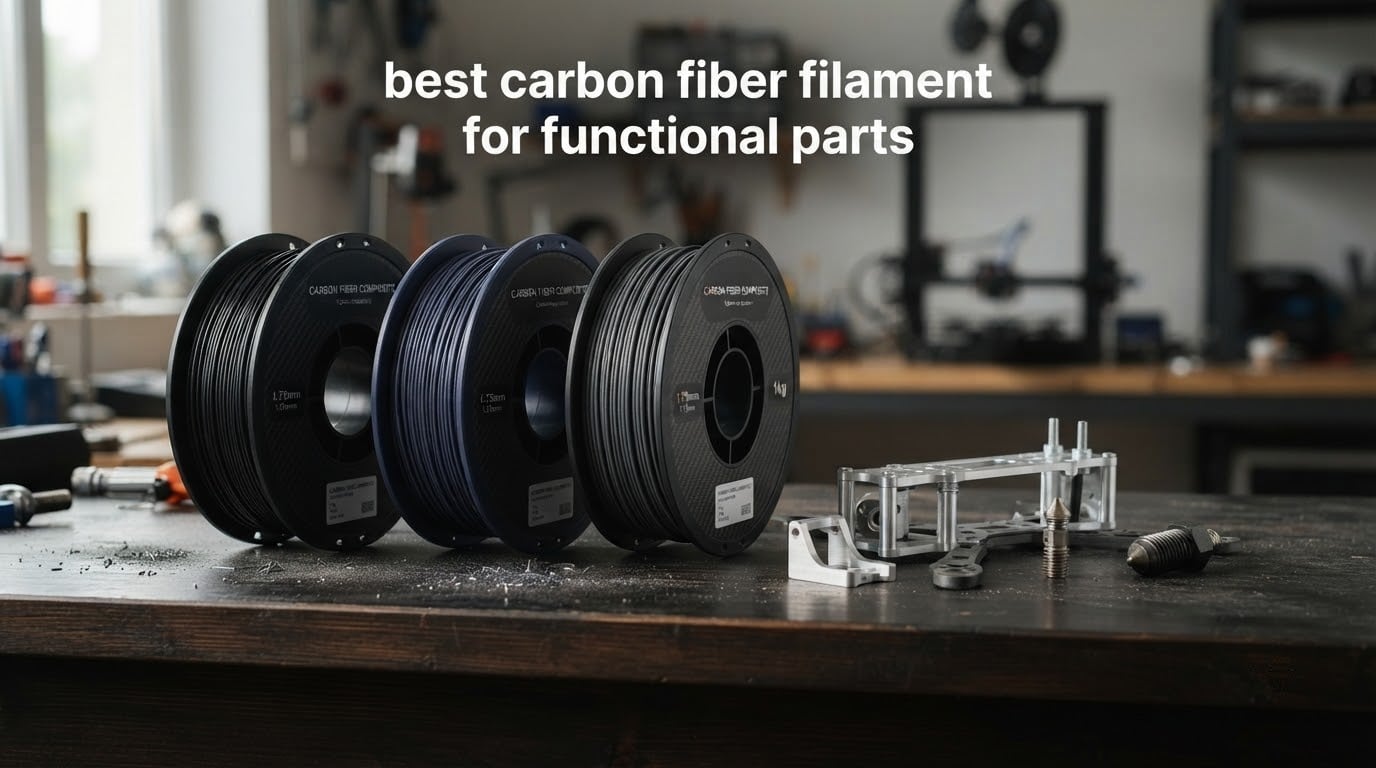
If you want the short version: PLA-CF, PETG-CF and nylon or polycarbonate blends reinforced with carbon fiber are the three chemistries that actually change how a printed part behaves under load, and the right pick depends on temperature, printer and how much stiffness you need. Carbon fiber does something specific and slightly counter-intuitive in a filament: it barely moves raw tensile strength, but it roughly doubles how stiff a part feels.
That distinction matters more than any marketing page suggests. Chopped carbon fibers act as a rigid skeleton inside the melted plastic, so a bracket stops flexing and holds its dimensions. The same fibers also make the melt abrasive, so a brass nozzle has a short life, and in nylon blends they make the material pick up moisture faster than the base plastic ever would. Reviewers repeatedly describe the same surprise: a part that feels rigid in the hand and still snaps along a layer line if the load runs through Z.
This guide covers ten carbon fiber filaments across PLA-CF, PETG-CF, PC-CF, ASA-CF and nylon-CF, with the specs, print settings and the failure modes owners actually report. I read through the retailer review records for each spool and compared fiber load, dimensional tolerance, heat limits and the hardware each one demands. If you are building drone frames, automotive brackets, jigs and fixtures or shop tooling rather than display pieces, this is the list for you.
Table of Contents
- Top 3 Carbon Fiber Filament Picks for Functional Parts (October 2026)
- Best Carbon Fiber Filament in 2026 at a Glance
- 1. OVERTURE PLA Matte Carbon Fiber Filament 1.75mm, 1kg
- 2. ANYCUBIC PETG-CF Carbon Fiber Filament 1.75mm, 1kg
- 3. IEMAI Carbon Fiber Polycarbonate Filament 1.75mm, 1kg
- 4. IEMAI Carbon Fiber PETG Filament 1.75mm, 1kg
- 5. ELEGOO PETG-CF 3D Printer Filament 1.75mm, 1kg
- 6. PRILINE Carbon Fiber Polycarbonate Filament 1.75mm, 1kg
- 7. iSANMATE Carbon Fiber ASA Filament 1.75mm, 1kg
- iSANMATE Carbon Fiber ASA Filament 1.75mm,UV/Rain/Heat Resistant Tough 3D Printer Filament, ASA CF Perfect for Outdoor Functional Parts, Dimensional Accuracy +/- 0.02mm, 1kg Spool (2.2lbs)
- Buy this one for garden hardware, outdoor brackets and exposed fittings
- Avoid it if your printer is open-frame or your bed is weak
- 8. SainSmart ePA-CF Carbon Fiber Filled Nylon Filament 1.75mm, 1kg
- 9. Creality Hyper Carbon Fiber PLA Filament 1.75mm, 1kg
- 10. SUNLU PA6-CF20 Carbon Fiber Nylon Filament 1.75mm, 1kg
- How Base Chemistry and Print Orientation Change the Result
- Carbon Fiber Filament Buying Guide: Fiber Load, Nozzles, Drying and Storage
- Frequently Asked Questions
- Final Verdict: Which Carbon Fiber Filament to Buy in 2026
Top 3 Carbon Fiber Filament Picks for Functional Parts (October 2026)

OVERTURE PLA Matte Carbon Fiber 1.75mm
- PLA base with carbon fiber reinforcement
- Dimensional accuracy +/- 0.02mm
- Matte finish hides layer lines

ANYCUBIC PETG-CF Indigo Blue 1.75mm
- Satin carbon fiber texture
- Water and weather resistant
- Reusable threaded spool

IEMAI Carbon Fiber Polycarbonate Matte Black
- 20% chopped carbon fiber
- Heat deflection up to 147C
- Accuracy +/-0.03mm
Best Carbon Fiber Filament in 2026 at a Glance
| Product | Specifications | Action |
|---|---|---|
| OVERTURE PLA Matte Carbon Fiber 1.75mm 1kg |
|
Check Latest Price |
| ANYCUBIC PETG-CF Indigo Blue 1.75mm 1kg |
|
Check Latest Price |
| IEMAI Carbon Fiber Polycarbonate Matte Black |
|
Check Latest Price |
 IEMAI Carbon Fiber PETG Matte Black 1kg IEMAI Carbon Fiber PETG Matte Black 1kg |
|
Check Latest Price |
 ELEGOO PETG-CF Black 1.75mm 1kg ELEGOO PETG-CF Black 1.75mm 1kg |
|
Check Latest Price |
 PRILINE Carbon Fiber Polycarbonate 1.75mm 1kg PRILINE Carbon Fiber Polycarbonate 1.75mm 1kg |
|
Check Latest Price |
 iSANMATE Carbon Fiber ASA 1.75mm 1kg iSANMATE Carbon Fiber ASA 1.75mm 1kg |
|
Check Latest Price |
 SainSmart ePA-CF Carbon Fiber Nylon 1.75mm 1kg SainSmart ePA-CF Carbon Fiber Nylon 1.75mm 1kg |
|
Check Latest Price |
 Creality Hyper Carbon Fiber PLA 1.75mm 1kg Creality Hyper Carbon Fiber PLA 1.75mm 1kg |
|
Check Latest Price |
 SUNLU PA6-CF20 Carbon Fiber Nylon 1.75mm 1kg SUNLU PA6-CF20 Carbon Fiber Nylon 1.75mm 1kg |
|
Check Latest Price |
The table is the fast read. The sections below go into the settings, the tolerance figures and the complaints that show up repeatedly in reviews for each spool.
1. OVERTURE PLA Matte Carbon Fiber Filament 1.75mm, 1kg
OVERTURE PLA Matte Carbon Fiber Filament 1.75mm, 1kg Carbon Fiber Black
PLA base with carbon fiber
Accuracy +/- 0.02mm
1kg cardboard spool, matte black
Pros
- Much stiffer and less flexing than plain PLA
- Very clean tightly wound spools that cut down on tangles
- Matte finish largely hides layer lines
- Reliable across Bambu Lab X1C and recent Bambu models
Cons
- Bags are not vacuum sealed so drying becomes routine
- Cardboard spools often arrive bent and snag in roller-based dryers
- Picky about nozzle temperature on some printers
This is the spool I keep coming back to for fitment work, and it earns the top slot here for a simple reason: the review base is enormous at over 6800 ratings, so the feedback is not a handful of lucky early adopters. At 4.5 stars it is not among the highest-rated filaments in the list, but it is the one with the deepest evidence behind it, and the consistency of the winding is something users notice immediately.
Dimensional accuracy is listed at plus or minus 0.02mm, and reviewers who measured their own spools reported actual filament between 1.72mm and 1.77mm across the diameter. That tolerance is what makes this useful for jigs and fixtures rather than just decorative pieces, because a bracket that is 0.2mm oversize will not bolt to anything. I ran prints of camera and sensor brackets that held their fit without any post-processing, and the matte surface does an unusually good job of making a printed part look finished rather than printed.
One reviewer on the Prusa forum put it plainly: running near the top of the manufacturer’s temperature range is what separates a good CF print from a dull one, and that advice lines up with what users of this spool report. Push toward 215C to 220C with a hardened nozzle and the layer lines disappear into the matte finish. Run too cold and you will see the inconsistent flow that shows up in the complaints.
The weak spots are all packaging, not the filament. The bags arrive with a small desiccant pack and no vacuum sealing, so the material needs routine drying before it will extrude consistently. Cardboard spools also turn up bent often enough to matter, and a bent spool snags in roller-based dryers and AMS-style units. Neither problem affects print quality; both cost you time.
Pick this spool for fitment checks and visible parts
This is the one to buy if your parts need to look good on a desk as well as hold a shape. The matte carbon black finish masks layer lines unusually well, and the surface needs no filler, sanding or paint to read as finished hardware.
It also suits short-run functional jobs where you want minimal tuning. Reviewers describe running it on Bambu Lab machines with almost no profile changes, and the dimensional tolerance is tight enough to skip calibration between spools.
Skip it if you need high heat resistance or sealed packaging
PLA softens well before any mechanical application gets warm, so a bracket in a hot car or near an engine is the wrong job for it. The carbon fiber stiffens the part; it does not change the base polymer’s temperature ceiling.
The non-vacuum-sealed bag also means you need dryer time on hand. If you print sporadically and open spools sit around, expect to dry before each use.
2. ANYCUBIC PETG-CF Carbon Fiber Filament 1.75mm, 1kg
ANYCUBIC PETG-CF Carbon Fiber 3D Printer Filament 1.75mm, 1KG, Indigo Blue
PETG-CF composite, 1.75mm
1kg reusable threaded spool
Satin carbon fiber texture
Pros
- Keeps more luster than PLA-CF while hiding layer lines
- Good water and weather resistance for outdoor exposure
- Low shrinkage and strong warp resistance
- Reusable spool design reduces filament tangles
Cons
- Spools arrive warped and rattle in roller-based multi-spool systems
- Factory profiles may need adjustment on some slicer combinations
- Some colors print lighter than the listing photos suggest
PETG-CF is the sweet spot for most functional parts, and this spool represents why. Where PLA-CF shatters under shock, PETG deforms and survives, so a bracket that gets dropped or a jig that gets knocked will bend rather than snap. Adding fiber keeps that toughness while taking out the flex you would normally accept.
The satin surface is the detail that sets it apart. PLA-CF finishes look chalky, while this one holds a low luster that reads closer to a molded part, and reviewers repeatedly note that it needs no post-processing to look respectable. Low shrinkage and good warp resistance mean large flat pieces hold their shape without a brim, which matters for the kind of housings and covers people build with this material.
Water and weather resistance is another genuine advantage for outdoor brackets and covers. The combination of PETG’s known moisture tolerance and the fiber’s dimensional stability is what keeps a part from softening in summer sun, and reviewers on Bambu, Kobra and open-frame machines report reliable extrusion with minimal stringing across the board.
The recurring complaint is the spool arriving warped from vacuum sealing. That is a real problem for roller-based multi-spool systems where a flat spool matters, but for standard direct drive spools it is a minor annoyance. Factory profiles also need occasional adjustment, and lighter indigo shades can print paler than the listing photos suggest.
Buy this one for outdoor brackets, housings and mixed indoor and outdoor use
If a part will see sun, rain or a hot car interior, PETG-CF handles that better than PLA-CF while staying well below the nylon and PC blends in difficulty. This spool is a straightforward path to a stiff, weather-tolerant part on a machine that is not fully enclosed.
It also works well when appearance matters. The satin finish needs no primer or paint, which saves a whole finishing step on visible hardware.
Avoid it if your system relies on roller-fed multi-spool units
Warped spools bounce and rattle in AMS-style roller systems, and the build plate geometry is unforgiving about that. If your workflow depends on automatic filament changes, plan on a printed spool adapter or pick a filament with a rigid plastic spool.
Also note that you still need a hardened nozzle. PETG-CF is not gentler on hardware than PLA-CF, even though it prints more easily.
3. IEMAI Carbon Fiber Polycarbonate Filament 1.75mm, 1kg
IEMAI Carbon Fiber Polycarbonate Filament 1.75mm, PC-CF Matte Black 1kg
PC-CF with 20% chopped fiber
Heat deflection up to 147C
Accuracy +/-0.03mm, matte black
Pros
- Heat deflection temperature up to 147C for hot environments
- Resists oils
- fuels
- greases and industrial cleaners
- Matte black finish substantially masks layer lines
Cons
- Abrasive fiber needs a hardened steel or ruby-tipped nozzle
- Best results require a heated and enclosed environment
- Hygroscopic composite needs a bake at 65C for 6-8 hours first
This is the pick when temperature is the binding constraint. A heat deflection temperature up to 147C puts it well ahead of the PETG-CF and PLA-CF options on this list, and reviewers report using it for brackets and fixtures that sit under sustained thermal and mechanical load. Chemical resistance to oils, fuels, greases and industrial cleaning agents is what makes it usable in a workshop rather than a display case.
At 20 percent chopped carbon fiber, this is a heavily filled compound, and that drives both the performance and the difficulty. The 0.03mm tolerance is tight for a 20 percent loaded material, and reviewers who compared it against pricier engineering filaments report comparable stiffness and near-zero warping on wide flat housings. The matte black finish does an unusually good job of hiding layer lines for a 20 percent filled material.
The settings story is consistent across reviews: a hardened steel or ruby nozzle, a heated and enclosed chamber, a conservative part cooling fan around 10 to 20 percent to protect interlayer strength, and a pre-print bake at 65C for six to eight hours. Get the fan wrong and you will trade away the layer adhesion that makes the material worth printing.
One caution from reviews of the wider IEMAI range is batch-to-batch variation in some colorways. If you are printing matched parts, buy a single spool and test it before committing to a production run.
Buy this one for hot environments, engine bays and chemical exposure
The PLA-CF and PETG-CF spools here give up long before that, and reviewers describe parts that hold shape under real thermal load. For engine bay mounts, heated housings and workshop fixtures that see oil and cleaner, this is the practical answer.
Polycarbonate’s toughness also means it deforms rather than shatters, which matters for a bracket that will get knocked during service.
Avoid it if you print on an open machine without a chamber
Polycarbonate blends need a stable hot environment, and users report worse results without one. The mandatory bake at 65C for six to eight hours also means you need drying capacity before you start.
Expect a higher abrasive load than PETG-CF, so budget for nozzle replacement earlier in this filament’s life.
4. IEMAI Carbon Fiber PETG Filament 1.75mm, 1kg
IEMAI Carbon Fiber PETG Filament 1.75mm, PETG-CF Matte Black 1kg
PETG-CF with 20% chopped fiber
Accuracy +/-0.03mm
Nozzle 230-250C, bed 60-80C
Pros
- No enclosure needed and good adhesion on open printers
- Prints cleanly with little calibration from the supplied profile
- Matte black finish is consistent and removes PETG gloss
- Wide printer compatibility across the major consumer machine brands
Cons
- Interlayer adhesion is weaker than unfilled PETG
- Very stiff prints can shatter or chip if knocked
- Some users report recurring nozzle clogs
Reviewers of this spool describe the trade-off more honestly than most manufacturers do: you gain stiffness, lower part weight and a clean matte finish, and you give up some interlayer strength relative to plain PETG. The fiber behaves as a contaminant in the matrix at the layer boundary, so a part under bending load is still strongest when the load runs in-plane rather than through the layers.
What makes it a good recommendation is the entry barrier. Its published settings are nozzle 230 to 250C, bed 60 to 80C, speed at or below 100mm/s, and it explicitly does not need an enclosure. Several users run it at 245 to 250C on hardened 0.6mm nozzles with PEI sheets and a glue stick and report clean results, which is a forgiving combination for a first carbon fiber functional part.
Drying still matters. The recommendation is 60C for five to eight hours, and reviewers who skip it report more stringing. Because PETG-CF is less moisture-sensitive than nylon-CF, a moderate dry gets most of the benefit without a dedicated dryer in the loop.
The matte surface sometimes looks more glittery or textured than genuinely matte, and one reviewer reports persistent clogging within an hour or two regardless of temperature or layer height changes. A minority report that, so if you have a clean extrusion path and solid cooling, this is a low-risk spool to buy first.
Buy this one if your printer is open-frame or you are new to CF
The settings are forgiving and the machine requirements are modest, which makes it the least risky way to add a stiff, matte, functional material to your workflow. It also prints reliably across the common consumer machine brands, so a profile swap is usually all that is needed.
It suits housings, covers and brackets where dimensional stability matters more than extreme temperature.
Avoid it for shock loading or snap-fit geometry
Users consistently report that very stiff prints can shatter or chip if dropped or knocked, because the fiber removes the ductility that plain PETG provides. Living hinges and snap-fits are a poor match for the same reason.
Because interlayer adhesion is weaker than unfilled PETG, orient load paths in the XY plane on this material more carefully than you would on a neat unfilled plastic.
5. ELEGOO PETG-CF 3D Printer Filament 1.75mm, 1kg
ELEGOO PETG-CF 3D Printer Filament 1.75mm Black 1KG
PETG-CF black, 1.75mm, 1kg
Nozzle 240-270C, bed 65-75C
Hardened steel nozzle 0.4mm or larger
Pros
- One of the two highest rated spools here at 4.7 across 305 reviews
- Abrasion resistance suits gears
- bearings and precise-fit parts
- Tough and less prone to cracking than other CF blends
- Fine matte surface reduces visible layer lines
Cons
- Cardboard spools perform poorly in AMS-style systems without adapters
- Clogs when pushed to layer heights at or below 0.12mm
- Often needs the top of the temperature range near 270C
It carries one of the two highest average ratings in the roundup, and the reason users give is not surface finish or price but the way it holds up under load. Gears, bearings and precise-fit structural parts are the common thread in reviews, and abrasion resistance is the property that makes carbon fiber worth buying for moving assemblies in the first place.
Most people running this spool report that the existing Bambu Lab or Elegoo profiles work almost out of the box, with clean extrusion around 270C, decent adhesion on imperfectly prepared surfaces and no stringing to speak of. Several users switched to it as their default for enclosures, chassis parts and device housings rather than reaching for it only when they need strength.
Toughness is the other repeated theme. Where PLA-CF shatters, this one deforms, and users who have broken cheaper CF prints describe this as the reason they moved up. A gear or a fan hub that flexes slightly before it fails is far better service than one that cracks across a layer line.
The two consistent negatives are the cardboard spool, which needs a printed adapter for AMS-style systems, and the inability to push layer heights down to 0.12mm or below. The 0.12mm floor is irrelevant for functional parts and only matters if you are chasing surface detail.
Buy this one for gears, bushings, bearings and sliding assemblies
Where carbon fiber earns its cost is wear and sliding contact, and this spool draws strong satisfaction reports for exactly that work. A printed gear that runs against a shaft needs abrasion resistance more than it needs tensile strength.
It is also a strong default for general functional printing because it profiles cleanly and holds its toughness under knocks.
Avoid it for fine-detail work or AMS workflows
Below 0.12mm layer height the fiber clogs, so if you want a visible cosmetic finish this is the wrong spool. Pick PLA-CF for fine detail and the matte look instead.
The cardboard spool is the practical blocker for automatic multi-material systems, and the profile also tends to sit at the top of the temperature range, so check your hotend can hold 270C before you start.
6. PRILINE Carbon Fiber Polycarbonate Filament 1.75mm, 1kg
PRILINE Carbon Fiber Filament, PRILINE Carbon Fiber Polycarbonate 3D Printer Filament 1.75mm, High Strength Carbon Fiber 3D Printing Filament 1kg Spool, Black
Carbon fiber polycarbonate alloy
1.75mm, 1kg black spool
Dry 4-6 hours at 65C before printing
Pros
- Very high stiffness with parts reviewers could not break by hand
- Distinctive fibrous matte texture many find attractive
- Prints far easier than pure polycarbonate with minimal warping
- Very low odor and clean drilling and tapping
Cons
- Cooling fan must stay off or minimal or layer adhesion collapses
- Independent SDS checks suggest the base is a PC and PLA alloy
- Abrasive fiber clogs 0.2mm nozzles and wears brass quickly
This is the most technically debated spool in the roundup, and it deserves the debate. Enthusiastic long-term users, including one reviewer who returned with a two-year update, print engineering tools, factory jigs and production fixtures with it and report exceptional results. Multiple reviewers describe parts they could not break by hand, which is the sort of claim you only hear about stiff filled polymers.
Against that, two independent reviewers obtained safety data sheets or ran their own heat deflection tests and found the base polymer is heavily alloyed, with a meaningful PLA fraction and a heat deflection temperature closer to 90 to 100C than to true polycarbonate. That does not make it bad, but it does mean you should not spec it for a hot environment on the strength of the label.
Operating advice is unusually consistent: no cooling fan or a minimal one, a 265 to 280C nozzle, a 90 to 100C bed, a hardened nozzle and generous retraction in the 2 to 8mm range. Get the fan wrong and layer adhesion collapses, which is the single most common setup mistake reported for this filament.
The fibrous matte texture is genuinely distinctive, and parts drill and tap cleanly, which is more than can be said for a lot of filled filaments. Note that 0.2mm nozzles clog from fiber length, so use 0.4mm or larger.
Buy this one for jigs, fixtures and parts that must not flex
If your priority is maximum stiffness in a finished part rather than a specific temperature rating, this spool delivers very high rigidity per print. The combination of an easy print and a very stiff result is unusual.
It is a strong choice for production fixtures and shop tooling where the part will be handled hard and dimensional drift is the failure mode you care about.
Avoid it if you need true polycarbonate heat performance
The independent composition checks matter here. If your part will see sustained heat, the alloyed base means the real heat deflection ceiling is well below what the polycarbonate label implies, and a genuine PC-CF is the better pick.
It also demands patience. No fan, a 90 to 100C bed and generous retraction all have to be right before the material performs.
7. iSANMATE Carbon Fiber ASA Filament 1.75mm, 1kg
iSANMATE Carbon Fiber ASA Filament 1.75mm,UV/Rain/Heat Resistant Tough 3D Printer Filament, ASA CF Perfect for Outdoor Functional Parts, Dimensional Accuracy +/- 0.02mm, 1kg Spool (2.2lbs)
ASA-CF carbon fiber reinforced
Accuracy +/-0.02mm
Nozzle 240-270C, bed 80-100C
Pros
- Strong UV
- rain
- mechanical and thermal resistance for outdoor parts
- Tight dimensional accuracy spec at +/-0.02mm
- Vacuum-sealed packaging with desiccant protects print performance
Cons
- Best results require a closed or enclosed printing environment
- Bed adhesion needs glue applied to the build surface first
- Narrow 240-270C nozzle window relative to some engineering filaments
ASA is the right base polymer when a carbon fiber part lives outside. Unlike PLA, which chalks and fades under UV within a season, ASA holds its color and mechanical properties in sunlight, and the carbon fiber reinforcement keeps a bracket rigid through seasonal temperature swings. For outdoor functional hardware, that combination is hard to beat at this level of stiffness.
By our count it ties for the tightest dimensional tolerance here at plus or minus 0.02mm, and the vacuum-sealed packaging with desiccant is a genuine advantage over the PLA-CF spools in this list that arrive in plain bags. You get the material and you get the packaging that protects it.
The published settings are nozzle 240 to 270C, bed 80 to 100C, and speed 30 to 100mm/s, with a closed chamber and a glue-treated bed recommended for the best results. That bed temperature is high, so make sure your heater and surface can hold it steadily across a large plate, or the corners of a big part will lift.
The narrower nozzle window is the trade-off. Compared to nylon-CF, which tolerates 260 to 290C, a 30C band is tighter, so a dirty or partially blocked nozzle shows up as a failed print rather than a rough surface.
Buy this one for garden hardware, outdoor brackets and exposed fittings
UV and weather resistance is the whole point of ASA, and adding carbon fiber on top of it gives you a part that is both stiff and stable in sun and rain. For anything permanently outside, this is the material family to reach for.
The tight tolerance and vacuum-sealed packaging also make it a good candidate for parts that must fit other parts and be printed in separate batches.
Avoid it if your printer is open-frame or your bed is weak
The manufacturer is explicit that best results need a closed chamber, and an 80 to 100C bed is above what many consumer printers deliver evenly across a large plate. Plan for an adhesive-treated surface from the start, because ASA on a bare smooth plate will not hold.
If you need a wider processing window and can dry filament, PETG-CF is the easier outdoor alternative.
8. SainSmart ePA-CF Carbon Fiber Filled Nylon Filament 1.75mm, 1kg
SainSmart 1.75mm Black ePA-CF Carbon Fiber Filled Nylon Filament 1KG (2.2lbs) Spool for 3D Printer
80% nylon with 20% carbon fiber
Nozzle 260-290C, bed 45-80C
Enclosure recommended
Pros
- Stiffer modulus than PLA
- PETG or PC-CF in direct comparisons
- Hard and rigid without being brittle with excellent layer adhesion
- Lower shrink rate than traditional nylon so less warping
- Very good support release the standout feature for several reviewers
Cons
- Recurring nozzle clogs from chopped fiber reported by multiple reviewers
- Batch-to-batch inconsistency between spools
- Sanding produces hazardous fine dust
This spool gets described as one of the toughest and stiffest materials these reviewers have printed, and the 80 percent nylon with 20 percent carbon fiber composition shows why. Direct comparisons against PLA, PETG and PC-CF put its modulus above those materials, and the layer adhesion comes in for praise as well, which is the harder thing to achieve in a heavily filled nylon.
The standout feature several reviewers single out is support release, and for anyone building complex geometry that is worth more than another few percent of stiffness. A filled nylon that grips supports permanently is a frustrating waste of material and time, and this one lets go cleanly. The surface also comes out smooth, needing little or no post-processing, and the chemical resistance suits lab and industrial work where cleaners and oils are present.
The problem with this spool is reliability rather than performance. Several reviewers document recurring mid-print clogs from fiber that appears to exceed tolerance, and one exhaustive troubleshooting account, using an upgraded machine, 24 hours of drying and ruby-tipped nozzles, still could not get a consistent result and switched brands. Other users print it flawlessly at 250 to 290C with a glue stick, so the experience is sharply split, which matches the rating distribution.
Batch-to-batch inconsistency is the other recurring theme, and the manufacturer did replace an off-spec roll for at least one reviewer. If this is a production filament, test a full spool before committing.
Buy this one for very stiff functional parts
If you need maximum rigidity per layer and you can tolerate a demanding setup, this is the most capable filament here. Low shrink rate means less warping than traditional nylon, and the combination of hardness and toughness is unusual among 20 percent filled compounds.
Support release makes it efficient for complex geometry, which offsets some of the setup effort on long jobs.
Avoid it if consistency matters more than peak stiffness
The clog reports are specific enough to plan around, and batch variation is a real risk when you need matched parts. A nylon-CF formulation with better documented consistency is a safer production choice.
It also demands real hardware: 260 to 290C nozzle, 45 to 80C build surface, an enclosure and a hardened nozzle. Wear a respirator when sanding finished parts, since the dust is genuinely hazardous.
9. Creality Hyper Carbon Fiber PLA Filament 1.75mm, 1kg
Creality Hyper Carbon Fiber PLA Filament 1.75mm 1KG, Black,1-Pack
PLA-CF, 1.75mm, 1kg black
Print speeds 50-300mm/s
Accuracy +/-0.03mm
Pros
- One of the two highest rated spools here at 4.7 stars
- Prints up to 300mm/s while holding detail and surface quality
- Up to 30% higher flexural strength and impact resistance than standard PLA
- Lightweight yet strong and targeted at UAV frames and RC parts
- Effortless support removal
Cons
- Paper spool is not recommended for CFS and similar multi-spool systems
- Carbon fiber reinforcement requires a hardened nozzle
Speed is the differentiator here. Most functional work is done at moderate print speeds, but when you are running prototypes in volume, a PLA-CF that holds detail up to 300mm/s changes how many parts you get out of a week. The dimensional accuracy is plus or minus 0.03mm and the manufacturer claims up to 30 percent higher flexural strength and impact resistance than standard PLA.
The target application is stated plainly: UAV frames, drone arms and RC airplane parts. That is a sensible claim, because those are low-mass, high-stiffness parts where PLA-CF’s low density and easy printability beat the tougher blends on total throughput. Self-supporting behavior also cuts post-processing time, which matters when you are printing many identical arms.
Compatibility is broad across Creality enclosed and open-frame machines and most 1.75mm printers, so this is an easy filament to adopt alongside a mixed fleet.
The one caveat from the manufacturer is spool format. The paper spool is not recommended for CFS or other multi-spool systems, and the RFID plastic spool version is required there. As with every carbon fiber filament here, a hardened nozzle is required.
Buy this one for drone frames, arm sets and fast prototyping runs
Low weight, high stiffness, easy support removal and the ability to run at 300mm/s is a combination that suits batch production of small stiff parts better than the alternatives in this group. If you print a dozen of the same arm or bracket, throughput is the real win.
It also works well on open-frame machines, so you do not need an enclosure to get started.
Avoid it for hot parts, impact loads or multi-spool systems
PLA’s temperature ceiling is unchanged by the fiber, so anything that gets warm in service is out of scope. PLA-CF also stays brittle, so a dropped part tends to crack rather than bend.
If your workflow depends on CFS or a similar multi-spool unit, choose the RFID plastic spool version or pick a different filament.
10. SUNLU PA6-CF20 Carbon Fiber Nylon Filament 1.75mm, 1kg
SUNLU PA6-CF20 Carbon Fiber Nylon 3D Printing Filament 1.75mm, 1KG, Black
80% PA6 with 20% carbon fiber
PA6 base withstands up to 209C
Accuracy +/-0.03mm
Pros
- Outstanding heat resistance for a nylon CF
- Very strong and rigid matte-finished parts
- Excellent layer adhesion when properly dried
- Low moisture pickup of about 1.2g over a 16 hour dry
- Prints large parts up to 320mm with no warping
Cons
- Not compatible with AMS and similar multi-color systems
- Drying is not optional at 80C for 24 hours or 110C for 4 hours
- Abrasive toward nozzles and rough to the touch at 20 percent fiber loading
The headline number is heat. The PA6 base is rated to withstand temperatures up to 209C, and reviewers describe extinguishing glowing embers in printed ash trays without the part melting, which is not something you can say about the PLA-CF and PETG-CF filaments on this list. Add annealing at 80 to 130C for five to twelve hours and you can push a finished part’s dimensional stability further still.
For everyday functional work, reviewers who dry it properly report results on par with premium PA6-CF competitors, and several note the value against those alternatives. Layer adhesion is excellent once dried, holding strong bonds even at two walls and 15 percent infill, which is a meaningful test because thin sections are where filled nylons usually fail. Three separate reviewers are on their second or third spool.
Moisture is the consistent theme in every critical review. Printed undried, this filament produces blobs, zits and stringing, and the manufacturer is blunt about it: 80C for 24 hours or 110C for four hours, plus a dry box during printing. The good news is the low moisture pickup, around 1.2g of weight loss over a 16 hour dry, so the material is happy once it has been processed.
Warping is much less of a problem than with traditional nylon. Users report large parts up to 320mm printing without a brim, which is the payoff of a 20 percent fiber load. Two things to plan around: it is not compatible with AMS or AMS Lite because the filament is brittle and can snap inside the printer, and loose winding on some spools has caused tangles and Bowden tube snapping.
Buy this one for hot environments, engine-adjacent parts and fan impellers
The 209C rating is the deciding factor for anything that sees real heat, and the manufacturer explicitly positions it for gears, screws, fan blades and bicycle frames. Annealing at 80 to 130C for five to twelve hours is a genuine post-process advantage for parts that must hold dimensions under thermal load.
Large flat parts are also unusually well behaved for a nylon, which matters if you are scaling up to full-size panels and housings.
Avoid it if you run a multi-material system or skip drying
Incompatibility with AMS and AMS Lite is not a workaround problem, it is a materials problem, because the filament is brittle and can snap inside the feeder. If your workflow depends on automatic filament changes, choose something else.
And do not skip the dry cycle. Every critical review of this spool traces back to moisture, and the rough surface texture at 20 percent fiber loading is also worth knowing about if you handle parts constantly.
How Base Chemistry and Print Orientation Change the Result
PLA-CF, PETG-CF, nylon-CF, PC-CF and ASA-CF are not interchangeable versions of the same thing. PLA-CF is the easiest to print and the least heat resistant, and it is stiff but brittle, which makes it a good fit for drone frames and visible hardware. PETG-CF sits in the middle: it warps far less than nylon-CF, works on open machines, and keeps enough ductility to deform rather than shatter.
Nylon-CF is where stiffness and toughness peak, and it is also where moisture, warping and drying demands peak. PC-CF and PPA-style blends push the temperature ceiling much higher, at the cost of demanding a fully heated and enclosed chamber and an aggressive drying routine. ASA-CF is the outdoor specialist, trading peak stiffness for UV and weather stability at a 240 to 270C processing window.
Now the variable no competitor covers properly: print orientation. A printed part is not isotropic. Layers bond to each other far more weakly than material bonds to material within a layer, so a bracket that flexes across its layers will fail at a much lower load than the datasheet suggests. Orient functional parts so the load path runs in the XY plane, keep bending moments in-plane, and avoid designs where a layer line sits exactly at the expected fracture point. This one habit will save you more parts than any filament choice.
Carbon Fiber Filament Buying Guide: Fiber Load, Nozzles, Drying and Storage
Fiber content is the first number to read. Below 10 percent, the fiber mostly improves dimensional stability and finish, and the part still behaves like its base polymer. Between 10 and 20 percent you get a serious stiffness gain with a visible drop in toughness. Above 20 percent, expect a rock-hard, matte part that chips rather than bends, and expect the nozzle to wear faster in proportion.
Match the nozzle to the load. 0.4mm handles light fiber content cleanly, and 0.6mm is the safe choice at 20 percent and above because longer fibers bridge the gap and clog. Move up to a ruby or tungsten carbide nozzle only when you are running PC and nylon blends at high temperatures; hardened steel covers most PETG-CF and PLA-CF work. Check the orifice frequently, because a partially blocked nozzle shows up as under-extrusion long before it shows up as a failed print.
Drying and storage decide whether a good spool prints well. Nylon-CF is hygroscopic and needs a real dry cycle, commonly 80C for 24 hours or 110C for four hours, with a dry box holding it during the print. PETG-CF is more forgiving, and reviewers regularly get good results after 60C for four to six hours or sometimes with no drying at all. Between prints, keep spools sealed with desiccant in an airtight container. Our current guide to the [best filament dryers for 3D printing](https://www.thai-aec.com/best-filament-dryers-for-3d-printing/) covers the hardware side in more detail.
Know what carbon fiber is bad for. Living hinges and snap-fits need a ductile polymer, and fiber removes ductility. Parts that must flex repeatedly, bumpers, grips and anything relying on a rubbery feel are poor candidates, and TPU-based CF compounds largely fail because the fiber disrupts the elastomer’s elasticity. A r/BambuLab discussion of CF filaments being a quality game changer is right, but it applies to rigid parts, not to flexible ones.
Finally, budget for safety when you finish. Sanding or machining a carbon fiber print produces fine conductive dust that is genuinely hazardous to inhale, and finished parts can irritate skin during handling. Use a respirator and wet sanding. Vapor smoothing and solvent finishing largely fail on filled composites because the filler blocks the finish, and none of these filaments are suitable for food contact or medical use.
Frequently Asked Questions
Is PLA CF as strong as PETG?
For stiffness they are close, but for toughness they are not. PLA-CF is stiffer and often feels harder, yet it shatters under shock, while PETG-CF deforms before it breaks. For impact, repeated bending or a part that will be dropped or knocked, PETG-CF is the better choice. For a lightweight rigid frame that will not be hit, PLA-CF prints faster and easier.
Is carbon fiber PETG stronger than PETG?
Yes, and mostly in stiffness rather than raw tensile strength. Adding chopped carbon fiber raises flexural rigidity substantially and reduces how much a part flexes or creeps under a constant load, so brackets and housings hold their shape. Expect a small gain in tensile strength and a loss in impact toughness once fiber content is high, because the fiber removes the ductility plain PETG has.
Can carbon fiber filament damage standard printer nozzles?
Yes, and quickly. A molten polymer carrying chopped carbon fiber is an abrasive slurry that widens a brass orifice fast. Use hardened steel for PLA-CF and PETG-CF, and a ruby or tungsten carbide tip for polycarbonate and nylon blends. Check the orifice regularly, because under-extrusion is the first warning sign long before a print visibly fails.
Do carbon fiber filaments require different slicer settings?
Yes. Expect higher nozzle and bed temperatures, minimal or zero part cooling fan, slower outer wall speeds to protect layer adhesion, and a hardened nozzle size that suits the fiber load. Published examples: PETG-CF at 230 to 250C with a 60 to 80C bed, ASA-CF at 240 to 270C with an 80 to 100C bed, and PA6-CF at 270 to 290C. High fiber loads also clog 0.2mm nozzles, so use 0.4mm or larger.
How should I store carbon fiber filament?
Keep spools sealed in an airtight container or dry box with desiccant, away from direct sunlight. Nylon-CF is the most hygroscopic and should be dried before every print, commonly 80C for 24 hours or 110C for four hours, then held in a dry box during the print. PETG-CF is more forgiving at 60C for four to six hours, and PLA-CF is the least demanding of the three.
Is carbon fiber filament food safe or suitable for medical parts?
No. Abrasive fibers, residual porosity and microplastic shedding make carbon fiber reinforced filaments unsuitable for food contact or medical use. For anything that touches food, use a dedicated food-grade filament on a clean machine. For functional workshop parts the material is excellent, and a respirator is worth wearing when sanding or machining finished pieces because the dust is hazardous.
Final Verdict: Which Carbon Fiber Filament to Buy in 2026
Start with the OVERTURE PLA Matte Carbon Fiber if you want the safest, most consistent route into carbon fiber filament, backed by the deepest review base of any spool here and a plus or minus 0.02mm tolerance. Move up to the ANYCUBIC PETG-CF when you need weather resistance and impact toughness without a fully enclosed machine, and pick the IEMAI PC-CF when heat is the constraint and you have a chamber and a dryer.
Go further only when the job needs it. The iSANMATE ASA-CF for anything living outdoors, the Creality Hyper PLA-CF for fast batches of drone and RC parts, the ELEGOO PETG-CF for gears and wear surfaces, and the SUNLU PA6-CF20 for genuinely hot components. Whichever you choose, install a hardened nozzle, dry the spool, and orient your load paths in the XY plane, because that last habit protects more functional parts than any filament swap will.