
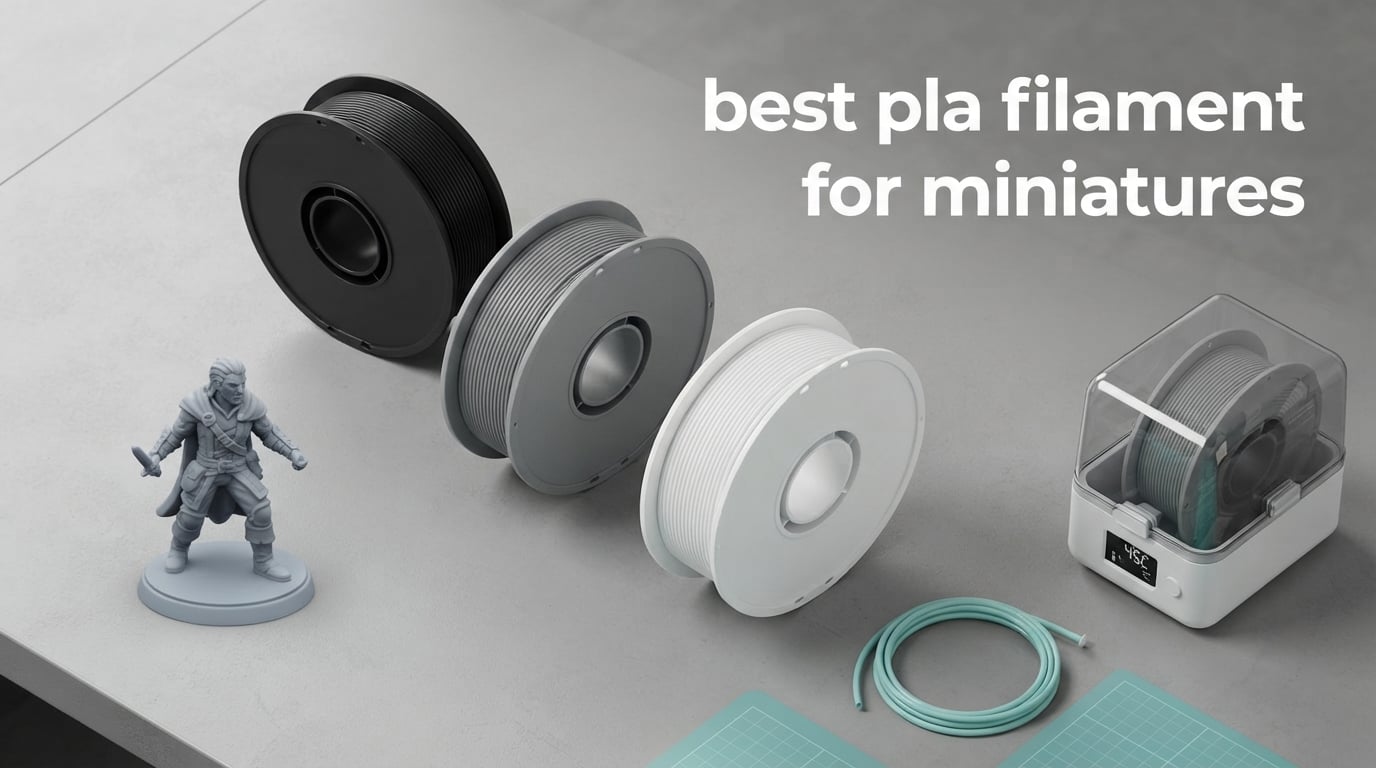
If you only buy one spool for 28mm and 32mm tabletop miniatures, get the eSUN PLA+ 1.75mm 1kg. It holds a plus or minus 0.03mm diameter across long prints, extrudes cleanly through a 0.2mm nozzle, and has the deepest review history of any filament in this roundup. For painted display work, pair it with the Overture Matte PLA, and for armies printed in bulk, the SUNLU PLA+2.0 handles 300mm/s cores without smearing faces.
That is the short version of the best PLA filament for miniatures, and the honest version is that filament matters less than most forums claim and more than most brands advertise. Settings decide layer height and support strategy. Dry filament decides whether a face comes out sharp or blobby. But the polymer you load decides whether a spear snaps during support removal and whether primer grabs the surface or beads on it.
We compared ten 1.75mm PLA and PLA+ spools on the criteria that actually show up on a gaming table: diameter consistency, melt flow at small nozzle sizes, overhang behaviour, finish, and how the plastic responds to filler primer, sanding, and thin acrylics. Every filament here is a well-known name with a large installed base, so what you are really choosing between is matte versus glossy, basic versus modified, and slow-and-safe versus fast-and-rewarding. If moisture is part of your problem, our filament dryer roundup covers the hardware side.
Table of Contents
- Top 3 Picks for the Best PLA Filament for Miniatures in 2026
- 10 Best PLA Filament for Miniatures (October 2026)
- 1. eSUN PLA+ 1.75mm 1kg – The Best All-Round PLA Filament for Miniatures
- 2. ELEGOO Rapid PLA Plus 1.75mm 1kg – Best Value for Fast Printing Cores
- 3. SUNLU PLA+2.0 1.75mm 1kg – Best for High-Speed Army Printing
- 4. OVERTURE Matte PLA 1.75mm 1kg – Best Matte Filament for Painting and Display
- 5. Polymaker PolyLite PLA Pro 1.75mm 1kg – Best for Hero Models and Thin Geometry
- 6. Polymaker PolyMax Tough PLA 750g – Best for Drop-Resistant Gaming Miniatures
- 7. Creality Hyper PLA 1.75mm 1kg – Best for Colour Accuracy on Painted Minis
- 8. eSUN PLA Basic 1.75mm 1kg – The Budget Pick for Bulk Printing
- 9. OVERTURE High Speed PLA 1.75mm 1kg – Best for Everyday Printing and Clean Feeding
- 10. eSUN High Speed PLA+ 1.75mm 1kg – Best for Overhangs and Tree Supports
- What Actually Matters When You Choose PLA Filament for Miniatures
- Filament vs Resin for Miniatures
- Frequently Asked Questions
- What is the best PLA filament for miniatures?
- Is PLA+ really better than PLA for miniatures?
- Is PLA or PETG better for miniatures?
- Is matte PLA better for painting miniatures?
- Can you use PLA for miniatures?
- Why are my miniatures popping and stringing?
- What filament works with super glue and Tamiya Extra Thin?
- Does filament brand actually matter for miniatures?
- Final Verdict: Which PLA Filament to Buy
Top 3 Picks for the Best PLA Filament for Miniatures in 2026

eSUN PLA+ 1.75mm 1kg
- Plus minus 0.03mm tolerance
- Enhanced toughness over standard PLA
- High speed printing formula
- Tangle free winding

ELEGOO Rapid PLA Plus 1.75mm
- Prints up to 600mm/s
- Plus minus 0.02mm accuracy
- High flexural modulus
- Mechanically wound spool

SUNLU PLA+2.0 1.75mm 1kg
- Crack resistant PLA+ formula
- Up to 300mm/s
- Plus minus 0.02mm accuracy
- Vacuum sealed packaging
10 Best PLA Filament for Miniatures (October 2026)
Every spool below is 1.75mm diameter and FDM compatible. The features column is drawn from the manufacturer data and the buyer feedback, not from our own test bench, so treat the tolerance and speed figures as rated specifications.
| Product | Specifications | Action |
|---|---|---|
| eSUN PLA+ Filament 1.75mm 1kg |
|
Check Latest Price |
| ELEGOO Rapid PLA Plus 1.75mm 1kg |
|
Check Latest Price |
| SUNLU PLA+2.0 1.75mm 1kg |
|
Check Latest Price |
 OVERTURE Matte PLA 1.75mm 1kg OVERTURE Matte PLA 1.75mm 1kg |
|
Check Latest Price |
 Polymaker PolyLite PLA Pro 1.75mm 1kg Polymaker PolyLite PLA Pro 1.75mm 1kg |
|
Check Latest Price |
 Polymaker PolyMax Tough PLA 750g Polymaker PolyMax Tough PLA 750g |
|
Check Latest Price |
 Creality Hyper PLA 1.75mm 1kg Creality Hyper PLA 1.75mm 1kg |
|
Check Latest Price |
 eSUN PLA Basic 1.75mm 1kg eSUN PLA Basic 1.75mm 1kg |
|
Check Latest Price |
 OVERTURE High Speed PLA 1.75mm 1kg OVERTURE High Speed PLA 1.75mm 1kg |
|
Check Latest Price |
 eSUN High Speed PLA+ 1.75mm 1kg eSUN High Speed PLA+ 1.75mm 1kg |
|
Check Latest Price |
1. eSUN PLA+ 1.75mm 1kg – The Best All-Round PLA Filament for Miniatures
eSUN PLA+ Filament 3D Printer Filament PLA Plus 1KG Black
1.75mm diameter
Plus minus 0.03mm
1kg spool, 340-350m
Enhanced toughness
Pros
- Very consistent extrusion with almost no stringing
- Neatly wound spools that resist tangles
- Reliable 0.03mm dimensional tolerance
- Good bed adhesion on long prints
Cons
- Some spools arrive damp and string until dried
- Bed near 70C can be needed for first layer
- Cardboard spool is awkward in AMS style feeders
The eSUN PLA+ is the spool we come back to. Its 1kg gives roughly 340 to 350 metres of filament, which on a 28mm figure eating 6 to 8g is a very long time before you are refilling. That matters when you are printing an army rather than a single hero model.
Extrusion is the headline here. Buyers consistently report smooth flow with almost no stringing and no clogs, and the diameter is held to plus or minus 0.03mm by the manufacturer. On a 0.2mm nozzle that tolerance is tight enough that layer height and flow settings behave the same on Monday as they did on Saturday, which is the thing that actually makes small details repeatable.
Where it earns its place on a miniature desk is toughness. PLA+ carries impact modifiers that let a sword tip or an outstretched arm flex slightly during support removal instead of snapping at the layer line. Reviewers call out good bed adhesion without part shift on long prints, and the surface comes out with even layer lines and a slight gloss that primer keys into well.
The honest weaknesses are moisture and the spool. Some buyers report spools arriving damp and stringing until dried, and a few batches show heavy bubbling straight out of the sealed bag. The cardboard reel also does not play nicely with AMS or MMU style feeders, so if you run a multi-material setup, budget for a separate external spool holder.
Who the eSUN PLA+ suits best
This is the filament to buy if you want one decision that covers most of a 28mm or 32mm D&D campaign: rank-and-file troops, a handful of bosses, scatter terrain, and a dungeon tile or two. It handles supports well, prints at normal hobby speeds, and takes filler primer, acrylics, and thin coats without complaint. It is also the safest first spool because the community has already debugged most of its quirks.
Buyers switching from standard PLA usually report the same thing: fewer snapped details, less visible brittleness at the wrist, and a noticeably calmer stringing situation around chainmail and hair. That is the whole upgrade, and it is worth it.
Where it is the wrong choice
If layer line visibility under raking light ruins immersion for you, this is a glossy formula and it will not hide anything. Pick a matte spool instead. If you are running an AMS feeder, the cardboard reel is a real friction point. And if you cannot commit to a filament dryer or a dry box, budget for the stringing that wet spools produce, because that failure mode hits faces first.
2. ELEGOO Rapid PLA Plus 1.75mm 1kg – Best Value for Fast Printing Cores
ELEGOO Rapid PLA Plus 3D Printer Filament 1.75mm Black 1KG
1.75mm diameter
Plus minus 0.02mm
30-600mm/s rated
1kg black spool
Pros
- Smooth fast extrusion suited to high speed cores
- High flexural modulus resists cracking
- Mechanically wound spools reduce tangles
- Works on standard and high speed FDM printers
Cons
- Not a matte or specialty surface filament
- Smaller independent review pool than eSUN spools
The ELEGOO Rapid PLA Plus is the one we reach for when the goal is throughput. The manufacturer rates it for 30 to 600mm/s thanks to enhanced fluidity, and buyers back that up with reports of smooth fast extrusion that suits high speed cores. For a goblin army that would take a week at 40mm/s, that headline number is the whole pitch.
Dimensional accuracy is quoted at plus or minus 0.02mm, which is the tightest tolerance among the modified PLA spools in this roundup, alongside SUNLU and Polymaker. Consistent diameter plus high flexural modulus and elongation is a good combination on small geometry: the material resists cracking on thin details rather than snapping cleanly through the layer line.
Winding is fully mechanical with strict manual inspection, and buyers single that out as a reason for tangle-free feeding. Low warp and good layer adhesion mean the first layer on a textured PEI plate is rarely the thing that ruins an evening. It is also listed as compatible with the Neptune 4 series, K1 and K1 Max, Ender 5, Kobra 2, and the AnkerMake M5.
The limitation is surface. This is a plain PLA Plus base, not a matte or lithophane line, so layer lines stay visible and you are still doing filler primer work if the model will be displayed. Review volume is also smaller than the eSUN listings, which means long-term batch consistency is harder for a buyer to judge from experience alone.
Who the ELEGOO Rapid PLA Plus suits best
Printers with hardened cores who want to run a high speed profile without giving up impact modifier strength. It is also a strong second spool for anyone whose main complaint is time per print rather than surface finish. The plus or minus 0.02mm tolerance gives it a good track record for consistent extrusion at 0.2mm when the flow is calibrated properly.
If you are mixing and matching, the consistency of the diameter means you can calibrate flow once on this and expect similar results on the other modified PLA spools in this list, which is not always true across brands.
Where it is the wrong choice
Skip it if the mini is going straight into a display cabinet and you want layer lines gone at the print stage. Glossy output plus a visible layer stack is a prep problem, and prep problems cost primer, sand, and time. It is also the wrong pick if you need a specialty finish; the range is functional rather than decorative.
3. SUNLU PLA+2.0 1.75mm 1kg – Best for High-Speed Army Printing
SUNLU PLA+2.0 3D Printer Filament, Black, 1KG
1.75mm diameter
Plus minus 0.02mm
Nozzle 205-220C, bed 50-60C
Spools at 100-300mm/s
Pros
- Better crack and brittleness resistance than earlier PLA+
- Quick melt supports speeds up to 300mm/s
- Neat winding reduces tangles and clogs
- Vacuum sealed packaging
Cons
- Standard colour range is limited for tabletop matching
- No matte or specialty surface variant here
SUNLU rebuilt the PLA+ formula for PLA+2.0, and the change buyers actually notice is brittleness. Rather than just being stiffer, the material resists cracking, which is the failure that ruins a partially printed model. On miniatures that spend years on a shelf next to a dice tray, that difference shows up in how many weapon arms are still attached a year later.
The rated print window is 205 to 220C nozzle, 50 to 60C bed, and 100 to 300mm/s, which is a fast melt profile. Diameter is held to plus or minus 0.02mm, and packaging is vacuum sealed to resist moisture, a detail that matters given that PLA is hygroscopic and absorbs water straight out of the air.
Physical spool design is worth knowing about. The reel measures 195mm in diameter by 57mm wide with a 63mm hub hole, and a reusable spool is available separately. That is a properly engineered hub rather than a cardboard pancake, so it feeds through enclosed AMS style units without the fibre shedding that plagues some cheaper spools.
Reported output is a smooth, matte-adjacent finish with very few outright failures. The one thing reviewers ask for is a wider standard colour range, because the current selection is not ideal if you want to match a specific army scheme without painting every rank and file model from white.
Who the SUNLU PLA+2.0 suits best
Anyone printing fifty or more figures on a machine that can push 200mm/s and above. The quick melt profile means the outer perimeters do not have to crawl, and the crack resistance is the specific insurance you want for a transport tray full of unpainted troops. It is also a good match for enclosed printers where drying is harder.
For wargaming terrain and scatter terrain, where models are big and time is the constraint, the 300mm/s ceiling is the deciding factor. We would still drop to thin perimeters for the actual miniatures and use the speed for the base pieces.
Where it is the wrong choice
Do not pick it for a colour-matched army straight out of the box, because the range is narrower than the standard PLA spools here. And if you are an enclosed-printer owner who never plans to dry filament, make sure you are working from a freshly opened sealed spool, since the vacuum packaging only helps once.
4. OVERTURE Matte PLA 1.75mm 1kg – Best Matte Filament for Painting and Display
OVERTURE Matte PLA Filament 1.75mm, 1kg Matte Black
1.75mm diameter
Plus minus 0.02mm CCD measured
Frosted matte finish
1kg spool, 2-year warranty
Pros
- Matte surface hides layer lines on display pieces
- Excellent bed adhesion and easy support removal
- No clogging
- no bubbling
- low odor
- Low shrinkage and controlled warping
Cons
- Matte reads slightly softer than glossy output
- Same cardboard spool concerns across the brand
Matte PLA works by scattering light instead of reflecting it, and the practical effect at miniature scale is that the layer stack stops announcing itself. The Overture Matte PLA uses a frosted finish that buyers consistently credit with concealing layer lines on display pieces, which is exactly the problem a hobbyist with a good camera and a display shelf is fighting.
Diameter is measured with CCD cameras and closed loop control to plus or minus 0.02mm, so the matte particles are not costing you extrusion consistency. Reviewers report no clogging, no bubbling, low odor, and low shrinkage, all of which add up to a spool that does not fight you during a long terrain batch.
Support handling is the sleeper feature. Buyers mention good bed adhesion with easy removal of rafts, brims, and tree supports, plus improved overhang performance. On a miniature that has just been depopulated, easy support removal is worth more than a marginally tighter diameter, because a snapped arm cannot be recovered with a better filament choice.
There is a two-year warranty on this line, which is unusual in a category where most spools carry thirty days or none. The colour range across matte finishes is wide enough to find a neutral or a deep tone rather than defaulting to bright plastic.
Who the Overture Matte PLA suits best
Display painters, anyone doing zenithal priming, and anyone who photographs their miniatures. A matte base also behaves well under washes and dry brushing because there is no gloss surface for pigment to pool unevenly on. If layer lines are the thing breaking immersion for you, this is the spool that removes the problem rather than asking you to sand it out.
It is also a sensible pairing with the eSUN PLA+ above: matte for the showcase hero models, glossy PLA+ for the fifty rank and file figures where surface is irrelevant and toughness is everything.
Where it is the wrong choice
Matte formulations are generally less forgiving on whip-thin parts than modified glossy PLA, so spears, antennae, and sword tips want extra care at support removal. And if you are printing a very large terrain piece for a game table, the finish matters far less than cost per kilo, so a basic spool is the better spend.
5. Polymaker PolyLite PLA Pro 1.75mm 1kg – Best for Hero Models and Thin Geometry
Polymaker PolyLite PLA Pro Filament 1.75mm 1KG Black
1.75mm diameter
Plus minus 0.02mm
Up to 300mm/s
1kg black, hex 161619
Pros
- Layer bonding rivals PETG on thin details
- Sharp detail reproduction on scaled features
- Near matte surface hides layer lines
- Forgiving temperature window and good bridging
Cons
- Strong support interfaces need wider XY spacing
- Cardboard spool catches in low friction holders
- Stronger printing odor than standard PLA
The PolyLite PLA Pro is the one to reach for when the model is a boss fight, not a conscript. Tabletop printers single it out for sharper detail reproduction on scaled-down features, and the reason is a formulation that combines enhanced impact resistance and rigidity with a very smooth, near matte finish. You get detail retention and a surface that does not glare under raking light.
Layer to layer bonding is the headline. Buyers report bonding that rivals PETG, which means thin details do not snap at the layer line when you remove supports or when a miniature gets knocked across the table mid-battle. That is the single most common complaint we see about standard PLA and the one this spool actually fixes.
Printability is forgiving too. A forgiving wide temperature range and excellent bridging mean undersupports on a raised sword or a cape edge are less catastrophic than on a stiff filament. Speeds up to 300mm/s are supported, and diameter is held to plus or minus 0.02mm with neatly wound, virtually tangle free spools.
The tradeoffs are real. Support interfaces are unusually strong, so you need wider XY spacing and tighter Z spacing to pop supports off a hero model, and neat winding turns into a genuine chore on some poses. The cardboard spool can catch on low friction holders and it sheds fibres, and the material prints with a noticeably stronger odor than standard PLA.
Who the PolyLite PLA Pro suits best
Hero models, display pieces, and anything with a lot of thin detail in a single silhouette: halberds, capes, wings, and outstretched arms. If you own a good hobby knife and a pair of flush cutters, the extra support effort is worth paying for the layer bonding. It is also a solid choice for D&D encounter bosses where the model will be handled constantly.
Warhammer-style armies built around many identical sculpts are a weaker fit, because the same filament that survives a heroic pose also slows down a goblin run.
Where it is the wrong choice
Skip it if detaching supports quickly matters more than surviving drops, or if you are sensitive to printing odor in a shared room. It is also more hydrophilic than many other PLA Plus lines, so budget for periodic drying or a dry box, otherwise you will be chasing steam pops at the same time as you fight support marks.
6. Polymaker PolyMax Tough PLA 750g – Best for Drop-Resistant Gaming Miniatures
Polymaker Polymax Tough PLA 3D Printer Filament 1.75mm 0.75kg Black
1.75mm diameter
Plus minus 0.02mm
Nozzle 190-230C, bed 25-60C
100-200mm/s, 750g spool
Pros
- Tougher than PLA+ with high impact strength
- Reliable extrusion on standard 1.75mm FDM
- Neat winding for smooth consistent feeding
- Resists snapping across layer lines
Cons
- 750g spool needs more frequent changes
- Lower speed ceiling than high speed PLA Plus lines
- Small review pool for batch judgement
PolyMax is the rubber toughened end of this list. It is formulated to be tougher than PLA+ with increased impact resistance, and the practical behaviour is that it bends before it breaks. For a gaming army that lives on a table, gets swept off by a sleeve, and gets dropped by a six-year-old, that is the property that matters more than any surface finish.
Extrusion is easy and reliable on standard 1.75mm FDM printers, and the spool is neatly wound for smooth consistent feeding. Diameter is plus or minus 0.02mm and the recommended window is a 190 to 230C nozzle with a 25 to 60C bed, which is a wide and forgiving range to calibrate in.
What you give up is throughput and batch size. The rated print speed is 100 to 200mm/s, noticeably lower than the high speed PLA Plus spools, and the spool is 750g rather than 1kg, so a large terrain project means more spool changes. Both are real costs when you are printing by the tray.
We want to be straight about the evidence here. The review pool on this listing is small, so long term batch consistency is harder to judge from owner reports than it is for the eSUN, Overture, or SUNLU spools. The rating is strong, the formula is well established, but you are buying on specification more than on volume of shared experience.
Who the PolyMax Tough PLA suits best
Handled miniatures. Characters that get picked up, passed around, and knocked about, rather than display models that sit still. It is also a good pick for conversion bits, kitbashed weapon arms, and any part you plan to glue and stress repeatedly, because the layer bonding survives handling that would crack standard PLA.
If your group plays at a table rather than in a display cabinet, this is the filament that matches how the models are actually used.
Where it is the wrong choice
It is the wrong spool for army-scale throughput, where the 100 to 200mm/s ceiling and the 750g format will cost you evenings. It is also the wrong pick for a careful display print if you care most about finish, because this is a functional tough formula rather than a surface-optimised one.
7. Creality Hyper PLA 1.75mm 1kg – Best for Colour Accuracy on Painted Minis
Creality Hyper PLA Filament 1.75mm, White, 1-Pack, 1KG
1.75mm diameter
Plus minus 0.03mm
30-600mm/s rated
1kg spool, plastic reel
Pros
- Clean high speed prints with rich colour accuracy
- Neat spooling with no cross turning or clogging
- Wrapped on a plastic spool instead of cardboard
- Stronger and more flexible than traditional PLA
Cons
- Some colours need bed and fan adjustments to adhere
- RFID tag only benefits Creality CFS printers
The Creality Hyper PLA is the odd one out in this roundup, and it earns its place on two specific points. First, colour accuracy across the range, which matters if you are doing basecoating your own print army instead of priming everything grey. Second, the plastic spool, which is a moisture resistant reel rather than the cardboard core used across most of this list.
It is rated for 30 to 600mm/s with plus or minus 0.03mm dimensional accuracy, and reviewers report that it holds up at very high speeds without a quality loss. Neat spooling is specifically credited with no cross turning, thread pulling, or clogging, which is the trifecta of problems that ruin a print night.
The embedded RFID tag is auto recognised by the Creality CFS on K2 Plus and Hi series printers, which removes the guesswork from filament settings if you own that hardware. It does nothing on any other machine, so treat it as a convenience rather than a feature you are paying for.
Buyers also note that the material is stronger and more flexible than traditional PLA with higher tensile strength than ABS, and that the range includes glow in the dark and glitter lines for gaming night effects. The main complaint is first layer behaviour: some colours need bed temperature and fan adjustments before they stick reliably on the first attempt.
Who the Creality Hyper PLA suits best
Printers who want to skip primer on a quick army and go straight to basecoat, since accurate pigment is only visible on an unprimed print. It is also a strong fit for anyone tired of fibre shedding from cardboard spools, and for Creality CFS owners the RFID removes a whole category of setup friction.
The wide colour range, including specialty lines, gives you more options for display pieces than a single monochrome spool can offer.
Where it is the wrong choice
It is the wrong pick for zenithal priming, because a pigmented base defeats the point of a two tone prime. And if your first layer already needs tuning on your plate, adding per-colour bed and fan adjustments is friction you do not need. Treat the RFID as irrelevant unless you own the matching Creality hardware.
8. eSUN PLA Basic 1.75mm 1kg – The Budget Pick for Bulk Printing
eSUN PLA Basic Filament 1.75mm, 1KG Spool (2.2 LBS, Black
1.75mm diameter
Plus minus 0.03mm
1kg black spool
Vacuum sealed with desiccant
Pros
- Keeps PLA easy printing with added toughness
- Mechanical winding plus manual inspection cuts tangles
- Low warping with fewer bubbles
- Vacuum sealed with desiccant after 24h drying
Cons
- Toughness is well below PLA+ and fibre reinforced lines
- No matte or silk surface options
Here is the contrarian part of this roundup. For rank and file figures, the ones you will basecoat in one colour and never look at again, a basic PLA is genuinely the correct choice, and eSUN PLA Basic is a good one. The job does not need impact modifiers. The job needs to print, and this does.
What you get is the same easy behaviour as standard PLA with a small toughness bump, enhanced flow properties aimed at high speed printing, and plus or minus 0.03mm dimensional tolerance. Winding is mechanical with manual inspection, which is why buyers report low warping, consistent feeding, and fewer bubbles than the price would suggest.
The packaging detail is the one that impressed us most at this tier. Spools are dried for 24 hours and then vacuum sealed with desiccant, which directly attacks the number one cause of bad miniature prints. A damp cheap spool that strings and pops is where budget filament usually loses money; this one is designed not to start that way.
Where the ceiling is, is strength. Reviewers are clear that the toughness here sits well below PLA+ and reinforced lines, and there is no matte or silk variant, so layer lines are exactly as visible as standard PLA makes them. That is a fine trade for a goblin, and a bad trade for a dragon.
Who the eSUN PLA Basic suits best
Bulk army printing where volume beats performance. If you are printing skeletons, goblins, scatter terrain, or a dungeon tile set, the money you save per kilo funds a second spool of something better for the boss models. It is also a sensible training filament for a new printer, because a basic PLA is the easiest to dial in.
Community members running other budget spools through their printers report similar results, which is the honest evidence that brand matters far less than people assume for basic material.
Where it is the wrong choice
Do not print thin weapon arms, wings, or antennae in it and expect them to survive. Do not choose it for a hero model or anything destined for a display shelf, because the surface will need filler primer and the geometry will need luck. And if you are printing unpainted models you intend to keep, spend the extra on a modified PLA.
9. OVERTURE High Speed PLA 1.75mm 1kg – Best for Everyday Printing and Clean Feeding
OVERTURE High Speed PLA Filament 1.75mm 3D Printer Filament,1kg Black
1.75mm diameter
Plus minus 0.02mm CCD measured
Patented clog free formula
1kg spool, 1-year warranty
Pros
- Consistent feed and layer adhesion print after print
- Deep uniform black that does not wash out
- Clog free formula with vacuum sealed spools
- Wide printer compatibility with 1-year warranty
Cons
- Not as strong as PLA Plus or Pro grade spools
- Occasional batch inconsistency and tangling
- Can need z-offset and bed prep tuning
The Overture High Speed PLA is the dependable everyday option, and the engineering behind it is more interesting than the rating suggests. Diameter is monitored with CCD cameras and closed loop control to plus or minus 0.02mm, and the patented clog free formula is combined with spools that are dried for 24 hours and vacuum sealed before they ship.
A larger spool inside diameter is another quiet win, because less filament rubs against the reel wall on the way to the extruder. That translates directly into smoother feeding, which is one of the reasons reviewers report consistent feed and layer adhesion print after print.
Colour is the other quiet strength. Buyers single out a deep, uniform black that does not wash out or fade mid-print, which sounds cosmetic until you realise that a washed out black turns a grey primed model blotchy under zenithal light. The range is compatible with most consumer and industrial FDM printers, and unopened spools carry a one-year shelf life when stored properly.
There are three honest caveats. It is not as strong as the PLA Plus or Pro grade spools in this roundup, a minority of reviews report batch inconsistency with tangling or adhesion problems, and the first layer can need z-offset and bed surface prep tuning. Alcohol cleaning alone is not always enough to make it stick on a smooth plate.
Who the Overture High Speed PLA suits best
Everyday 28mm and 32mm printing on a standard plate, particularly for models that will be primed black or dark grey. The deep black and consistent feeding suit a zenithal priming workflow well, because you are not fighting a blotchy base coat on every conscript in the unit.
It is also a safe pick for someone who wants a low-fuss first spool with a one-year warranty behind it, and for anyone printing a mix of terrain and figures on the same machine.
Where it is the wrong choice
Skip it for thin, fragile details and for models that will be handled hard; the strength ceiling is not there. And if your plate gives you trouble, be prepared to spend an evening on bed prep rather than assuming a filament swap will fix adhesion.
10. eSUN High Speed PLA+ 1.75mm 1kg – Best for Overhangs and Tree Supports
eSUN High Speed PLA+ Filament 1.75mm, 3D Printer Filament Speedy PLA Plus for Fast Printing, Dimensional Accuracy +/- 0.03mm, 1KG Cardboard Spool (2.2 LBS) 3D Printing Filament for 3D Printers, Black
1.75mm diameter
Plus minus 0.03mm
50-300mm/s range
1kg cardboard spool
Pros
- Keeps fine structure integrity at high speed
- Very good bridging and overhang performance
- Low shrinkage and low warping with good layer bonding
- Neat winding that feeds without tangles
Cons
- Cardboard spool sheds fibres and fights AMS feeders
- Some colours need wider Z-hop and slower walls
This is the spool for the part of miniature printing that frustrates people most: geometry that points downward. Buyers specifically report very good bridging and overhang performance along with a smooth surface, which is precisely what you need for a raised sword, a cape edge, or a tree of miniatures standing on its own supports.
The print speed range is 50 to 300mm/s, so it works for both a careful hero model and a fast batch. Dimensional tolerance is plus or minus 0.03mm, and the PLA Plus base brings the toughness and layer bonding that keeps a depopulated tree from snapping. Low shrinkage and low warping mean the part does not move on the plate during the long top layers of a model.
Fine structure integrity is the phrase reviewers use most, and it is the one that matters at 28mm scale where a face is four or five layers wide. The material is made from plant derived starch raw materials, and the winding is neat enough that buyers report feeding without tangles or nozzle clogging.
The cardboard spool is the recurring drawback. It sheds fibres and is awkward in AMS style feeders, so multi-material users should plan on a rigid spool holder. A few colours also want a wider Z-hop and slower outer walls to keep stringing down around fine features like hair and chainmail.
Who the eSUN High Speed PLA+ suits best
Printers of minis with significant unsupported geometry: outstretched arms, capes, wings, spears held at an angle, and any model printed as a tree with a shared base. Good overhang behaviour also means you can push support density down, which shortens print time and reduces the number of support scars you have to clean.
It is a good all-rounder for someone who wants PLA Plus toughness without giving up control of the outer wall speed.
Where it is the wrong choice
Do not choose it if you run an enclosed multi-material system and dislike fibre-shedding cardboard cores. And if your models are almost entirely vertical walls with no overhangs at all, you are paying for a benefit you will never see, and a basic PLA would do the same job.
What Actually Matters When You Choose PLA Filament for Miniatures
Five things decide whether a print looks hand-painted or looks like a print: polymer formulation, diameter consistency, moisture, nozzle compatibility, and how the surface takes paint. Everything else in the spec sheet is marketing. Here is how each one shows up on a 28mm model.
PLA vs PLA+ vs Matte vs Tough vs High-Flow
Standard PLA prints beautifully and then snaps a sword tip. PLA+ adds impact modifiers, so it bends before it breaks, and it is the right default for handled miniatures. Matte PLA changes the surface optics, scattering light so layer lines recede, and it costs a little toughness on the thinnest parts. Tough formulations push impact resistance further at the expense of surface and speed. High-flow and high-speed PLA is built for a faster core with higher melt flow, which shortens the print time on bulk armies.
For painting, matte wins on finish and modified glossy wins on survival. For gaming tables, tough wins. For an army of a hundred goblins, basic or high-speed PLA wins on time. The community view is consistent on this split, and it is why people end up with three spools instead of one.
Dimensional accuracy is the quiet decider
Look for the tolerance figure, because it is the most honest number on the listing. Everything from plus or minus 0.02mm to plus or minus 0.03mm appears in this roundup. At a 0.2mm nozzle, a loose diameter shows up as inconsistent extrusion between layers, which shows up as a smeared face or a lost detail zone on a cloak fold. Tight tolerance is what makes a profile transferable between two different spools.
Manufacturer ratings are useful but not identical to what you measure. Run a flow rate calibration and a wall test after every spool change, and treat any brand change as a fresh calibration rather than a drop-in swap.
Dry your filament, because PLA is hygroscopic
PLA absorbs water from the air, and that water vaporises inside the hot end mid-print. The results are the ones that ruin miniatures specifically: audible popping, bubbles, a rough outer surface, stringing that catches on chainmail, and blobby faces. This is the single most common cause of a bad print in the hobby, and it has nothing to do with filament quality.
Dry spools at 45 to 50C for 4 to 6 hours, then store them in a dry box with fresh desiccant. Filaments that arrive vacuum sealed with desiccant, like the SUNLU PLA+2.0 and the eSUN PLA Basic, buy you time, but the seal only helps until the spool is opened. The Polymaker PolyLite PLA Pro prints with a stronger odor and is described as more hydrophilic than many other PLA Plus lines, so it is the one to dry first.
Nozzle size and layer height still beat filament choice
A better polymer will not rescue a 0.2mm layer height on a 0.4mm nozzle. For D&D scale minis, a 0.2mm or 0.25mm nozzle with 0.08 to 0.12mm layer heights is where detail resolution comes from, at 20 to 35mm/s on the perimeters. A hardened steel nozzle is worth fitting if you intend to run abrasive or fibre reinforced lines later, and it pairs well with the higher-flow spools here.
If you are new to this, our guide to resin printers for miniatures is worth a look before you spend on a hardened nozzle, because resin is where the real detail ceiling is.
Colour choice for priming
Grey is the best all-round base colour for primed miniatures because it shows shadows, reveals surface defects, and takes both black and white zenithal highlights cleanly. White is the choice if you want colour-void painting or a light, clean tabletop look. Black is the choice if you are doing a dark, grimy army and you never intend to highlight the recesses in a bright colour.
Members of r/FDMminiatures specifically recommend dark grey PLA as a built in option for multi-tone and zenithal priming, and we agree with the reasoning. The practical advice is to print one hero model in grey, one in white, and one in black before committing a full spool, then choose the base your painting style actually suits.
Filament and glue compatibility
This question comes up constantly and is rarely answered well. The short version: PLA is not chemically attacked by cyanoacrylate, so super glue and Tamiya Extra Thin both work fine on printed PLA, and both are among the safer choices for a printed surface. What you avoid is solvents, because PLA softens and deforms in acetone, isopropyl alcohol used in excess, and most spray thinner.
One Thingiverse user reported PLA performing poorly for fine detail on a QIDI Tech I and moved to ABS, which is a useful counterpoint. We would treat that as a machine and settings outcome rather than a material truth. If you need full solvent compatibility for plastic solvent glue, that is a different material class entirely, not a different PLA.
Filament vs Resin for Miniatures
Resin wins on detail and loses on everything else. An SLA or MSLA print resolves features that FDM physically cannot reach at this scale, and for a single hero model or a character portrait, resin is simply the better medium.
Filament wins on volume, cost, safety, and workflow. Printing fifty skeletons in resin is a multi-day operation with ventilation, gloves, curing, and a drying process for every single model. The same fifty skeletons on an FDM machine with a fast-flow PLA+ spool is a weekend project, and the parts arrive dry, ready to prime, with no post-cure step.
The most practical answer is a hybrid. Use filament for rank and file, terrain, scatter pieces, and anything that will be handled or dropped, and reserve resin for the handful of models that need to read as display pieces. If you are choosing a resin machine, our resin printer roundup covers the hardware side of that workflow.
Frequently Asked Questions
What is the best PLA filament for miniatures?
The eSUN PLA+ 1.75mm 1kg is the best all-round PLA filament for miniatures because it holds a plus or minus 0.03mm diameter, extrudes cleanly through a 0.2mm nozzle, and adds impact modifiers that stop thin weapons and outstretched arms snapping at the layer line. For display pieces, Overture Matte PLA hides layer lines better, and for bulk armies SUNLU PLA+2.0 prints at up to 300mm/s.
Is PLA+ really better than PLA for miniatures?
Yes, for anything that will be handled or dropped. PLA+ carries plasticisers and impact modifiers, so thin details bend before they break instead of shattering at the layer line. Standard PLA prints more easily and looks similar, which is why it is still the right choice for rank-and-file figures that will be primed in one colour and never handled.
Is PLA or PETG better for miniatures?
PLA is better for almost all miniature work because it sands, files, primes, and takes acrylic paint more easily, and because its lower melt temperature reduces stringing on fine detail. PETG is stronger and more impact resistant, but it is harder to sand cleanly, it can string more at small nozzle sizes, and it may need extra cleaning before primer will grip it.
Is matte PLA better for painting miniatures?
Matte PLA is better for painting and display because the frosted surface scatters light, which hides layer lines before you ever reach for filler primer, and it takes washes and dry brushing evenly. The trade-off is that matte formulations are generally less forgiving on whip-thin parts like spears and antennae, and it still does not replace a filler primer coat on a hero model.
Can you use PLA for miniatures?
Yes, PLA is the default material for 28mm and 32mm tabletop miniatures on FDM printers. It prints at low temperatures with minimal warping, sands and files cleanly, accepts acrylic and model paints well, and costs a fraction of resin. Use PLA+ for handled models, matte PLA for display pieces, and basic PLA for bulk terrain and troops.
Why are my miniatures popping and stringing?
Almost always moisture. PLA is hygroscopic, so it absorbs water from the air, and that water vaporises in the hot end and shows up as audible popping, bubbles, a rough surface, stringing around fine detail, and smeared faces. Dry the spool at 45 to 50C for 4 to 6 hours and store it in a dry box with fresh desiccant before blaming the filament brand.
What filament works with super glue and Tamiya Extra Thin?
Standard PLA and PLA+ both work with cyanoacrylate super glue and with Tamiya Extra Thin, because PLA is not attacked by those adhesives. What to avoid on printed PLA is solvent, since acetone, heavy isopropyl alcohol use, and spray thinner will soften or deform the part. Filler primer and epoxy putty are also safe on PLA surfaces.
Does filament brand actually matter for miniatures?
Less than most people assume. Layer height, nozzle size, support strategy, and whether your filament is dry account for most of the difference in final quality. Brand matters at the margins, particularly for diameter tolerance, moisture packaging, and impact modifier quality, but plenty of hobbyists print successfully on budget spools for rank-and-file models without noticing a difference.
Final Verdict: Which PLA Filament to Buy
If you are printing 28mm and 32mm miniatures and want the best PLA filament for miniatures for your money right now, start with the eSUN PLA+ 1.75mm 1kg. It is the most proven modified PLA in this roundup, it feeds predictably, and it survives the handling that breaks standard PLA. Buy one spool and learn it before you experiment.
Then match the second spool to the job. Overture Matte PLA if the miniatures are going on a display shelf or into a zenithal priming workflow. SUNLU PLA+2.0 if you are printing an army on a fast machine and want throughput without giving up crack resistance. Polymaker PolyLite PLA Pro if the models have thin, delicate detail that has to survive support removal.
For terrain, scatter pieces, and any print where surface finish is irrelevant, spend the smallest amount you can. The eSUN PLA Basic is a dependable, well-sealed budget spool, and the savings fund a better filament for the models that actually get looked at.
Whatever you choose, buy a dry box before you buy the third spool, and re-run flow calibration whenever you change filament. Those two habits do more for miniature print quality than any brand on this list.